
“Ted Lasso” Tackles Mental Health in Deceptively Ambitious 2nd Season
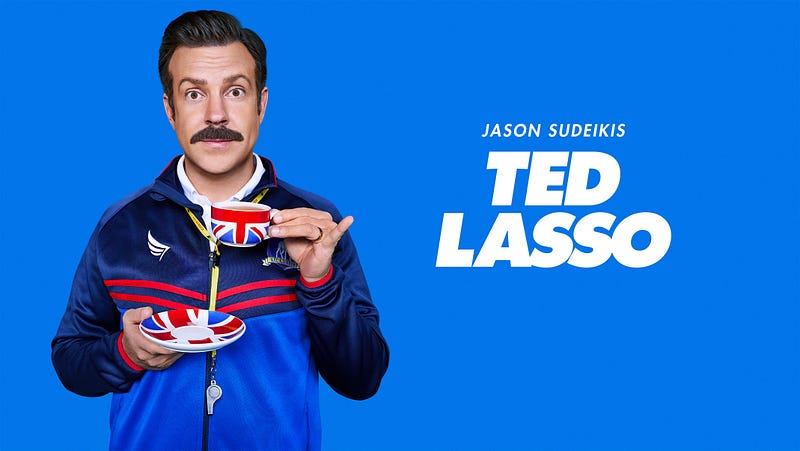
Last Friday, AppleTV+ released the final episode of reigning Emmy champ Ted Lasso’s second season. After a sweet but slow start, the show unexpectedly built to a powerful crescendo in which it delved into several complex psychological themes.
[Author’s Note: The following article is packed to the brim with spoilers, particularly about the final episodes of Season Two. If you have not watched yet and plan toI strongly recommend you bookmark this article and return to it after doing so.]
The Journey to Season Two
AppleTV+, Apple’s streaming service, launched on November 1, 2019 with the all-star drama series The Morning Show. The Jennifer Aniston-Reese Witherspoon-Steve Carell scored awards and was renewed for a second season (which is currently in the midst of), but it did not quite become the pop culture behemoth Apple clearly hoped it would. Luckily for them, they got their breakout series a few months later when Ted Lasso premiered on August 14, 2020. The show debuted with relatively little fanfare but quickly gained buzz and fans. It proved to be an unexpectedly delightful series that defied expectations at every step of the way during its first season.
The setup seemed almost painfully cliché on paper — an American football coach named Ted Lasso with some marital baggage jumps on an opportunity to relocate across the pond to coach struggling British football (AKA soccer) team AFC Richmond, but turns out to have only been hired by owner Rebecca Welton in an attempt to get revenge on her ex-husband by driving his beloved sports team into the ground. Just writing that out, I envision a mishmash of lame “fish-out-of-water” comedy (e.g., “The British do so many funny things that don’t make sense to Americans!”), Major League-esque misogyny (e.g., “the rich lady owner is evil!”), and painfully trite inspirational pep talks (e.g., Hoosiers). Yet somehow, it sidestepped all of these pitfalls.
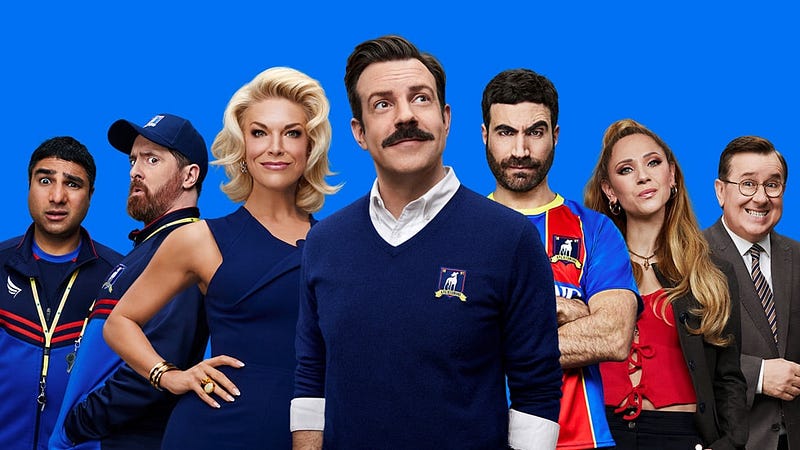
The major reason for the first season’s success was the charming lead performance of much-lauded co-creator and star Jason Sudeikis. After being a consistently charming and hilarious presence on multiple television series and films (e.g., Saturday Night Live, 30 Rock, Horrible Bosses), he finally found a star vehicle worthy of his talents and charm. He imbues the titular character with a folksy wisdom and naivete that is utterly charming but never weak, bumbling, or ignorant. He is a fully developed and in many ways singular character, that Sudeikis knocks into the stratosphere. Nearly matching him is Hannah Waddingham (heretofore best known to American audiences as the “Shame Nun” on Game of Thrones) as Rebecca Welton. She alternates between being savagely cunning and immensely sympathetic. She could have so easily been either a one-dimensional villain or a strictly-for-laughs caricature, but Waddingham and the writing team are deeply interested in her and have enormous respect for her. In many ways, the first season of Ted Lasso was a two-character piece chronicling Ted and Rebecca’s rocky parallel journeys as they try to move on from the heartbreaking end to their marriages.
And all this occurred against the backdrop of a sports comedy. Thankfully, the locker room banter is largely free of obscenity and homophobia and several characters are fleshed out in interesting ways (particularly Brett Goldstein’s smoldering and near-retirement Roy Kent, Phil Dunster’s arrogant and shallow Jamie Tartt, and Nick Mohammed’s insecure kit manager-turned-assistant coach Nathan Shelley). The ensemble also included winning performances by Jeremy Swift as Rebecca’s long-suffering assistant Leslie and Juno Temple as Keeley, who starts off as Jamie’s model girlfriend but quickly turns into something much more interesting.
In addition to the superb performances by the ensemble, the writers deserved much of the credit for making the show a success. Although only one episode of the first season was a true classic in my opinion (episode 7 — “Make Rebecca Great Again”), each was utterly charming, emotionally engaging, and briskly paced. The series was co-created by Bill Lawrence (Scrubs), Joe Kelly, and co-stars Sudeikis and Brendan Hunt, all of whom clearly sought to take very familiar plot elements and repurpose them into something fresh. It is exceedingly rare to see a comedy series aimed at adults in the modern era that is so free of cynicism and so full of heart. When I finished the first season, it became clear to me that with a little fine tuning, Ted Lasso could go from a great show to an extraordinary one.
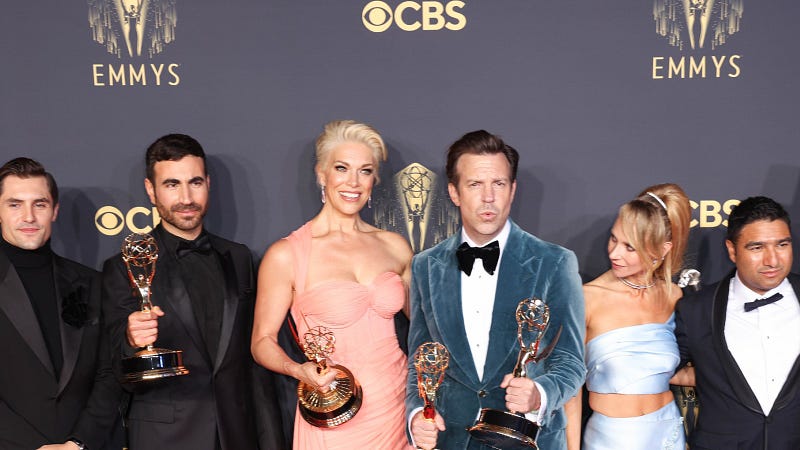
It turned out, however, that as enthusiastic as I was about the first season of Ted Lasso, others were even more so. It became a full-fledged cultural phenomenon in the months after its release, fueled in large part by the sheer joy it brought people. It also had an astonishing run during awards season, picking up major wins at the Critics Choice Awards, Screen Actors Guild Awards, Golden Globe Awards, and Writers Guild Awards before taking home a whopping 7 Emmys from 20 nominations at the ceremony last month. The show picked up the coveted Outstanding Comedy Series trophy as well as acting awards for stars Sudeikis, Waddingham, and Goldstein.
With so much buzz and momentum, I was deeply curious about where Ted Lasso would go next. Would it suffer a sophomore slump or continue its late season one growth as it moved into its second season?
The Fascinating Dynamics and Themes of Season Two
I finally jumped into Season Two as it was hitting its halfway point. By this point, there was already a robust and persistent social media conversation about the second season. There were ultimately two camps, best exemplified by the fact that I saw the show’s Christmas episode heralded as “an all-time Christmas classic” and “a profoundly unwatchable embarrassment” back-to-back on my Twitter feed. One camp felt the show was getting richer and deeper in its second season, while the other decried it for lacking any real tension. The latter camp was louder (as the negative ones usually are).
Even though I had yet to start the season, I remember finding the latter camp’s criticisms confounding. Their complaints seemed to center on the fact that virtually all the characters were nice, good people and there was a lack of villains with whom conflict could develop. What a limited view of drama and human nature, I remember thinking. Poignant, thought-provoking drama has often been wrung from characters inner journeys and, in my opinion, it is often more moving than traditional interpersonal conflict. And even kind people have profound internal struggles.
I dove into the second season and consumed the first six episodes in the span of a week. I must confess I was a bit disappointed, however. After a charming season premiere that set up some interesting dynamics and equitably focused on key members of the ensemble, the show had a ho-hum trio of episodes that were beset by some uninspired plotting. I started to fear that the second camp was right after all and Ted Lasso was failing to live up to its promise. But then it produced a classic episode with its fifth, “Rainbow,” a loving ode to romantic comedies that significantly propelled multiple plot lines. For me, this marked the point when the second season truly kicked off. What followed was a number of episodes that entertainingly and movingly delved deeply into the psyches and struggles of its central characters. It turns out the show’s first few episodes were a bit deceptive, their simplicity and sweetness belied the ambitious themes and developments the writers had planned.
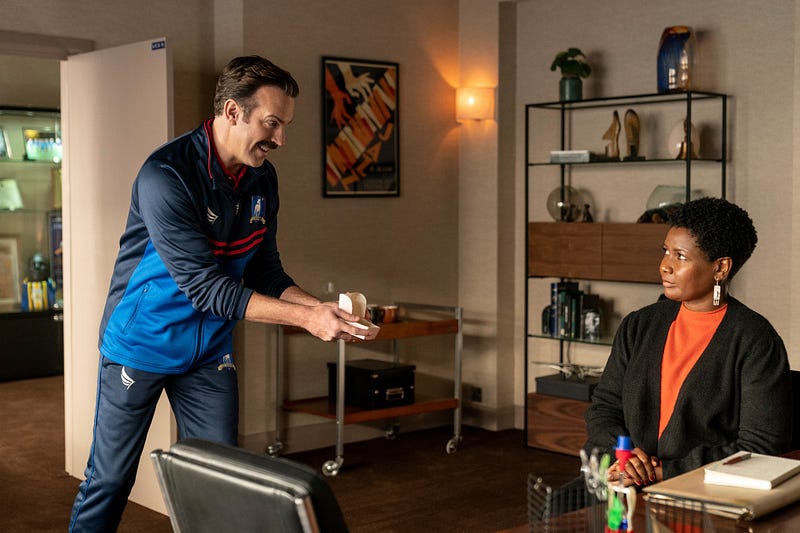
Ted and Dr. Sharon. When the second season begins, the team is not in a good place. They are disheartened by their relegation. They are on a losing streak. Roy is gone and their new captain Isaac is less than inspiring. And then, in the season premiere’s boldest twist, one of the show’s sweetest character (Dani Rojas, played by Cristo Fernandez) mistakenly delivers a fatally blow to the team’s canine mascot during a penalty shot. Higgins subsequently decides to hire a renowned psychologist for the team to boost morale.
The psychologist comes in the form of Dr. Sharon Fieldstone (superbly played by Sarah Niles). She is a capable, confident, no-nonsense woman who strongly resists Ted’s charms at first. Likewise, Ted makes it clear from the get-go that while he supports her work with the players (who she clearly has a magic touch with), he wants nothing to do with her or her profession. His stubbornness and close-mindedness is very un-Ted like. And, as it turns out, that’s precisely the point.
After Ted experiences a mid-game panic attack that sends him rushing off the pitch, he finally relents and agrees to meet with Dr. Fieldstone. He continues to display notable resistance, but eventually she earns his trust and he confesses his secret to her — his father died by suicide at age 16. We go on to learn in subsequent episodes that he discovered his father’s body, an unfathomable trauma for anyone, let alone an adolescent.
With this revelation, many aspects of Ted’s character come into clearer focus. This helps us understand why his separation from his own son (through the divorce and his new job overseas) is so acutely painful to him and why he goes to such great lengths to be a father figure to his colleagues and players. It explains his passionate disdain for “quitters” (which he describes his late father as in a profoundly painful but realistic moment.) It provides some context for what drives his battles with depression and anxiety that were hinted at long before the panic attack. It also influences why he so relentlessly (and sometimes irritatingly) dishes out “dad jokes” and pop culture references. He states that it is a way of paying homage to his father’s memory; to always look for the best in people and be mindful of how they are struggling. I suspect to some degree it is also a meticulously well-honed defense mechanism; a cheery facade that conceals his inner pain. It also helps us understand why we has such a soft spot for ’90s pop culture. Ted’s exact age might not be clear, but it is conceivable that his father’s death occurred in the early 1990s and he subsequently took great comfort and refuge in the movies, television, and music he endlessly references.
The final episodes of the season find Ted not only learning to like and appreciate Dr. Fieldstone, but becoming remarkably attached to her. His acute anger when she leaves without a proper goodbye plays out familiar dynamics between psychotherapists and their patients and her admission that working with someone as resistant as Ted forced her to show vulnerability and become a better therapist is insightful and poignant. All in all, it is one of the more accurate, ethical, and moving portrayals of psychotherapy portrayed on screen in recent years. (It also could very well win Sudeikis and Niles some major acting awards.)
As the season reaches its conclusion, Ted’s mental health struggles are made public by the press and he takes ownership of them both publicly and privately, proudly coming out as a mental health advocate. It is still astonishing to me that these things are still so taboo in 2021, but they are — particularly among men and especially in the world of professional sports. Thus, Ted’s journey — and the show’s careful fostering of it — is an important one.
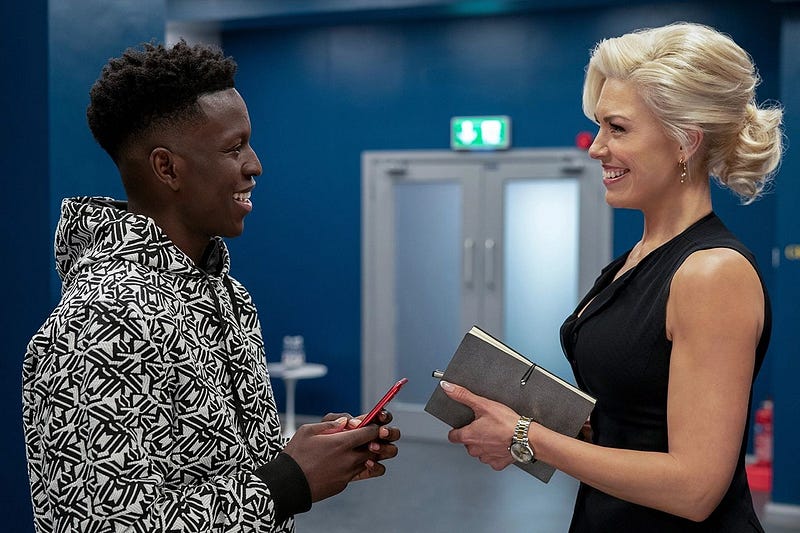
Rebecca and Sam. Since the pilot, I have felt that Ted Lasso was as much about Rebecca Welton as it was about Ted. The aftermath of her divorce is perhaps the major catalyst for the plot and emotional dynamics in the first season and Waddingham’s commanding, Emmy-winning work was head-and-shoulders above the rest of the supporting cast. The second season finds her continuing to try to find love through dating apps and repairing relationships with people in her life.
The most powerful moments for Rebecca come in the tenth episode, cleverly titled “No Weddings and a Funeral,” in which her father dies. Expected to give a eulogy, Rebecca ends up confessing to her mother (beautifully played by veteran British actress Harriet Walker) the secrets she had held for years about her father’s infidelity. It turns out her mother knew and turned a blind eye, prompting further rage from Rebecca. As an added blow, her cruel ex-husband Rupert shows up to the funeral with his new bride and baby. The whole ordeal adds context to Rebecca’s character — her distrust of men, her difficulty getting over her divorce from Rupert, and her general cynicism. It is also revealed in a dramatically stunning way, as the conversations where Rebecca recounts discovering her father’s infidelity as a child and Ted recounts discovering his father’s dead body are seamlessly interwoven.
After getting some memorably blunt but very well-intentioned and effective pep talks from Roy and Keeley in the season’s opening episodes, Rebecca delves into the world of dating apps. The whole group starts using Bantr, a new app that Keeley is doing PR for that focuses on connecting through conversation as opposed to photos. She develops an intense, ongoing flirtation with a man who the show nudges viewers into believing is Ted, only to reveal that it is the team’s 21-year-old Nigerian soccer star Sam Obisanya (played by the exceedingly charming Toheeb Jimoh). The two meet and reluctantly initiate a romance that seems to mark Sam’s first love and a second chance for Rebecca. At the end of the season, Rebecca decides to step back from Sam to work on her own wounds and he lets her go graciously but not before warning her that he’s only going to get better. It’s a moment that could have easily been executed disastrously, but it works wonderfully.
Thankfully, Sam comes into his own as a fully fledged character this season and is not just treated as a token minority or one-dimensional love interest. Early in the season, he gets the opportunity for a lucrative, high-profile endorsement with a company that he later discovers is wreaking environmental and economic havoc on his home country. He stands up for himself and brings international attention to the issue. Feeling empowered, he also manages to stand up to a billionaire Edwin Akufo (Veep’s Sam Richardson, in perhaps the show’s funniest guest appearance to date) who wants to “buy” him and send him to a team based in Africa. When Sam announces he is staying in the UK, Ted asks him why. Looking at Ted but speaking to Rebecca, he says something along the lines of, “I wish I could say it was for you, but it is for me.” It is a powerful moment of growth for his character.
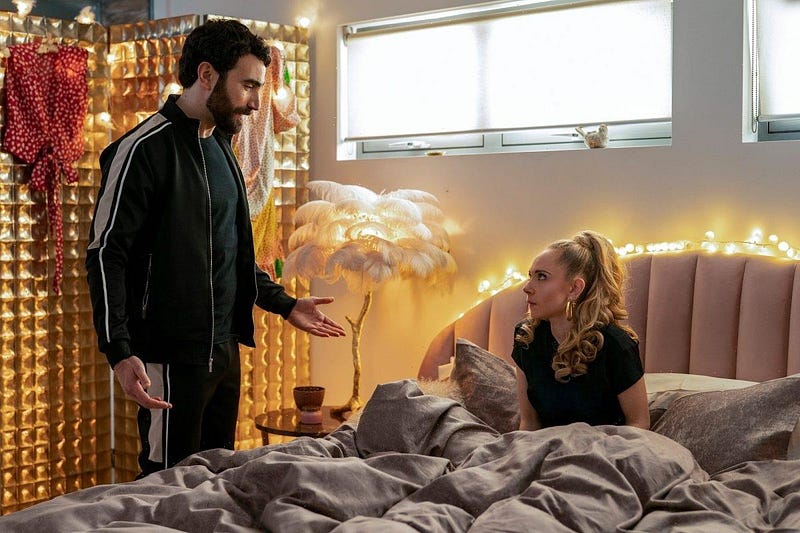
Roy and Keeley. Having retired due to his advancing age, gruff Roy Kent (Brett Goldstein, who won the Emmy for his portrayal) is living a low-key life with former model and PR star Keeley (Juno Temple, who was nominated at the Emmys but lost to her co-star Waddingham). She encourages him to find a new mission in life, directing him to become a sports commentator. He reluctantly agrees and proves very popular with his blunt, insightful, and often profane takes. Nevertheless, he remains unfulfilled. Seeing this and also needing help with the struggling team, Ted convinces Roy to return as an assistant coach. It is a nice arc for the character, whose gruffness and cynicism clearly belie a warm heart and a desire to do something meaningful. (Just take a look at his adorable relationship with his young niece, Phoebe, for evidence of this.)
The most interesting aspects of Roy’s character development in the second season comes from his relationship with Keeley. There is a decidedly less tragic but still powerful A Star is Born-style dynamic to their relationship— his star is fading and hers is on the rise. Keeley is gaining self-confidence, overcoming long-held insecurities as she gains success as a businesswomen. The script throws a number of traditional conflicts and roadblocks their way, including Nate kissing Keeley, Roy’s initially innocent flirtation with Phoebe’s teacher, and Jamie professing his undying love for Keeley (more on those Nate and Jamie dynamics below). But the script also makes it clear that these are all essentially red herrings. The core issue is that despite their love for each other, Roy and Keeley are missing each other at a fundamental level. And why exactly that is remains unclear even as they embark on what is ultimately a separation in the finale. There is clearly more to explore here next season.
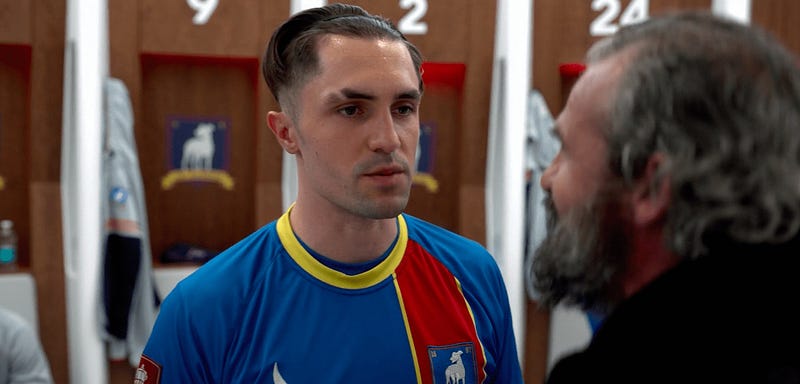
Jamie. With the exception of Rebecca’s sleazy and malicious ex-husband Rupert, Jamie Tartt (Phil Dunster) was the closest thing the first season had to a villain. His astounding arrogance and shallowness could not have contrasted more starkly with the other characters and some of the most satisfying moments of the first season were watching him get his comeuppance. His role is much smaller this season, but his character actually experiences more growth despite the limited screen time.
He starts off the season in a low place, getting kicked off a remarkably trashy reality series Lust Conquers All and finding himself without a soccer team. Against the wishes of the players, Ted brings him back. One reason is that Jamie has undeniable talent that could help the team reverse its losing streak. Another reason is that Ted sees Jamie as wanting and being worthy of redemption. Undoubtedly, Ted’s desire to care for Jamie is fueled by Jamie’s tragic, deeply abusive relationship with his own father. In an emotional high point of the season, Jamie’s father drunkenly arrives in the locker room after a big loss and humiliatingly berates him in front of the team. Afterwards, Roy — Jamie’s biggest adversary — silently moves toward him and gives him a firm hug.
Jamie spends much of the season trying to be a real team player and even befriend the teammates who he once dismissed as being beneath him. His journey is played mostly for laughs, but it has real moments of power (like the one described above). When he professes his desire to get back together with Keeley toward the season’s end, it plays as more than a convenient twist that further complicates Roy and Keeley’s relationship. It plays as the fitting next step on his character’s journey to being a better man.
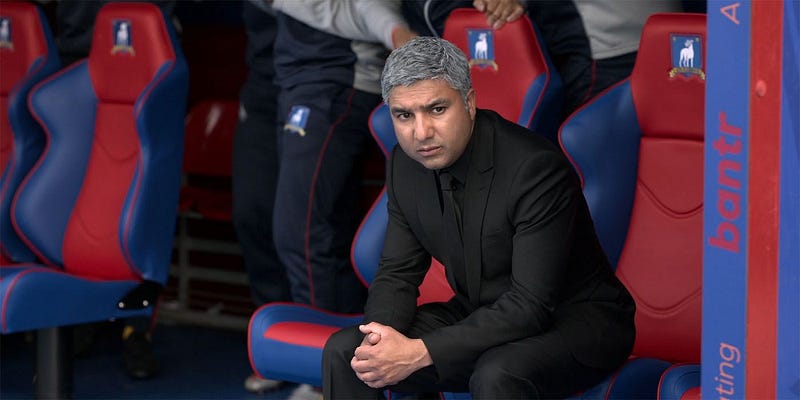
Nate. The most widely-discussed aspect of the show’s second season has been the fall from grace of Nathan “Nate the Great” Shelley. In the first season, Nate was the mild-mannered kit manager who was the target of some lighthearted harassment by the players and whose good ideas had long been overlooked. Ted saw something special in him and promoted him to assistant manager. Nate’s rise was one of the most heartwarming aspects of the first season, which makes it all the more fascinating that by the end of the second season he is firmly established as the show’s arch-villain.
To some, Nate’s descent came out of left field. In the final episodes, it is revealed that he leaked the news of Ted’s mental health struggles to the media, Nate brutally berates Ted (and others), and he goes to work for West Ham United (a rival team recently bought by Rebecca’s ex-husband). And on the way out, he rips Ted’s “Believe” poster in two and symbolically leaves the remnants on Ted’s desk. I understand why some felt that Nate’s rage and cruelty were narratively unjustified and I especially understand why some people took issue with the nuanced, kind-hearted show establishing an arch-villain of any kind in the first place.
For me, however, Nate’s descent was well-contextualized narratively. In particular, the writers took great care to show his intense desire to gain the love and respect of his remarkably cold father. Whether it was conscious or not for Nate, Ted evoked Nate’s feelings for his father and when he perceived Ted as being too busy for him, unsupportive of him, or — at worst — taking credit for his own ideas, it tapped into a profound rage that Nate had nurtured since childhood. And this coincided with a number of other seemingly small moments that Nate interpreted as humiliations. Keeley told him that the free Nespresso machines were only for the players. Frequent references were made to the fact that the only suit he owns was purchased for him by Ted. And when he forced a kiss upon Keeley, Roy didn’t even seem threatened enough to confront him. It is evident here more than anyone else that the writers were playing a long game. Several innocuous and seemingly pointless moments from earlier episodes were deliberately setting up later developments.
Ultimately, the question of whether Nate was actually harmed or rejected by the other characters is irrelevant. The fact is that he perceived harm and rejection from them and felt it profoundly. His anger is palpable as is the accompanying shame, best exemplified by the scene where he berates and spits at himself in the mirror. Time will tell whether it was the right narrative move for Ted Lasso to take Nate in this direction, but it is immediately apparent that it at least succeeded at giving the underutilized Nick Mohammed great material and at getting viewers talking.
Season Two Summary
The second season of Ted Lasso is certainly not without its flaws. In addition to the string of uneven episodes that start the season, there are jokes that fall flat, symbolism and themes that are too heavy-handed, and plot twists that do not receive proper buildup or have satisfying resolutions. And I am firmly in the camp who thought that bizarre detour that the ninth episode took in exploring the private life of Coach Beard (series co-creator Brendan Hunt) was a misfire. But there remains much, much more that is great about Ted Lasso than that which is problematic.
Perhaps the most interesting thing about the show’s second season is how it chose to evolve so significantly rather than deliver more of the same. The show could have easily coasted a couple of more seasons on “fish out of water” comedy about Ted navigating British culture, will-they-or-won’t-they romances between the main characters, and inspiring and thrilling climaxes set at key games. Instead, it delved deep into its characters’ psyches and along the way essentially became a drama series that had key elements of humor built in. (Interestingly, the show not only took the tone but also the format of a drama series as the episode lengths significantly increased as the season went on).
Ted Lasso still might not be television’s most polished show, but it remains one of the most likable, entertaining, best acted, and — as of its second season finale — most fascinating.
For Your Consideration: Follow the author on Medium and Twitter.
Check out other articles by this author about television and streaming:
- Only Murders in the Building Wraps Superb First Season
- Alias: 20 Essential Episodes for its 20th Anniversary
- The Handmaid’s Tale’s Stunning Return to Form in Season Four
- The One about Friends: The Reunion
- A Fond Farewell to the Quietly Groundbreaking Mom
- The Glorious and Long Overdue Arrival of The Nanny on Streaming


