Technologies Don’t Solve Problems — They Just Disguise Them
Why we can’t forget the impact of our ideas on real people

Technologies seem free of embedded agendas. Their automation and opacity make highly reversed situations appear quite normal and natural.
For example, most Americans accept the premise that they need a car to get to work. And a better car leads to a more pleasant commute. But that’s only because we forgot that our pedestrian and streetcar commutes were forcibly dismantled by the automobile industry. The geography of the suburban landscape was determined less by concern for our quality of life than to promote the sales of automobiles that workers would be required to use. The automobile made home and work less accessible to each other, not more — even though the car looks like it’s enhancing the commute.
Once the figure and ground have been reversed, technology only disguises the problem.
In education, this takes the form of online courses that promise all the practical results for a fraction of the cost and inconvenience. The loftier goals of learning or enrichment are derided as inefficient self-indulgence, or the province of decadent elites. Online courses don’t require a campus or even a live teacher. A responsive, algorithmically generated curriculum of videos and interactive lessons is customized for the individual learner. It is the pinnacle of utilitarian education. Particular learning outcomes are optimized, and skills acquisition can be assessed through testing — also via computer.
Of course, when an online company is assessing its own efficacy, it is bound to make positive determinations. Even when companies don’t tip the scales in their own favor, the underlying technology will be biased toward measuring only the educational values that have been programmed into it.
Automated classes work for rudimentary, job-related skills such as machine repair, simple medical procedures, or data entry. But they are terrible for creative thinking and interpretation. They don’t even work particularly well for learning computer code, which is why most serious developers end up abandoning online code schools in favor of real-life programming boot camps with human instructors and struggling peers. People who learn by computer are not encouraged to innovate. They are simply being trained to do a job. They can repeat tasks, but they can’t analyze or question the systems to which they are contributing. The more that real colleges incorporate the methods of their online competition, the less of this deeper learning they can offer.
For these reasons, many of the most ambitious engineers, developers, and entrepreneurs end up dropping out of college altogether. One tech billionaire famously offers $100,000 to 20 young people each year to abandon college in order to pursue their own ideas. The message he’s sending to students is clear: If you want to get somewhere significant, don’t worry about school.
When we reduce education to its utilitarian function, it may as well be performed by computers. Besides, as the anti-education billionaire would argue, people learn job skills better on the job itself — as interns or entry-level employees. But people who so easily dismiss education have forgotten what school is really for.
A live educator offers more than the content of a course. Human interaction and presence are important components of effective pedagogy. Moreover, a teacher sets an example by embodying the ideals of learning and critical thinking. Possessed by a spirit of inquiry, the teacher enacts the process of learning for students to mimic. The act of mimesis itself matters: one human learning by watching another, observing the subtle details, establishing rapport, and connecting to history. It’s the ancient practice of people imitating people, finding role models, and continuing a project from one generation to the next.
The human social engagement is the thing; the utilitarian applications are just the excuse. When we allow those two to be reversed, the figure becomes the ground.
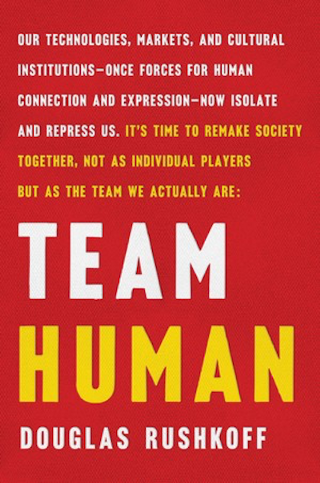
This is section 27 of the new book Team Human by Douglas Rushkoff, which is being serialized weekly on Medium. Read the previous section here and the following section here.