
“Technofeudalism — What Killed Capitalism” by Yanis Varoufakis
A Review
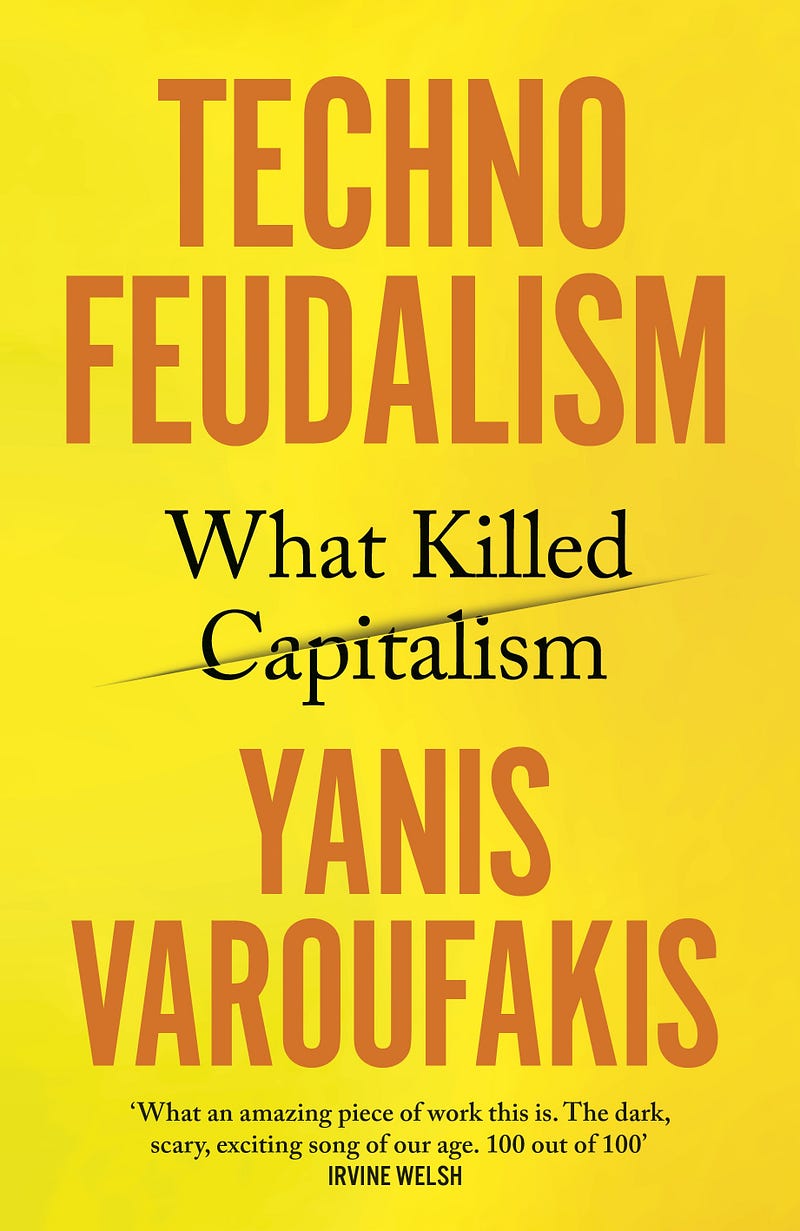
This struck me as one of those books that people will refer to widely in future, so a good one to read, especially as I have a lot of respect for this motorbike-riding, former Greek finance minister, who tried to stick it to the banking overlords at the time of the 2008 financial crisis, at the time Gordon Brown was busy saving the world.
I was spoon-fed Marxism as a student of sociology at Leicester University in the late 1970s, and I have an amateur interest in economics, so was anticipating a good read.
I tried to like the book, I really did, and I hate to give a poor review, but have to say I find it deeply disappointing. The author clearly understands capitalism and the markets well, but for me there are a number of faults with the book.
For one thing, I find the way that it is formatted, as if the author is speaking to his father irritating. It was written at a time when Yanis’s father was very unwell, and completed after his death, so in some ways it is a very touching tribute to his father’s influence and guidance. However after a while, the repeated use of this format detracts from the book, at least for me, an unnecessary distraction from the serious points it is trying to make.
The book seeks to make the point that traditional capitalism is in its death throes, that the good old days of capital exploiting labour to make profits are on the way out. Oh, how we will miss them!
They are being replaced by the rapid advance and intrusion of the internet into all areas of our lives. Witness the way that it is becoming increasingly difficult to carry out transactions or payments off-line or in hard currency. We are forced into using self-checkout machines, parking apps, or to pay by card. No ID no vote. No card no ticket. No smartphone or computer? Tough.
The feudalism arises, at least according to the author, from the way that the initially free digital commons of the internet’s idealistic founders, have been ruthlessly commercialised, and enclosed and privatised by the tech companies, in the same way that once-public land has been largely enclosed by driving out the peasants. The tech barons paved over paradise and put up a virtual parking lot.
This means, for Varoufakis, that we are heading towards a return to a feudal-like society ruled by the uber-wealthy tech titans such as Musk, Page, Brin, Zuckerberg, Bezos and the like, who exploit our attention and our personal data, selling these to the highest bidder.
Moreover, companies such as Amazon have sought to monopolise and charge for access, extracting rent from sellers and consumers alike, driving competition out of business by ruthless practices of undercutting and exploiting their power.
Varoufakis, to whom the epithet could also apply, amusingly describes Elon Musk as an “enfant terrible”, part genius part monster, whose puzzling takeover of Twitter (now “X”) was part of a scheming grand plan to build an “everything app” and extend his influence and the tentacles of global empire even further into our souls.
Yanis claims that we are now forced to pay Big Tech rent, in the same way that medieval peasants were forced to fork out tithes to the lord of the manor in early times. I can see where he is coming from up to a point. Where I would differ, is that no one is forcing us to use Google, Facebook, TikTok and the like, subscribe to Netfix or Amazon Prime, or drive a Tesla (if only!). There are plenty of choices and alternatives, some more ethical, and none of them are essential for daily life. If you don’t like them, don’t use them. Life does not come to an end just because you haven’t posted on your Insta in the last half an hour, or at least so I am told!
Also I was disappointed at the lack of wider perspective, context and vision from Yanis. For example, there was no reference to the excellent concept of “Doughnut Economics” by Kate Raworth, which is also a very influential book, in reminding us that the financial world is completely underpinned by our need for a life-sustaining environment: no ecology no economy if you like. It is almost as if the whole environmental awakening has passed a dinosaur Marxist by, though Yanis does make some passing references to the need for a transition to green alternative energy.
There is also a puzzling, complete failure, to reference Paul Mason’s “Post-capitalism: A Guide To Our Future,” another very influential book on the end of capitalism from a Marxist perspective. Interestingly Mason, who shares Yanis’s political leanings, takes a completely, different view of where we are heading, with his claim that the internet is making so many things free that it will eventually undermine capitalism.
Again, I would differ. Of course, there are some incredible free resources like Google Search, Google Maps, Gmail, Wikipedia, many free news sites and papers online, and so on, and you can watch any film under the sun for free if you are willing to risk prosecution and nasty viruses using pirate sites. However, the basics we need for life, small things like housing, fuel, clean water, and food, have actually got far more expensive.
The thing is, Varoufakis and Mason can’t both be right, and ironically I disagree with them both! We are neither entering the Utopian post-capitalist world of Mason, where the best things in life are free, nor have we yet been taken over by technofeudalist overlords.
Similarly, there is a failure to reference the work and views of another very well-known writer on the world of finance, Nassim Nicholas Taleb, the author of “The Black Swan” and “Anti-fragile”, an expert on financial risk, rare events and resilience. Both these books are very relevant to any serious study of the future of capitalism.
So overall, while I am glad I have read “Technofeudalism”, because it will be widely referenced, it failed to live up to my expectations.
As always, thank you for reading.

To join a new Facebook group “Medium Matters” where writers can support each other and share articles.
Mastodon- you can find me here


