
avatarFaisal Khan

Free AI web copilot to create summaries, insights and extended knowledge, download it at here

4386

Abstract

igure></iframe></div></div></figure><h2 id="d35e">World’s First AI Universe Simulator</h2><p id="1d40">Since time travel still seems to be a distant reality, the best way to find out about mysteries like what happened after the Big Bang is to create computer simulations. These simulations have a drawback though — they are either slow & accurate or fast & less accurate. Now a team of <a href="https://thenextweb.com/artificial-intelligence/2019/06/26/the-first-ai-capable-of-simulating-the-universe-works-so-well-its-scary/">researchers has created</a> a super fast and highly accurate AI Universe simulator (called the <b>Deep Density Displacement Model, or D3M</b>).</p><p id="fd73">The newly developed AI system can produce three-dimensional simulations of the Universe, even on the parameters that it wasn’t trained on — scary for some, but truly revolutionary for others. Last year, Astrophysicists were finally able to reverse-engineer the origin & evolution of our universe through detailed simulation. While the technology used in this method took minutes & produced acceptable results, the new AI simulator produces far more accurate results in milliseconds.</p><h2 id="578a">Google’s Internet Project Loon</h2><p id="5a69">The spin-off from the parent company Alphabet, <a href="https://x.company/projects/loon/"><b>Project Loon</b></a> was launched in 2011 to bring internet connectivity to remote parts of the World. The floating solar-powered balloons are intended to work in far-flung areas where the cellular towers are too expensive to build.</p><p id="ec71">Although the project has gotten entangled into regulatory hurdles in countries like Indonesia & legal battles at home, it <a href="https://www.reuters.com/article/us-alphabet-loon-focus/google-internet-balloon-spinoff-loon-still-looking-for-its-wings-idUSKCN1TW1GN?utm_campaign=the_download.unpaid.engagement&amp;utm_source=hs_email&amp;utm_medium=email&amp;utm_content=74305528&amp;_hsenc=p2ANqtz-_t9DZSVP3DC2FhAlJI8UzqLH1nfq0qzwCGgdA7A7_huaGM-OKoFRZHEHImE97--MLDJeAbnDdk0kk4GdbJ6EvT28p1Gw&amp;_hsmi=74305528">has now announced</a> the first commercial trial in Kenya to begin in the coming weeks. This was made possible after Kenya’s aviation authority signaled a final approval this month. The test would be conducted in partnership with Nation’s №3 carrier Telkom Kenya.</p><figure id="ac46"><img src="https://cdn-images-1.readmedium.com/v2/resize:fit:800/0*iHalJfygJ_RJQO4e"><figcaption></figcaption></figure><p id="0f65">Loon has demonstrated the utility of these helium balloons to provide wireless connectivity in disaster-stricken areas of Peru and Puerto Rico. Google is also <a href="https://futurism.com/the-byte/google-internet-cable-africa-europe?mc_eid=aa16199a1b&amp;utm_medium=email&amp;utm_campaign=a93bfd2497-EMAIL_CAMPAIGN_2019_06_28_05_43&amp;mc_cid=a93bfd2497&amp;utm_source=The%20Future%20Is&amp;utm_term=0_03cd0a26cd-a93bfd2497-249963305">planning to build</a> its third international, under-sea internet cable dubbed “<b>Equiano</b>“ which is going to be partially operational by 2021. Earlier this year, <a href="https://readmedium.com/tech-diaries-apples-reinvention-starlink-launch-microsoft-s-pivot-towards-blockchain-5727818a40c7">Starlink</a> a project of SpaceX, launched the first batch of satellites in an initiative to provide global connectivity. The big techs have joined hands to build the digital infrastructure of the World.</p><h2 id="ccc3">Pentagon’s Laser Project</h2><p id="ca05">According to <a href="https://www.technologyreview.com/s/613891/the-pentagon-has-a-laser-that-can-identify-people-from-a-distanceby-their-heartbeat/">MIT Technology Review</a>, The U.S Special forces have developed a laser device that can detect a person’s unique cardiac signature from a distance. The project named “ <b>Jetson</b> “ can work as far as from 200 meters, expecting to enable longer distances in the future. It can detect a heartbeat by analyzing tiny vibrations on the skin. People familiar with the project claim the device is accurate more than 95% of the time. The device can come in handy when other biometric identifications systems fail. To achieve the intended accuracy, however, the target needs to be sitting or standing still for about 30 seconds.</p><h2 id="9e96">World’s Smallest MRI Machine</h2><p id="7a32">Magnetic resonance imaging (

Options

MRI) machines have become commonplace in the medical industry with its capability of creating detailed images of a person’s internal organs & tissues using magnets & radio waves. These bulkier machines are about to undergo a transformation with a proposed scaled-down version. One so small, that it can image individual atoms — welcome to the age of <a href="https://readmedium.com/how-is-moores-law-becoming-irrelevant-in-the-age-of-quantum-computing-5beb39fafc01">Quantum computing</a>!</p><p id="015e">For the purpose, Researchers from U.S & South Korea attached magnetized iron atoms to the tip of a scanning tunneling microscope subsequently sweeping the top of the device over iron and titanium atoms placed on the magnesium oxide surface. The resulting disruption in the electrons & the energy released was imaged by the system.</p> <figure id="4424"> <div> <div> <img class="ratio" src="http://placehold.it/16x9"> <iframe class="" src="https://cdn.embedly.com/widgets/media.html?src=https%3A%2F%2Fwww.youtube.com%2Fembed%2FmyeB_gpegoc%3Ffeature%3Doembed&amp;url=http%3A%2F%2Fwww.youtube.com%2Fwatch%3Fv%3DmyeB_gpegoc&amp;image=https%3A%2F%2Fi.ytimg.com%2Fvi%2FmyeB_gpegoc%2Fhqdefault.jpg&amp;key=a19fcc184b9711e1b4764040d3dc5c07&amp;type=text%2Fhtml&amp;schema=youtube" allowfullscreen="" frameborder="0" height="480" width="854"> </div> </div> </figure></iframe></div></div></figure><h2 id="d330">3D-Printing a Lamborghini</h2><p id="12e3">Watching Sci-Fi TV series like the Star Trek where the space ship “replicators” could produce anything from food, a small scale tool or complex machinery at the touch of a button or with voice commands always fascinated me. We are moving ever closer to that reality with Life-size 3D printing becoming a thing now. <a href="https://www.3dprintingmedia.network/you-too-could-now-3d-print-a-lamborghini-aventador-at-home/">According to reports</a>, Physicist Sterling Backus along with this son has been working on 3D printing a full-scale Lamborghini Aventador in his own backyard.</p><p id="93ca">Apart from the engine, chassis & other structural parts, the entire car is 3D printed. For safety reasons, some of the parts have been encapsulated in carbon fiber. The father-son duo intends to show the car off at local schools as a STEAM (Science, Technology, Engineering, Art, and Math) project. Not bad at all… A $20K 3D printed Lamborghini Aventador!</p><p id="e5d7"><a href="mailto:[email protected]"><b>Email</b></a><b> </b>📭| <a href="https://twitter.com/fklivestolearn"><b>Twitter</b></a><b> </b>📜<b> | <a href="https://www.linkedin.com/in/faisal-khan-2a3009b/">LinkedIn</a> </b>📑<b>| <a href="https://stocktwits.com/trade_nut">StockTwits</a> </b>📉<b> | <a href="https://t.me/joinchat/IWzyHBGWCFwPQTe8Tm5H_Q">Telegram</a> </b>🔗</p><div id="53a2" class="link-block"> <a href="https://readmedium.com/the-current-state-of-stable-coins-in-six-charts-e3c2bc58a3fe"> <div> <div> <h2>The current state of Stable coins in Six charts</h2> <div><h3>2019–2020 are shaping up to be the biggest years for Stable coins coming live</h3></div> <div><p>medium.com</p></div> </div> <div> <div style="background-image: url(https://miro.readmedium.com/v2/resize:fit:320/0*yMagfOpUTdJnxBes)"></div> </div> </div> </a> </div><div id="d0bb" class="link-block"> <a href="https://readmedium.com/how-big-are-the-big-techs-ff08b8038cee"> <div> <div> <h2>How big are the ‘Big Techs’?</h2> <div><h3>Technology Companies have become the biggest brands in the World</h3></div> <div><p>medium.com</p></div> </div> <div> <div style="background-image: url(https://miro.readmedium.com/v2/resize:fit:320/0*sR9XEwnVd0XBk4E_)"></div> </div> </div> </a> </div><p id="f25f"><i>Originally published at <a href="https://www.datadriveninvestor.com/2019/07/09/tech-diaries-the-controversy-around-the-crispr-gene-edited-babies/">https://www.datadriveninvestor.com</a> on July 9, 2019.</i></p></article></body>

Tech Diaries: The controversy around the CRISPR gene-edited Babies

More on World’s First AI Universe Simulator, Google’s Project Loon, World’s Smallest MRI Machine & 3D-Printing a Lamborghini

The Scientist dubbed “China’s Frankenstein” — He Jiankui, a Chinese biophysicist, rocked the Medical World last November at The Second International Summit on Human Genome Editing in Hong Kong — when he announced that he had genetically modified the DNA of the twin baby girls (whom he named Lulu & Nana), using the CRISPR tool before bringing them into the World. He shocked the audience with another surprise saying that one more Chinese woman was pregnant with a CRISPR baby. And while the rest of the medical community has been busy debating the pros & the cons of genetically modified humans, yet another CRISPR baby is due to be born any moment if it hasn’t already come into the World.

He’s team used CRISPR to damage a single gene called CCR5 to make the twin girls immune to infection by HIV. The Chinese scientist has been criticized in China & around the World for conducting a medical experiment without addressing the moral or ethical issues around the use of this revolutionary technology. “JK,” as the Chinese scientist has come to be known as, has not been heard from since January.

The mystery gets further convoluted by the fact that some American scientists and journalists were in on the conception of the third gene-edited baby, but did not stop this from happening. Nobel laureate Craig Mello of the University of Massachusetts, Stephen Quake of Stanford University, and journalists from the Associated Press all kept He’s experiments in secrecy.

The worldwide condemnation of the Chinese CRISPR experiment has not only discouraged the government there to acknowledge the birth of the third CRISPR baby, but also pushed them to introduce gene-editing regulation. However, the apparent success of this experiment & ease of access has encouraged others to use this gene-altering technology on humans. A Moscow-based Russian scientist wants to make CRISPR babies pending the approval.

He has revealed recently that five pairs of Russian parents have given him the go-ahead to gene-edit their embryos to prevent the babies from inheriting the parents’ deafness. For some, it is a futuristic technology that can find cures for long-standing medical mysteries, while for others the tampering of genomes raises serious ethical questions by playing “God”. What’s your take on it?

World’s First AI Universe Simulator

Since time travel still seems to be a distant reality, the best way to find out about mysteries like what happened after the Big Bang is to create computer simulations. These simulations have a drawback though — they are either slow & accurate or fast & less accurate. Now a team of researchers has created a super fast and highly accurate AI Universe simulator (called the Deep Density Displacement Model, or D3M).

The newly developed AI system can produce three-dimensional simulations of the Universe, even on the parameters that it wasn’t trained on — scary for some, but truly revolutionary for others. Last year, Astrophysicists were finally able to reverse-engineer the origin & evolution of our universe through detailed simulation. While the technology used in this method took minutes & produced acceptable results, the new AI simulator produces far more accurate results in milliseconds.

Google’s Internet Project Loon

The spin-off from the parent company Alphabet, Project Loon was launched in 2011 to bring internet connectivity to remote parts of the World. The floating solar-powered balloons are intended to work in far-flung areas where the cellular towers are too expensive to build.

Although the project has gotten entangled into regulatory hurdles in countries like Indonesia & legal battles at home, it has now announced the first commercial trial in Kenya to begin in the coming weeks. This was made possible after Kenya’s aviation authority signaled a final approval this month. The test would be conducted in partnership with Nation’s №3 carrier Telkom Kenya.
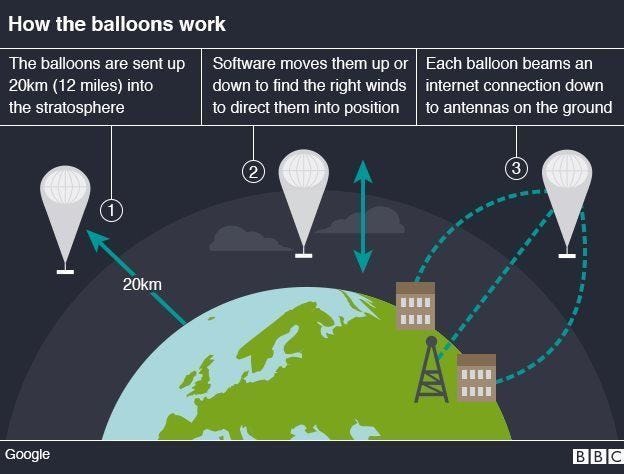
Loon has demonstrated the utility of these helium balloons to provide wireless connectivity in disaster-stricken areas of Peru and Puerto Rico. Google is also planning to build its third international, under-sea internet cable dubbed “Equiano“ which is going to be partially operational by 2021. Earlier this year, Starlink a project of SpaceX, launched the first batch of satellites in an initiative to provide global connectivity. The big techs have joined hands to build the digital infrastructure of the World.

Pentagon’s Laser Project

According to MIT Technology Review, The U.S Special forces have developed a laser device that can detect a person’s unique cardiac signature from a distance. The project named “ Jetson “ can work as far as from 200 meters, expecting to enable longer distances in the future. It can detect a heartbeat by analyzing tiny vibrations on the skin. People familiar with the project claim the device is accurate more than 95% of the time. The device can come in handy when other biometric identifications systems fail. To achieve the intended accuracy, however, the target needs to be sitting or standing still for about 30 seconds.

World’s Smallest MRI Machine

Magnetic resonance imaging (MRI) machines have become commonplace in the medical industry with its capability of creating detailed images of a person’s internal organs & tissues using magnets & radio waves. These bulkier machines are about to undergo a transformation with a proposed scaled-down version. One so small, that it can image individual atoms — welcome to the age of Quantum computing!

For the purpose, Researchers from U.S & South Korea attached magnetized iron atoms to the tip of a scanning tunneling microscope subsequently sweeping the top of the device over iron and titanium atoms placed on the magnesium oxide surface. The resulting disruption in the electrons & the energy released was imaged by the system.

3D-Printing a Lamborghini

Watching Sci-Fi TV series like the Star Trek where the space ship “replicators” could produce anything from food, a small scale tool or complex machinery at the touch of a button or with voice commands always fascinated me. We are moving ever closer to that reality with Life-size 3D printing becoming a thing now. According to reports, Physicist Sterling Backus along with this son has been working on 3D printing a full-scale Lamborghini Aventador in his own backyard.

Apart from the engine, chassis & other structural parts, the entire car is 3D printed. For safety reasons, some of the parts have been encapsulated in carbon fiber. The father-son duo intends to show the car off at local schools as a STEAM (Science, Technology, Engineering, Art, and Math) project. Not bad at all… A $20K 3D printed Lamborghini Aventador!

Email 📭| Twitter 📜 | LinkedIn 📑| StockTwits 📉 | Telegram 🔗

Originally published at https://www.datadriveninvestor.com on July 9, 2019.

Artificial Intelligence
Future
Technology
3D Printing
Internet
Recommended from ReadMedium