
Teaching Yourself Black History is More Important Than Ever
The Story of Two Men They Don’t Teach You About
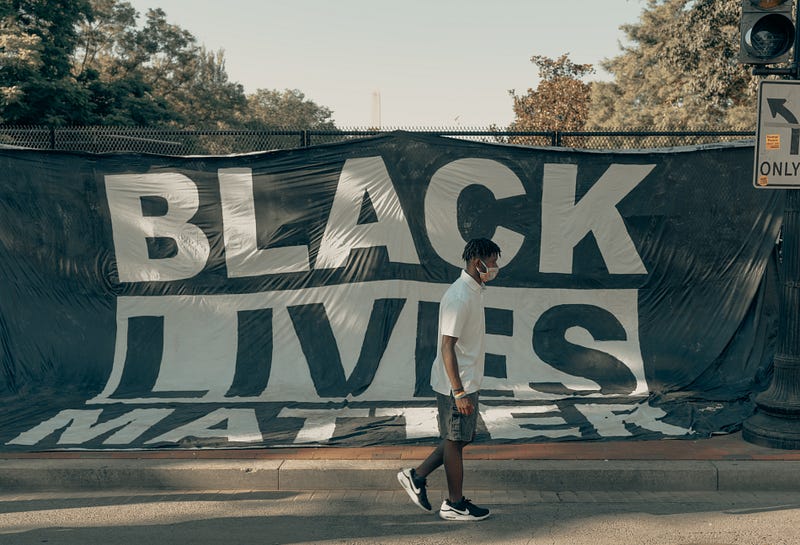
When my father reached college on the back of a D1 track scholarship he realized something — he had been “miseducated.” He began to read books like The Invisible Man by Ralph Ellison, Martin Luther King Jr.’s “Letter from the Birmingham Jail” and the depressingly ironic The Mis-Education of the Negro by Carter G. Woodson. My father didn’t know his black history, which made me realize something: Neither did I.
Black revolutionaries like Malcolm X, James Baldwin, and Black Panthers co-founder, Huey Newton weren’t taught to me in public school. Although these men played a pivotal role in the Civil Rights Movement — arguably the most important event of the last century — I didn’t learn about them until much later in my life. Unfortunately, I came to the same conclusion that my pops came to nearly 30-years ago: The public-school system had failed us.
This conclusion allowed me to understand where many of our current problems stem from. After all, the quote “history repeats itself” is only half true. It should actually go: “History repeats itself, only when we haven’t learned from our past mistakes.”
Were other people like me and my father? Was ignorance about black history ubiquitous? Black 10th grader Damitrius Hester seems to think so.
“We learned a lot about Martin Luther King, I loved it, but I wish we were taught more about black history,” said Hester, whose graduating class at Mahwah High School consists of less than 25 black kids. “Maybe if we talked more about us in school, people would show black people a little more respect — maybe we could change the world.”
“The revolution has always been in the hands of the young. The young always inherit the revolution.” — Huey Newton
It seemed that Hester was being taught MLK and Rosa Parks, but a fuller picture of black history was being left off the table. Figures like Malcolm X or Huey Newton and his Black Panther Party or the insightful James Baldwin seemed too controversial for the history books.
In the wake of George Floyd’s murder — now, more than ever — we need to breathe life back into black history if we want any chance at real progress. So, here’s the story of two black men they don’t teach you about in public school.
Silencing Our Strongest Black Figures
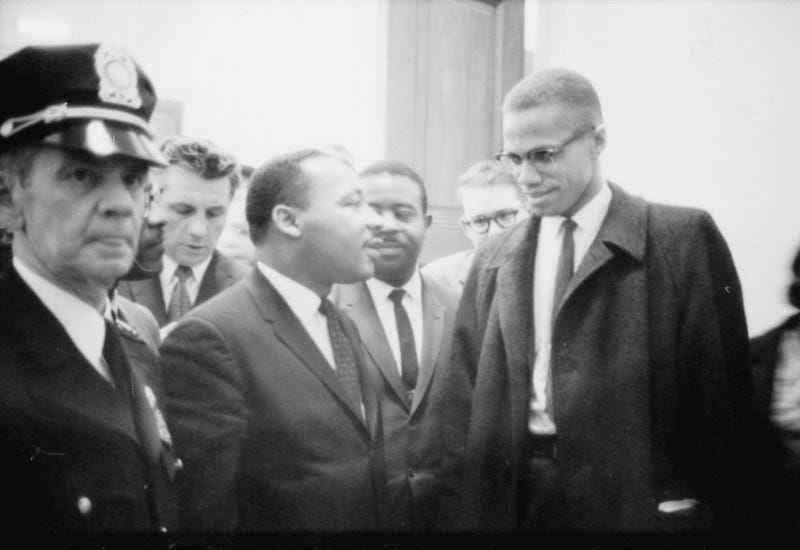
On February 19, 1965, two days before Malcolm X was murdered, he said this:
“It is a time for martyrs now, and if I am to be one, it will be for the cause of brotherhood. That’s the only thing that can save this country.”
I’m sure Malcolm would’ve liked to believe that we didn’t need any more martyrs like George Floyd. But Malcolm X wasn’t an optimist, he was a pragmatist, and the fact that we’re dealing with the same problems 50 years later would’ve hardly surprised him.
Malcolm X believed in self-empowerment for the black community. For every black person, he wanted them to be independent, self-reliant, and if necessary, able to defend themselves.
“Concerning nonviolence, it is criminal to teach a man not to defend himself when he is the constant victim of brutal attacks.”
He believed the only way for black people to survive (and one day thrive) in America was to have total control of their communities. This meant black owned-supermarkets, movie theaters, and most important, schools. Ones that actually had black professors teaching black history.
Malcolm was so adamant about voting that he’d tell folks they’d move them out of town if “they didn’t have the sense of responsibility to get registered.”
Malcolm wanted black people to stop forcing themselves into a white man’s society and instead create their own.
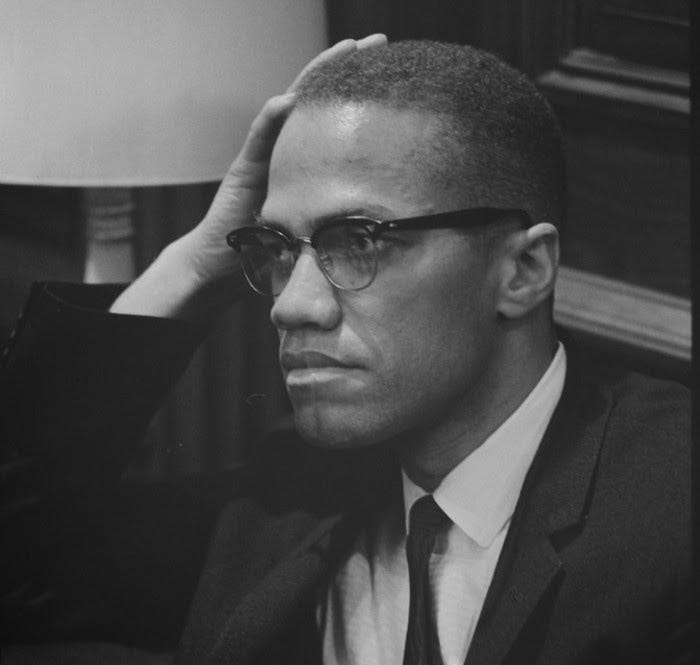
In order to accomplish his vision, he became a big proponent of convincing black people to register to vote. Malcolm was so adamant about voting that he’d tell folks they’d move them out of town if “they didn’t have the sense of responsibility to get registered.”
Malcolm never stopped fighting but realized he was engaging in a struggle that may never reach an end. After all, this was a country that once would’ve considered him 3/5 of a man.
“If you’re not ready to die for it, put the word ‘freedom’ out of your vocabulary.” — Malcolm X
Huey Newton And The Black Panthers
Huey Newton, the son of a Louisiana sharecropper was another miseducated African-American who felt betrayed by his country. Newton didn’t know how to read after graduating high school and was left to educate himself.
It took Newton five tries to read through Plato’s Republic but after he did, he was hooked, becoming an autodidact obsessed with learning his cultural history. He went on to earn a two-year degree, and in pursuit of furthering his education, he met the equally revolutionary Bobby Seale.
“The revolution has always been in the hands of the young. The young always inherit the revolution.” — Huey Newton
Newton and Seale would go onto to create the Black Panther movement and the 10-point program which became the ethos of the organization. Here are four poignant points from that program that Seale highlighted in his speech at the “Free Huey” rally of 1968:
- Number 5 — “We want decent education for black people in our community. One that teaches us the true nature of this decadent, racist society and teaches young black people their place in this society.”
- Number 7 — “An immediate end to police brutality of black people.”
- Number 8 — “All black people held in jail need to be released because they haven’t had a fair trial. They’ve been tried by all-white juries, that’s like being tried in Germany and being a Jew.”
- Number 10 — “We want housing, clothing, education, justice, and peace.”
“We’re going to stop what’s being done to us — you dig it?” — Bobby Seale
White America and the federal government didn’t see eye-to-eye with the Panthers, however. J. Edgar Hoover, the Director of the Federal Bureau of Investigation, described the Panthers as a ‘’black extremist organization’’ consisting mostly of ‘’hoodlum-type revolutionaries.’’
History Repeating Itself
“History repeats itself” — it’s cliché yes, but this tired aphorism continues to haunt our country. Why haven’t we learned from the viral police beatings of Rodney King or the acquittal of his perpetrators? Or the death of 17-year-old Trayvon Martin and the acquittal of his killer George Zimmerman.
Why hasn’t history taught us — and taught our leaders and our institutions — better?
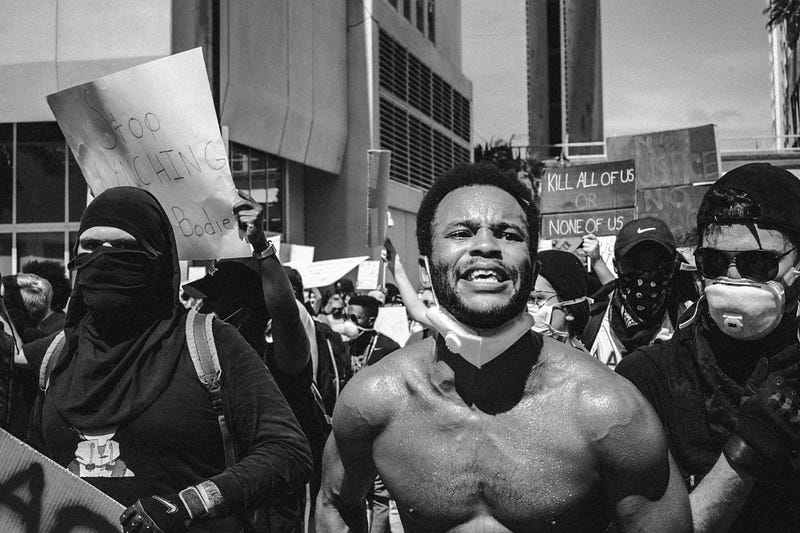
Following Floyd’s death, some places already seem to be stepping in the right direction. Newark, NJ recently updated their curriculum with a better focus on African American History.
“The treatment of African Americans, their contributions, the brutality against them — it’s intricately woven into American history,” said Deborah Smith-Gregory, president of the Newark NAACP. “All Americans need to know that.”
It’s high time we take our education into our own hands. If you visit the Holocaust Museum in Washington D.C. you’ll see in big, unmissable lettering, the words…
Never Forget… it’s time we did the same.
Suggested Viewing Material
“My alma mater was books, a good library… I could spend the rest of my life reading, just satisfying my curiosity.” — Malcolm X
Films/Video
- Malcolm X (1992)
- 12 Years a Slave (2013)
- Moonlight (2016)
- Get Out (2017)
- The Watermelon Woman (1996)
- I Know Why The Caged Bird Sings (1979)
- Do The Right Thing (1989)
- Menace II Society (1993)
- Dolemite (1975) And Dolemite Is My Name (2019)
- 13th (2016)
- Malcolm X’s Interview at Berkley (1963)
- Bobby Seale : The 10 Point Program of The Black Panther Party (1968)
- Dick Gregory Wisdom — The 2-Hour Special (2015)
- Muhammad Ali — Wake Up And Apologize (1972)
- The Birth of a Nation (1915)
Books/Writings
- The Mis-Education of the Negro by Carter G. Woodson
- Where Do We Go from Here: Chaos or Community? by Dr. Martin Luther King, Jr.
- The Fire Next Time by James Baldwin
- The Invisible Man by Ralph Ellison
- Hillbilly Elegy by J.D. Vance
- Brother in Arms by Kareem Abdul Jabbar
- Heavy by Kiese Laymon
- Harlem Hellfighters Graphic Novel by Max Brooks (Mel Brooks’ son)
- Revolutionary Suicide by Huey Newton
- Autobiography of Dr. Martin Luther King, Jr.
- Autobiography of Malcolm X
- Letters from Birmingham Jail by Dr. Martin Luther King, Jr.
- Race, Religion And Racism by Dr. Fred Price
- Unseen: Unpublished Black History from the New York Times Photo Archives
Originally published at https://yardcouch.com


