Teaching Your Children to Swim
It’s an odd juxtaposition of pride and terror.
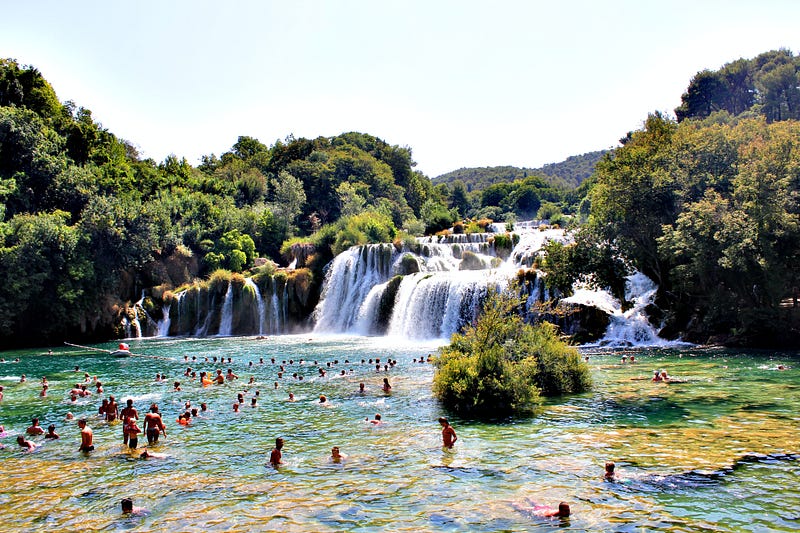
There is a public swimming area near where I live. It’s a river with a jumble of massive rocks that form a dozen small waterfalls and a chute of fast water that pushes you downstream with an irresistible force. When you go there with your kids, first they are terrified, then they become curious, then they dive in with reckless abandon and never want to leave.
My girls are good swimmers. We’ve made the progression from floaties, to uncertain floundering, to competence. Going swimming is great! It wears the children out, combats the heat of the day, and has them whooping and hollering with the pure joy of life.
But swimming at a natural section of rapids on a quickly flowing river is also inherently terrifying. It doesn’t matter that people have been going there to swim for years, some protective part in the back of your mind is always thinking, “What if they get their foot caught on a rock?” “What if they slip and bang their head?” “What if a big kid jumps on them?”
Arrrghhhhh!
But all that means you have to jump into the water with them with a scowl on your face and try to scare every other random swimmer into good behavior. Most of the time it works.
We went to the waterfall for the first time this summer and I tried to dredge the foggy cobweb infected warehouse of my memory for a recollection as to how strong a swimmer my youngest had become. Of course she saw the waterfall and wanted to jump right in.
“Can you swim?”
“Of course!”
“Well, how about if I go with you the first time?”
So she grabbed hold of me and we jumped into the current, and all of a sudden I couldn’t see anything but pink fingers with sharp fingernails desperately clawing and pushing and clamoring towards the surface while simultaneously pushing me down into the depths. The ride was over in a minute and I came up sputtering. My daughter grinned.
“That was fun!”
“Are you not terrified?”
“No!”
“I thought you said you could swim!”
“I can.”
“Okay, why don’t you show me here?”
“Okay.”
She waited. I looked at her. She was standing with her feet on the ground. Maybe she hadn’t understood?
“I want to see you float.”
“Yeah.”
“Okay, come over here.”
She came over. I turned her around so that she faced downstream. I held her by the stomach and the legs face down.
“Now, I’m going to gently push you into the water, okay?”
“Okay.”
“Be sure to keep your head up, okay?”
“Okay.”
“It’s not deep here, so if you start to sink, you can put your feet down, okay?”
“Okay.”
“Ready?”
“Okay.”
I gently pushed her forward. She sank like a stone. A second later she emerged from the water like a breaching whale. She turned around and fixed me with a look of absolute rage and betrayal.
“What the hell are you trying to do, drown me!”
“But…”
“Why did you push me into the water like that?”
“I…”
“I almost died you sadistic lunatic! Mom’s going to hear about this!”
She stomped off. A few minutes later mom came marching in tow. She gave me a quizzical look.
“Am I wrong in remembering that they could swim?”
“No, they can swim.”
“I thought we took them in for lessons last year.”
“We did.”
“She was doing laps in the pool right?”
“Right.”
My youngest stood with her arms crossed staring at me in a rage.
“I’m sorry dear, I guess I misunderstood. What did you want me to do?”
“I wanted you to hold me in place not push me into the current.”
“Okay, come here and I’ll do that.”
She came over and the fury passed. Around thirty seconds later she was sprinting to the water chute and splashing and diving and giggling like she’d been born with gills.
I was glad to see her more confident. But I still felt concerned about the rocks.
I sat and stared around at the other swimmers in an attempt to channel the anger I’d seen reflected on my daughter’s face in order to keep them in line. I succeeded more or less, even though I don’t think I quite managed to match her visage of pure anger.
In fairness, that probably would have been overkill anyway.


