PRIDE 2023 DEFIES WHITE SUPREMACISTS, CHRISTIAN NATIONALISTS
Teaching Queer Kids at Writing Camp, I Learned You Can’t Prohibit Pride
Or Being Queer
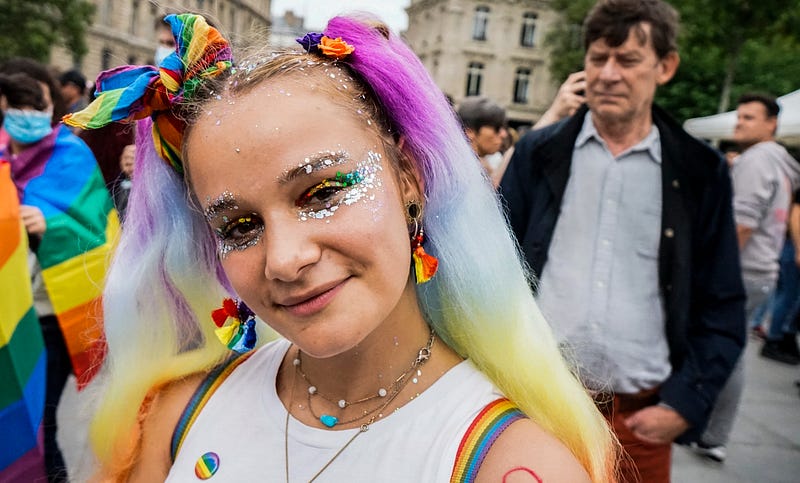
Some prohibitions I’m down with because they’re truly dangerous — like banning smoking from public facilities. I breathed in second-hand smoke for the first 20 years of my life from multiple family sources, and then off and on for the next 35 years whenever I’d visit family or walk into the faculty lounge at my teaching institution. But even anti-smokers like me know that total bans don’t work, even if they’re put in place to promote better health.
Because it’s even more dangerous and more immediate, I would support a total ban on assault-style weapons, though I know that even with such a ban, people who wanted them badly enough would find ways to purchase them from clandestine entities. For when these people and their apologists declare that America is “One Nation Under God,” what they mean is that we’re “One Nation Under Guns.”
These dangerous health concerns worry me, but what in this June Pride Month moment worries me more are all the attempts to ban something that poses no danger to anyone’s health: the idea and reality of being queer. That fear-mongers in our political/religious world try to stigmatize queer people as sick, Satanic, and a danger to children — as a far worse threat than guns, continues to stun me and to defy my notion of common sense.
Every day I try to keep up with all the petitions that I want/need to sign, the stories I MUST read, and the sorrow/rage I feel when yet another bigot, politician, or religious zealot (and often they’re a complete, three-in-one) dehumanizes someone just because that person can’t/won’t fit into the traditional binary.
Farther than my eyes can see and beyond any horizon I know, being queer is not a danger to anyone’s health, though people’s fear allows them to target, demonize anything, anyone, they don’t understand. This kind of fear and hate-mongering has been part of the American story since before our country’s full, legal inception. That we seem to learn nothing from our own history indicates that so many of us are poor students, or we just don’t consider or believe in the quality/equality/ of each human life.
In full disclosure, I am a white, historically heterosexual man in his mid-60s. I have been married for almost 39 years (June 21 is coming!) and have two grown daughters. I have written across Medium about music, culture, and my increasing awareness that the things and people and ideas and books that I love most in life, as well as some of the experiences I’ve had, allow me to walk within the borders of Queer identity.
I plan to write more on this journey as the weeks and months pass, but what I most want to write about today, in order to celebrate Pride and to return to the theme of prohibition not working, is my experience last summer teaching Creative Nonfiction to high school students.
In this summer program, where 10th and 11th graders must apply for admission, most of these young people did not want to take nonfiction, fearing, so I learned, that they’d be forced to compose work that was expository (a word that deadens nerves in 15 year-olds almost as fast as “discipline”).
After the first two days, though, when they discovered that we were here to write personal, memoir-styled essays using music or any other form of art to enhance our stories, it was like all the inner lights turned on within them. And if for whatever reason you don’t think people at this age have complex stories to tell… but then I’m imagining that at this site, you’re very aware of such a reality.
I cannot disclose too much of what these students wrote, since the class is a safe space. But I do want to touch on two students especially, because they highlight the problem with banning anyone’s identity and believing that in doing so, they are doing good work, doing God’s work.
First, there was “Lily.” Lily presented as a young man and was identified by a clearly male name, but at our orientation session, they asked that we all use their preferred name. Lily wrote beautifully about their world, their family, and of their desire to transition fully one day. Lily wasn’t the only student, by far, to identify as queer, but in one fundamental way, they were the student having the most difficulty. When they gave their final reading, their classmates stood applauding loudly and long.
And then they left early the next day, one day early, because their parents had planned a family vacation that just couldn’t wait one more day so that Lily could receive their diploma and say a proper goodbye. On the day that Lily left us, all faculty were warned that if we see Lily with their parents, that we MUST remember to refer to Lily by their unwanted birth name, because calling them Lily in front of their parents would lead to trouble for Lily.
By their own admission, Lily acknowledged their parents as traditional Christians who wouldn’t understand Lily’s desire to transition.
I never saw Lily with their parents, because Lily rushed into my other writing section to whisper goodbye and to thank me privately for encouraging them. I have thought about Lily so often ever since, remembering, too, that the faculty was told to remind Lily every day to take their meds, though we didn’t know, really, what these meds were. I’m guessing for anxiety and depression, for truly, I saw so much of myself in Lily.
The other student I most remember, “Isabella,” responded to several prompts through the lens of her ally-ship with LGBTQ+ friends. Yet, the story that riveted the class concerned an experience she had the previous year, at a Christian-themed camp.
Isabella made a close male friend, and she wondered if this friendship might become something more. And so, in the spirit of getting closer, she confided to this friend that she had grave doubts about Jesus and God — that she didn’t really have faith in either. At first, her friend listened, talked with and counseled her. But then…
Like Isabella, I have no religious faith, and also like her, I understand that when the faith isn’t there, no amount of talking, persuading, or threatening can make it magically appear.
Unlike Isabella, though, I never had an evangelical person grab me around the throat, shake me, and throw me down on the hard earth trying to get the spirit in me.
As she read her personal story, Isabella’s soft voice grew more assured, even as her fellow writers and I grew more and more concerned and outraged. Her writing was clear, strong, powerful, and I think her work could/should be published one day. But like her classmates, too, I was so worried in the moment that all I could do and say was to ask if anyone else knew what happened and if she still was in touch with this friend.
“I didn’t tell anyone,” she said. “And yes, we’re still friends. He apologized and I think I can handle him in the future.”
“I wish you would tell your parents or someone at the camp,” I said. “No one has the right to do that to you.”
On the last day of class, Isabella stayed behind, and walked over to me.
“Thank you,” she said and then she hugged me.
Of course, I haven’t heard from her since.
There is a part of me that would like to sponsor a ban on Evangelical Christianity. On the Republican Party as it is constituted today. On old white men being able to govern. What they’re teaching, advocating, allows too many to feel vindicated in hating and assaulting queer people, their allies, and others who cannot adhere to authoritarian articles of faith.
Pushing young people, queer people, against a wall, choking them for being who they are or not being able to be whom the traditionalists want them to be are antithetical stances to the ideas of liberty and freedom we’re supposed to stand for, if we’ve ever actually stood for such ideals.
And so I know that because of those ideals and because of the reality I see and feel around and within me, prohibitions won’t work, though I also know that these banning processes cause so much suffering. For Lily, for Isabella, for me, and for countless others.
I’m not certain that all of those who advocate these bans believe what they’re espousing. And I don’t know, in the end, which is worse: their lies or their true faith.

This story is a response to the Prism & Pen writing prompt, Pride 2023 DEFIES White Supremacists, Christian Nationalists.
Pride 2023 DEFIES White Supremacists, Christian Nationalists
A Prism & Pen writers prompt
medium.com


