
Teaching In The Midst Of Pandemic
Discussing the challenges in teaching online classes from a teacher’s perspective

Facts: 1. Currently, 8 countries are under full lockdown. 2. Millions of children’s learning have been affected by the pandemic. 3. About 40 countries have had their schools closed for more than 10 months.
The pandemic has undoubtedly changed many aspects of our life, including teaching and learning. Due to the need for social distancing to curb the spread of the virus, children have to continue their studies via online platforms. We have been involuntarily opted for online teaching and learning for the past months, and people are concerned with the outcome. In an article published in Wall Street Journal, Hobbs and Hawkins concluded that online learning in the midst of the pandemic was a failure. In another report, students in Malaysia agreed that online learning in Malaysia “required improvement to be done”, indicated that we are still far from achieving effective teaching and learning in online learning.
As a teacher, I admitted that teaching online classes amid the pandemic is a formidable challenge, and I would say that we have failed in the mission. So, what contributed to the failure of online learning? Are we not ready to embrace the digital learning epoch? Here, I will discuss two main challenges in teaching online classes.
Human Interaction Vs Screen Staring
Teaching has been defined as “a scientific process, and its major components are content, communication and feedback.” While nothing was mentioned in this definition that teaching requires physical contact, nor did it required the teacher and student to exist in the same location physically, I still prefer to teach students in a face-to-face setting, as in a typical classroom.
I do not have enough data to say that all teachers would prefer classroom teaching, but I did speak to teachers I know who have complained about the stressful moment of teaching online classes. We wondered why teaching online classes become a stressful event even for the most enthusiastic teacher?
I ponder if “losing control” on interaction was the main source of stress in teaching online classes. Compared to teaching online, teaching in the classroom enables teachers to have live interaction and interpret a student’s facial expressions and body language from time to time. These non-verbal clues provide insight to teachers, enabled us to reflect and assess our teaching constantly. This instant assessment on teaching help teachers to navigate and modify instruction whenever necessary.
On the other hand, online classes often left teachers clueless about their teaching as students tend to switch off their cameras during class. Teaching becomes a one-way communication where the teachers deliver the content by speaking and staring into the screen. I often get frustrated when my students show only black screens with their names on them, switched off their microphones and left me speaking alone to the laptop’s screen. The feeling of failure in engaging students in teaching has brought more frustration and stress than I imagined.
Physical Demonstration Vs. Verbal Instruction
The subject I am currently teaching required physical contact, especially for younger students. Before the pandemic, I could sit with my student, holding their hand and showing them how to manipulate the beads on the abacus for calculation.
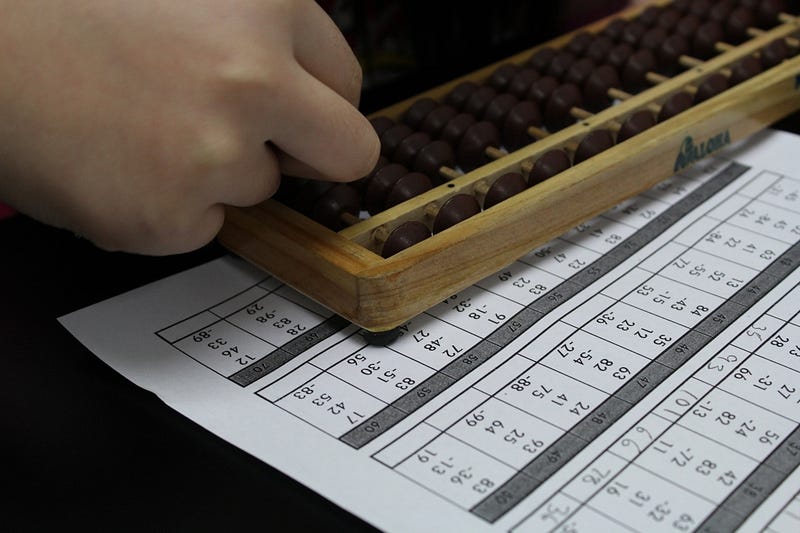
Young students whose finger dexterity has not been well developed required help and guidance from the teacher, and holding their hand to move the beads become the best strategy to teach the students to use the abacus.
When we were forced to teach the subject using online platforms, it changed everything. Students have to rely heavily on the teacher’s verbal instruction, which is a huge problem because they would have a problem understanding some abstract jargon such as “clear your abacus”, “keep your hand ‘floated’ on the abacus”, and “fingering.”
Even when we showed the action via the camera, students might have problems re-orienting what he sees on the screen and executing the action in his perspective. If you have taught a child to hold his pencil while facing him, you will notice that he will mirror your action — raise his left hand while you raise your right — confusing them with left and right.
Nevertheless, young children of 4- to 6-years-old are active, and they have a shorter attention span than older children. To tackle this, we have prepared objects to teach the concept of addition and subtraction. We want them to touch the objects because using one more sense —touch — on top of visual and auditory, could enhance the learning experience. Besides, it is easier to conduct educational games and activities in the classroom than the online classes. Students tend to engage in class activities when their classmates also participated, and social learning is a powerful tool in teaching. Teaching online classes seems to elude the social element due to the physical distance between teachers and students.
Conclusion
Teaching online classes is a formidable challenge to many teachers. In my opinion, technology could be one of the biggest issues. While technology could, and should, help enhance learning, we could not prevent losing the human touch in the use of technology.
However, I believed that there would be a way to compensate for the cons of online classes. Whether to implement a more advanced technology or a change in instructional design, we should make it swiftly because our children could not wait any longer. After all, each day passed with ineffective teaching is another day they missed for effective learning.


