
Teacher Forcing in Machine Learning
Changing the mindset of traditional models

Teacher forcing is a modern training strategy used in the development of sequence-to-sequence models, which are central to many applications in natural language processing tasks.
This technique is often employed in RNNs and its variants — LSTMs and GRUs.
Some of the most common applications include:
- Machine translation
- Text summarization
- Chatbot functionality
# But what is “teacher forcing”?
At its core, is a method to guide and accelerate the learning process of a model by providing it with the correct input at each step of the sequence rather than allowing it to generate the next step based on its previous outputs.
Let´s visualize this better with an example:
Imagine a classroom setting where a student is learning to form sentences in a new language — the teacher provides a word, and the student attempts to predict the next word in the sentence.
If the student guesses incorrectly, the teacher immediately supplies the correct word.
The student then uses this correct word as the starting point for predicting the subsequent one, rather than continuing the sentence from his mistake.
This ensures that the student is always practicing the formation of sentences from correct sequences, reinforcing the right patterns and structures.

Teacher forcing in Recurrent Neural Networks
In the context of machine learning, teacher forcing operates under the exact same principle.
During the training of a seq2seq model, the correct previous output (from the training dataset) is fed as the input to the model for the next prediction, instead of the model’s previous prediction — which could be incorrect.
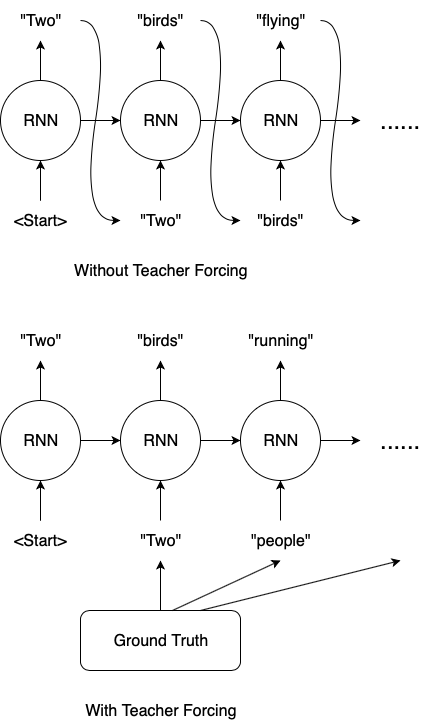
For example, let´s say we want to train a predictive model, and the caption we are trying to predict is:
“Two people reading a book”.
However, our model makes a mistake in predicting the 2nd word and we have “Two” and “birds” for the 1st and 2nd prediction respectively.
- Without Teacher Forcing, we would feed “birds” back to our RNN to predict the 3rd word (which might also be predicted wrongly).
- On the other hand, if we use Teacher Forcing, we would feed “people” to our RNN for the 3rd prediction — increasing the chances that the third word will be predicted correctly.
Teacher Forcing in translation
As I stated before, another area in which teacher forcing is highly employed is in translation.
Let´s go through another example.
For instance, consider a seq2seq model designed to translate English sentences into French.
The English sentence is:
“The weather is nice today”.
And the correct French translation is:
“Le temps est beau aujourd’hui”.
The model is initially unaware of how to translate this correctly.
In a training scenario without teacher forcing, if the model incorrectly predicts the first word as “La” instead of “Le,” — the next input will be incorrect, potentially compounding errors down the line of translation.
With teacher forcing, regardless of the model’s previous output, the correct word “Le” will be fed as the input for the next word’s prediction, helping the model learn the correct sentence structure and vocabulary more effectively.

But how does the model really learn if it´s being constantly fed with the correct answer?
It might seem counterintuitive to “teach” a model by providing the answers upfront; however, this method is grounded in the principles of how learning occurs (not only in artificial systems but also in biological ones).
When we employ teacher forcing in training seq2seq models, we’re not merely giving away the answers but rather utilizing the correct responses as a strong signal to guide the learning process.
We are letting the model make predictions and storing the weights of these predictions in the memory.
However, (as you might have figured out) this type of training has some negative aspects.
Let´s review some of the pros and cons of this technique.
Pros and Cons of Teacher Forcing
Pros
Teacher Forcing accelerates the training process substantially.
In the initial phases of training, the model often makes inaccurate predictions. Without Teacher Forcing, the model’s hidden states are influenced by a chain of incorrect predictions, accumulating errors and making it challenging for the model to improve.
Cons
At the inference stage, where the model typically lacks access to the solution, it has to rely on its previous output for the next prediction.
This creates a mismatch between how the model is trained and how it operates during inference, potentially resulting in reduced performance and instability.
This phenomenon is known as Exposure Bias.
Bibliography
- https://towardsdatascience.com/what-is-teacher-forcing-3da6217fed1c
- https://machinelearningmastery.com/teacher-forcing-for-recurrent-neural-networks/
Thanks for reading! If you like the article make sure to clap (up to 50!) and follow me on Medium to stay updated with my new articles.
Also, make sure to follow my new publication!


