
Tea as Therapy. You should see my tea collection. Part I
It’s kind of ridiculous 🤣
Tea is such a wonderful way to take care of yourself physically as well as mentally, spiritually, and emotionally. I drink tea sometimes for pure enjoyment, but many times I am drinking it to do myself some good — if I am truly lucky, I am able to accomplish both ☺️
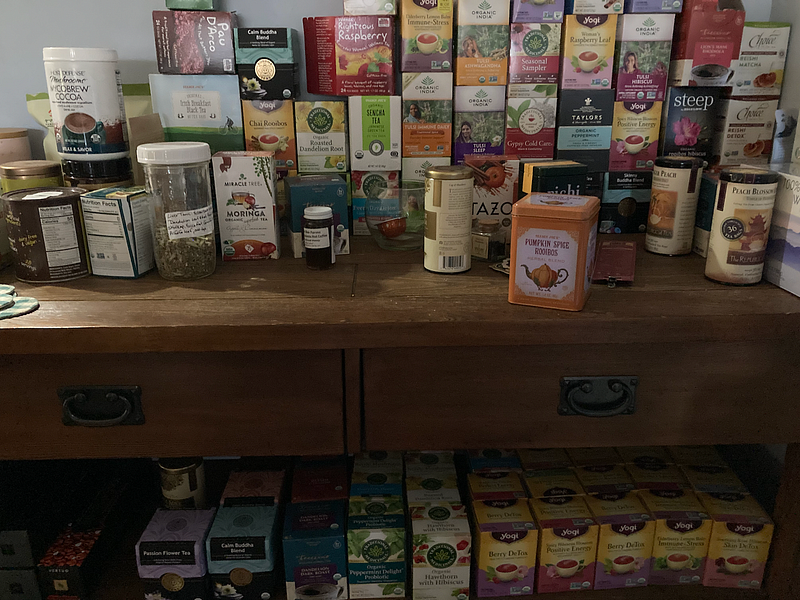
Not only do I have shelves of bulk herbs to make teas, tinctures, topical creams and healing salves and such, but also I have boxes and boxes of teas.
No, seriously, I have close to 6 dozen (+) boxes of teas on hand.
To name a few, I have: raspberry, raspberry leaf, nettles, oolong, jasmine, pau d’arco, turmeric ginger, peach ginger oolong, Irish breakfast, several different kinds of detox varieties as well as stress relief varieties, rooibos, tulsi, peppermint, genmaicha, sencha, muchroom, healthy cycle, dandelion leaf &/or root, and many Many more!
Teas of all kinds are a cherished ancient healing art-form, apothecary, throughout history and time — just ask your local herbalist :)
SIDE NOTE:
🙏🏼 If you would like to sign-up, please click this link as it directly helps me, HolisticNerd — you are awesome — thank you, Thank you, Thank You! 🙏🏼
Please see my about page for my educational background, additional info about me, and any additional disclaimers.
Please enjoy the references section at the end for resources used to support this article formatted in APA style as well as a ‘You might also be interested in’ section of related articles.
Not only is tea enjoyable for the senses and not just the palate, but it also provides many benefits to the physical health of the body through micro, trace, & phytonutrients as well as polyphenols, flavonoids, antioxidants, and much more. This of course varies depending on the type/style of tea, growing and harvesting methods, as well as the soil and many other factors.
For instance, Stinging Nettle tea (an herbal tea otherwise known as an herbal infusion, or tisanes, and if extremely potent are called an herbal decoction) contains B vitamins, magnesium, iron, and selenium to name a few (1).
Potentially Interesting Side Note here…
Upon scouring through this deliciously informative article, I came across a word I inferred the meaning of but was still curious and wanted to be sure. Sooooo, it sent me down a small rabbit hole searching for the meaning via google, anatomy and pathology books, medical dictionary and even a Harvard Medical book for families — all came up with nothing — well, Google kind of did but not using the word itself and so I wanted more clarity. I then searched Google Translate Latin (I suspected) to English mictional which means micturition in English and is “the act of urinating”.
“Young leaves can be used to make curries, herb soups, and sour soups. The root of the stinging nettle is used to treat mictional difficulties associated with benign prostatic hyperplasia, while the leaves are used to treat arthritis, rheumatism, and allergic rhinitis.”
Much like anything else in life though, there can also be health risks/concerns from either consuming ‘too much’ of any one kind of beverage (including teas) or personal individualized vulnerabilities as well as combinations with other teas, herbs, supplements, and especially medications — so, AS ALWAYS, be careful and do your own research, due diligence, and consult with your health care team and/or pharmacist!***
To continue on from the many, many possible physical benefits of various teas, let’s discuss perhaps the lesser known advantages: mental, emotional, energetic, and even spiritual.
Although there can always be debate around any topic, health and wellness being of AbsoLutely No Exception, many articles and studies, as well as the oftentimes less appreciated ancient wisdom, suggests and shows great welfare of tea consumption in many ways including MENTAL HEALTH.
Simply typing in “mental health benefits of tea” into (NIH) the National Library of Medicine: National Center for Biotechnology Information, a whole slew of articles about various studies come up including but not limited to:
- Green Tea Suppresses Brain Aging
- Improvement of Depressed Mood with Green Tea Intake
- Tea and tea drinking: China’s outstanding contributions to the mankind
- Health Benefits and Chemical Composition of Matcha Green Tea: A Review
- Association of Tea Consumption with Risk of Alzheimer’s Disease and Anti-Beta-Amyloid Effects of Tea
- Consumption of coffee and tea and risk of developing stroke, dementia, and poststroke dementia: A cohort study in the UK Biobank
The mental health benefits of relaxing with a cup of tea should be, and perhaps are starting to become, better studied and more well-known.
Now, I know not everyone is a tea drinker of any kind, but for a moment close your eyes and think about a cup of hot chocolate, come on — who doesn’t love hot chocolate lol, and just imagine having the time to juuust beeeee. Feeling the warmth of the cup and the intoxicating aroma of your delicious beverage. Perhaps sitting comfortably on the couch or rocker by the fire, indoors or outdoors and a comfy blanket keeping you cozy. The feeling of peace sweeps over you, your shoulders drop and the weight is lifted if even for but a moment. The chaos and overwhelm of the world along with the demands of life sliiiiiiiiiip away if even just briefly and without consent …
Feel your body. Feel your breath. Feel your stress level balance out. Wouldn’t it be nice to feel like this more often? Perhaps it might be nice for others in our lives too? By taking those 3–5 or even 10 minutes for yourself, just imagine how much better you can show-up for the people you love the most!
You had a chance to not just decompress, but actually become present in your body — pulling the attention back to yourself and away from all the distractions and interruptions of life and work and craziness of the world…
This simple exercise can be at your beck and call whenever you need it, and it can be done as a stand-alone, or in conjunction with a delightful cup of warm something — let’s just say tea lol
“Explorations into the effects of tea on behaviour and mental health come at a time of growing scientific interest in the role of nutrition in mental health and preventive medicine.” (2)
Although there are, of course, many benefits to the various kinds of teas themselves, part of the wonderful benefits are from taking (or rather giving yourself) the time to sit with, relax, and enjoy your cup of tea
According to the Canadian Mental Health Association (CMHA) of Ontario in their article, Celebrate Hot Tea month with a cup for your mental health, there are at least 4 major mental health benefits of tea:
Tea is good for your body and brain.
Tea can create an alert and calm state of mind.
Tea can improve cognition and memory.
Tea soothes stress.
(3)
I know myself, many of my clients over the years, my husband, and many other people I have met, tea is a delightfully enjoyable and oftentimes looked forward to relaxing experience. It is something that can be enjoyed in solitude with or without silence or music or meditation/yoga, or even socially.
— A Brief Interruption — Just a few tips. Please read. —
First, anything underlined in people’s articles/stories are links you can click on — such as my about page listed below. Bold and italic are just for emphasis.
Also, you can comment, highlight, and even clap up 50 times — helping a story become more viewed/popular!
Lastly, for only $5/month or $50/year you can become a member and your membership fee directly supports writers on Medium that you read — it changes people’s lives, including your own!
Taking time for tea
Taking time for tea equates, essentially (at least oftentimes), to Taking TIME for Yourself!
Damn-it anyhow, you deserve a nice cup of tea and some time to/for/by yourself — it’s OKAY, you are NOT being Selfish!
You are practicing the subtle art of giving a crap about yourself, your physical, mental, emotional health and well-being! You matter too, and those who truly love you will not only understand, they will not only fully support this, they will ENCOURAGE it/you!
I know that finding/making that little bit of extra time can be very hard, but please try if even only for 3 minutes every other day, figure out how to squeeze in a little bit of time just for you and a cup of tea.
Please stay tuned — there will be a least a Part II
You might also be interested in:
- An Introduction toooooooo… Herbs
- More about Herbs
- Catnip: Not just for Our Furry Feline Friends
- A ‘Better’ use for your Saffron?
- Why you should watch Down to Earth with Zac Efron and Darin Olien
❤ With all the Love, Grace, and hopes for a Better, Brighter, Happier and Healthier tomorrow, as well as to Your Health & Wellness, Happiness, and Well-being. ❤
With Love, Light, Prayers and Blessings ❤ Your Idealistic HolisticNerd ~ ❤ Mind ❤ Body ❤Spirit/Soul ❤ ~
(Note: Any links/books/etc. mentioned in the article are NOT affiliate links, and I do NOT earn any commission.)
References:
- Bhusal, K. K., Magar, S. K., Thapa, R., Lamsal, A., Bhandari, S., Maharjan, R., Shrestha, S., & Shrestha, J. (2022). Nutritional and pharmacological importance of stinging nettle (Urtica dioica L.): A review. Heliyon, 8(6), e09717. https://doi.org/10.1016/j.heliyon.2022.e09717
- Gilbert, Natasha. (2019, Februar 6). The science of tea’s mood-altering magic. Outlook. https://www.nature.com/articles/d41586-019-00398-1
- Canadian Mental Health Association. (2015, January 15). Celebrate Hot Tea month with a cup for your mental health. https://ontario.cmha.ca/news/celebrate-hot-tea-month-cup-mental-health/


