
taylor swift’s “evermore”: track-by-track review

On December 10th, Taylor Swift made an announcement that no one saw coming — the imminent release of her 9th studio album within 24 hours. The news came less than 5 months after she dropped her 8th studio album, also inspired by and written and produced within her COVID-19 isolation. The “sister album” (as she calls it) continues many of the same wrenching lyrical themes and bold musical arrangements of the prior album while also going in new and exciting directions.
an overview of evermore
On July 24, 2020, Taylor Swift sent shock waves through the music industry when she unexpectedly dropped her 8th studio album, folklore. She had always spaced out her album eras by more than two years and this album came less than a year after her 7th studio album, Lover. In addition to being a surprise (announced to the world less than 24 hours before its release), it was also notable for three other reasons. The first is that it was the first high-profile music release produced during the COVID-19 pandemic. The second is that it represented a marked departure from Taylor Swift’s increasingly pop music-oriented sound. The third is that it was good; like really, really good.
Within a few weeks, folklore had become the best-selling album of 2020. The first single, “cardigan,” became Taylor Swift’s sixth #1 hit on the Billboard Hot 100 and gave her the distinction of being the first artist to debut atop the album and single charts in the same week. The album received the best reviews of her career to date, obtaining an astonishing average score of 88/100 on Metacritic. It was recently nominated for 5 Grammys, including Album of the Year (her fourth nomination in that category; she’s one of only two female artists who have ever won it twice). And it is currently racking up other end-of-the-year accolades, including being in the top spot on many high profile publications’ lists of the year’s best albums.
Perhaps the only thing more shocking than the surprise release and subsequent success of folklore was the surprise drop of her 9th studio album, evermore, only 20 weeks later.
Taylor followed the same strategy with evermore that she did with folklore. She announced it via social media less than 24 hours before it debuted with cover art, links to her website for pre-orders and merchandise, and a statement about the origin of the album. The statement read:
“To put it plainly, we just couldn’t stop writing songs. To try and put it more poetically, it feels like we were standing on the edge of the folklorian woods and had a choice: to turn and go back or to travel further into the forest of this music. We chose to wander deeper in … I’ve never done this before. In the past I’ve always treated albums as one-off eras and moved onto planning the next one after an album was released. There was something different with Folklore. In making it, I felt less like I was departing and more like I was returning. I loved the escapism I found in these imaginary/not imaginary tales. I loved the ways you welcomed the dreamscapes and tragedies and epic tales of love lost and found into your lives. So I just kept writing them.” — Taylor Swift
Only a few days after its December 11 release, the album has already amassed enough sales to guarantee a #1 debut on next week’s Billboard 200 chart, spawned a notable hit in the form of lead single “willow,” received similar critical acclaim to its predecessor (its current Metacritic score is 85/100), and led numerous critics to retool their “best of” end-of-year list.
Rather than reflect a distinct new “era,” evermore represents a “sister album” to folklore. It could also be described as a companion album or sequel. What it is not is an album of outtakes from the folklore recording sessions that were assembled together to prolong the buzz around that album. It is a fully realized, cohesive artistic vision and, in fact, is even longer than folklore.
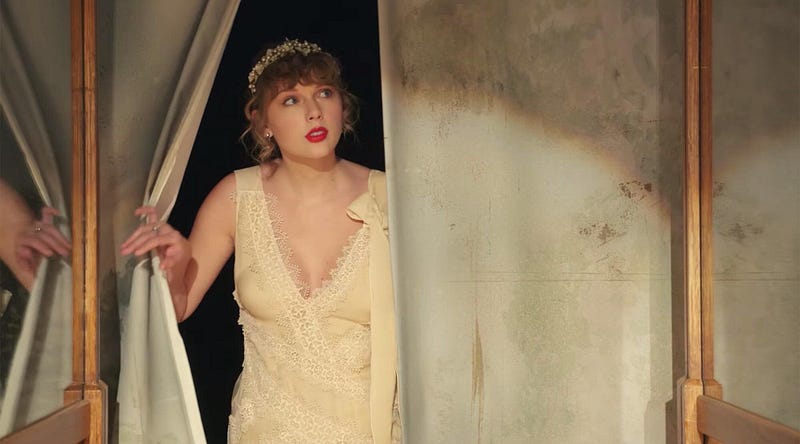
Taylor Swift continues to work with the same creative team on evermore, but with a different emphasis. Whereas folklore’s tracks were split pretty evenly between those produced by Jack Antonoff and Aaron Dessner, this one much more heavily features Dessner’s work and also collaborations from Bon Iver, HAIM, and Marcus Mumford (of Mumford & Sons). The result is that there is even more of an indie rock sound to many of the songs. But it also takes interesting detours into chamber rock, grunge, folk music, and her country roots.
Even more than was the case with folklore, there is little sense of tempo or urgency on evermore. The songs take their time to breathe and build and the tempo shifts not only between songs but very often within them. In terms of production, the songs frequently go to genuinely unexpected places. And while some of these experiments work better than others, they are all fascinating.
As is usually the case with any Taylor Swift album, the highlight is the songwriting. She continues her time-honored tradition of delivering heartfelt confessionals, albeit with more psychological complexity and maturity than ever before. She also further experiments with third-person storytelling and interwoven narratives. We may not get something as clever and audacious as the teenage love story trilogy from folklore, but there are fascinating recurring characters and themes here. The themes of devastating heartbreak, begrudging forgiveness, romantic neglect, forbidden love, human evil, nostalgia, and grief all prominent.
Like folklore, evermore cannot be appreciated after a single listen. It took me multiple listens to fully be cast under its spell and appreciate the intricacies of its writing and production. It’s far from Taylor Swift’s most accessible album, but it’s one of her very best.
Without further ado, here is my track-by-track review of evermore.
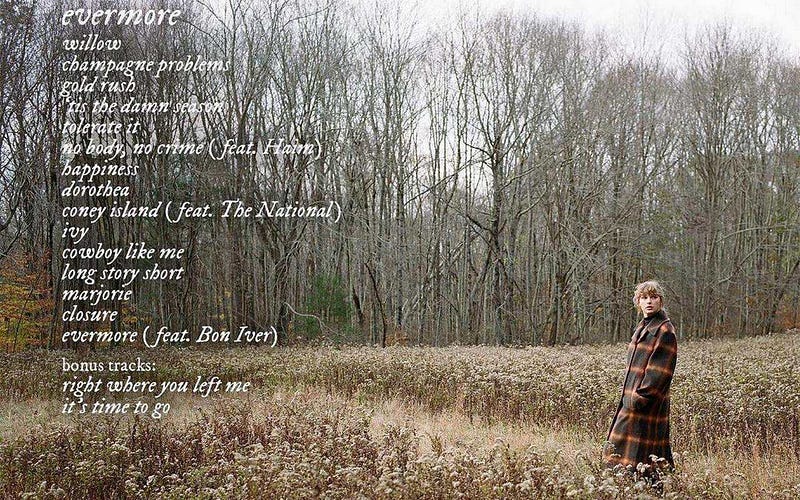
evermore: track-by-track review
“willow”
This folksy, yearning love song was an interesting choice for the album’s lead single. It is hardly the album’s catchiest, most provocative, or most powerful song, but it is a strong and fitting start to the album. The lyrics depict the complexities of wanting someone to love you back and Swift’s vocals effectively oscillate between deep and plaintive and heightened and breathless. As is virtually always the case, Swift said it best when she described the glockenspiel-driven song by saying, “I think it sounds like casting a spell to make somebody fall in love with you.”
- Favorite lyrics: “Wait for the signal, and I’ll meet you after dark/ Show me the places where the others gave you scars/ Now this is an open-shut case/ I guess I should’ve known from the look on your face/ Every bait-and-switch was a work of art”
“champagne problems”
Swift describes the storyline of this song as involving “longtime college sweethearts [who] had very different plans for the same night, one to end it and one who brought a ring.” It is a wrenching piano-driven ballad co-written with her romantic partner Joe Alwyn (under the pseudonym William Bowery). It is filled with stunning details that evoke vivid imagery and also delves into the female protagonist’s mental health struggles. One of the most interesting aspects of the song to me is its title. “Champagne problems” is typically a phrase that is used to describe problems that may seem very real and painful to an individual but are truly insignificant when compared to the suffering of others. But a broken engagement and mental illness are undeniably painful topics. Is she acknowledging that in the epic tragedy of 2020, singing about a breakup feels trivial? Or is she sharing the protagonist’s perspective of the situation? Questions like this are part of what drive the brilliance of evermore.
- Favorite lyrics: “Sometimes you just don’t know the answer/ ’Til someone’s on their knees and asks you/ ‘She would have made such a lovely bride/ What a shame she’s fucked in the head,’ they said/ But you’ll find the real thing instead/ She’ll patch up your tapestry that I shred”
“gold rush”
The only song on the album produced by Jack Antonoff, who produced about half the songs on each of her last three albums, this one opens with an ethereal chant and then unexpectedly evolves into a quicker pace and poppier sound. The lyrics find the protagonist falling for someone that is universally adored and being pursued with the fervor of settlers looking for gold in California (hence the title). She is filled with longing and jealousy and ultimately realizes that the chase and the fight isn’t worth it.
- Favorite lyrics: “At dinner parties, I call you out on your contrarian shit/ And the coastal town we wandered ‘round had nеver seen a love as pure as it/ And thеn it fades into the gray of my day-old tea/ ’Cause it could never be”
“‘tis the damn season”
One of my favorite songs on the album, “‘tis the damn season” is propelled by an electric guitar strum and tells the story of a woman who left her small town of Tupelo, Mississippi to make it in Hollywood. She is back for the holidays and reunites with an old flame. Her ambivalence about both leaving and returning home is palpable and Taylor Swift’s aching vocal performance is one of her best. The song is a winner on its own, but is made even richer when you reach the track “Dorothea” and realize that this track is also about her, albeit from a different perspective. It’s the kind of world building and intertwining narratives that were a big part of what made folklore so ambitious and breathtaking.
- Favorite lyrics: “Sleep in half the day just for old times’ sake/ I won’t ask you to wait if you don’t ask me to stay/ So I’ll go back to L.A. and the so-called friends/ Who’ll write books about me if I ever make it/ And wonder about the only soul/ Who can tell which smiles I’m fakin’/ And the heart I know I’m breakin’ is my own/ To leave the warmest bed I’ve ever known”
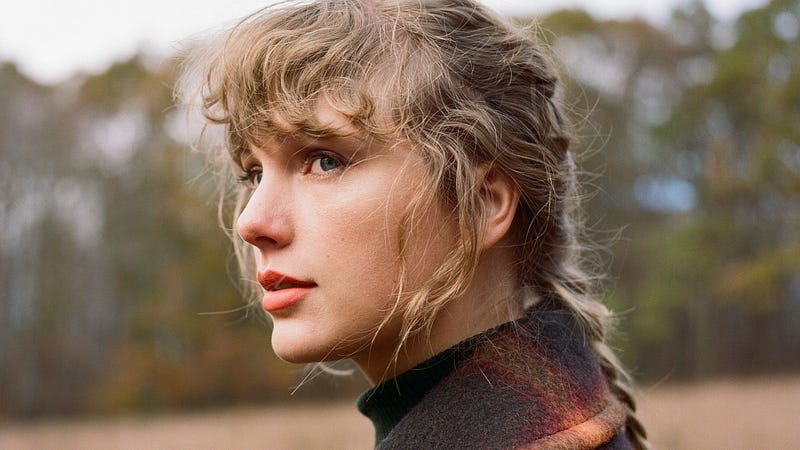
“tolerate it”
Many albums ago, Taylor Swift’s fans noticed that her fifth tracks tend to be a particularly wrenching and confessional ballads (e.g., “All Too Well,” “The Archer,” “My Tears Ricochet”). The fifth track of evermore is no exception. The refrain “I know my love should be celebrated/ But you tolerate it” is a punch to the gut and it perfectly sums up the song, which tells of a woman who has been faithfully devoted to her partner for years but is becoming increasingly resentful that he fails to demonstrate fidelity and passion in return…or even interest. The song evokes the heartbreaking dynamic of being in love with someone who appears largely indifferent toward you.
- Favorite lyrics: “While you were out building other worlds, where was I? Where’s the man who’d throw blankets over my barbed wire?/ I made you my temple, my mural, my sky/ Now I’m begging for footnotes in the story of your life/ Drawing hearts in the byline/ Always taking up too much space or time”
“no body, no crime (feat. HAIM)”
My favorite song on the album — and one of my favorite songs Taylor Swift has ever made — is this ambitious collaboration with the rock band HAIM. In the grand tradition of Cher’s “Dark Lady” and Carrie Underwood’s “Two Black Cadillacs,” the song tells the story of a murder (a double murder, no less!) from various perspectives. I fell in love with it instantly, but it took me numerous listens to fully comprehend the shifting narrative. The first verse involves the narrator’s friend telling her that she thinks her husband is cheating. The second verse tells of the narrator’s friend’s disappearance and the narrator’s suspicion that it was her husband that killed her. The third verse tells of the narrator murdering her late friend’s husband and subsequently covering it up. There is a chilling refrain and the song’s productions and vocals perfectly fit the cinematic and macabre content. It is also one of the most authentically and unapologetically country songs she has produced in ages.
- Favorite lyrics: “Good thing my daddy made me get a boating license when I was fifteen/ And I’ve cleaned enough houses to know how to cover up a scene/ Good thing Este’s sister’s gonna swear she was with me/ Good thing his mistress took out a big life insurance policy”
“happiness”
Taylor Swift reportedly wrote this song only a week before the album’s release, but it hardly feels like a rush job. It tells the story of someone in the aftermath of a breakup realizing that although they are devastated, they know there will be happiness again. It is fittingly slow, deliberate, and contemplative in its production. It also finds Swift engaging in a remarkably mature and complex approach to a breakup that contrasts markedly with the music she wrote as a teenager. Just look at lines like “No one teaches you what to do/ When a good man hurts you/ And you know you hurt him, too.”
- Favorite lyrics: “Honey, when I’m above the trees/ I see it for what it is/ But now my eyes leak acid rain on the pillow where you used to lay your head/ After giving you the best I had/ Tell me what to give after that/ All you want from me now is the green light of forgiveness/ You haven’t met the new me yet/ And I think she’ll give you that”
“dorothea”
The dyad from “‘tis the damn season” is revisited here, albeit from the perspective of the male this time. He talks about his high school girlfriend (the titular Dorothea) who went off to become a star in Hollywood. He pines for her and wonders if she ever thinks about him now that she has moved on. Although it’s more uptempo and upbeat than many of the other songs, it has a heartbreaking innocence and earnestness.
- Favorite lyrics: “It’s never too late to come back to my side/ The starts in your eyes shined brighter in Tupelo/ And if you’re ever tired of bеing known for who you know/ You know that you’ll always know me, Dorothea”
“coney island (feat. The National)”
This indie rock duet with Matt Berninger of the rock band The National (whose bandmate Aaron Dressner produced much of evermore), is intensely nostalgic. It depicts with vivid detail and heartbreaking longing the story of a couple looking back on a relationship that fell apart largely because of unequal levels of commitment. For me, it never reaches the dramatic heights I was hoping it would, but the lyrics are gorgeous and the mix of Swift’s mellifluous vocals with Berninger’s raspy baritone is truly special.
- Favorite lyrics: “Break my soul in two looking for you/ But you’re right here/ If I can’t relate to you anymore/ Then who am I related to?/ And if this is the long haul/ How’d we get here so soon?/ Did I close my first around something delicate?/ Did I shatter you?”
“ivy”
Swift delves back into the lyrical theme of infidelity on this banjo-driven track that features harmonizing from Justin Vernon of Bon Iver. It tells the story of a woman who has reluctantly fallen in love with a man who is not her husband. She longs to be faithful, but cannot stop herself even though she is perfectly aware of the havoc it will wreak. The track is similar thematically to “illicit affairs,” which is a standout from folklore (and like “ivy” was the tenth track on that album).
- Favorite lyrics: “Clover blooms in the fields/ Spring breaks loose, the time is near/ What would he do if he found us out?/ Crescent moon, coast is clear/ Spring breaks loose, but so does fear/ He’s gonna burn this house to the ground”
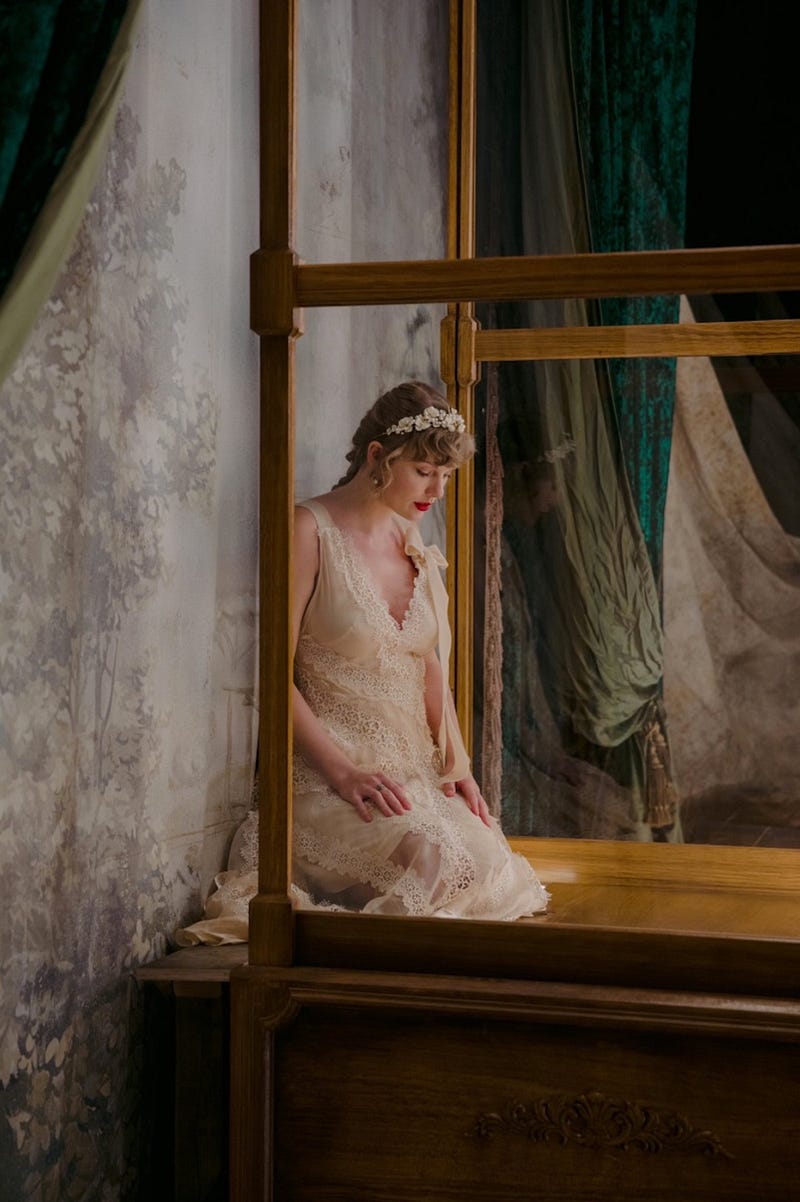
“cowboy like me”
Of all the songs on evermore, this song snuck up on me the most. I was somewhat indifferent to it upon first listen and yet I kept returning to it over and over due to its hypnotic production and exceedingly interesting lyrics. Like “no body, no crime” this song goes back to her country roots and also involves vivid storytelling. But the similarities pretty much end there. Rather than a double murder, this song tells the story of two grifters who are constantly looking for wealthy people to romantically pursue but unexpectedly break all their own rules by falling in love with each other. The lyrics are beautifully complemented by backup vocals from Marcus Mumford (of the popular country rock band Mumford & Sons) and an elegant orchestration involving guitars, mandolins, and harmonicas.
- Favorite lyrics: “And the skeletons in both our closets/ Plotted hard to f*** this up/ And the old men that I’ve swindled/ Really did believe I was the one/ And the ladies lunching have their stories about/ When you passed through town/ But that was all before I locked it down”
“long story short”
This tale of rising from the ashes is one of the few songs on her one-two punch of folklore and evermore that with slightly different production could have been right at home on one of her previous, pop-oriented albums. It’s an indie-rock track that heavily features drums and guitars and has a jaunty, catchy chorus. It is another meditation on the cruel treatment Taylor Swift received from the media that she received due to various controversies and (mostly) some old-fashioned misogyny a few years earlier. But the way she cheerfully dismisses it and refocuses on her current happiness with her romantic partner suggests that she has fully moved on, making it one of the album’s truly heartwarming songs.
- Favorite lyrics: “Past me/ I wanna tell you not to get lost in these petty things/ Your nemeses/ Will defeat themselves before you get the chance to swing/ And he’s passing by/ Rare as the glimmer of a comet in the sky/ And he feels like home/ If the shoe fits, walk in it wherever you go”
“marjorie”
Yet another example of how folklore and evermore are “sister albums” is the fact that the thirteenth track of each is an ode to one of her grandparents. While folklore’s “epiphany” focuses on her grandfather’s time in WWII, evermore’s 13th track “marjorie” tells the story of her grandmother. Identified by many critics and fans as a highlight of evermore, it is a gorgeously written tale of guilt, grief, and regret. The subject, Marjorie Finlay, was an opera singer who died when Taylor was just 13 years old. As such, the song takes an alternating perspective of young Taylor not appreciating her grandmother enough while she had her and grown Taylor wishing she could do it all over. To make it all the more poignant, the song samples her grandmother’s actual vocals for the backing track.
- Favorite lyrics: “I should’ve asked you questions/ I should’ve asked you how to be/ Asked you to write it down for me/ Should’ve kept every grocery store receipt/ ’Cause every scrap of you would be taken from me/ Watched as you signed your name ‘Marjorie’/ All your closets of backlogged dreams/ And how you left them all to me”
“closure”
Aptly described by genius.com as a “wild industrial folk number,” “closure” tells the story of a woman who keeps getting offered the opportunity for closure with an ex-partner, but repeatedly rejects it. She does so not out of a desire to hurt him, but rather a reflection that he is doing it for selfish reasons and she simply doesn’t need it. She has moved on. Its unique, complex, and unpredictable orchestration and production make it one of the album’s most sonically bold tracks.
- Favorite lyrics: “I know I’m just a wrinkle in your new life/ Staying friends would iron it out so nice/ Guilty, guilty, reaching out across the sea/ That you put between you and me/ But it’s fake and it’s oh so unnecessary”
“evermore (feat. Bon Iver)”
Although it never reaches the power of “exile,” the collaboration with Bon Iver that appeared on folklore and is one of Swift’s best songs, there is a lot to admire here. Particularly, there is the thrilling bridge that occurs mid-song that features Taylor and Justin Vernon of Bon Iver trading lines and harmonizing. The majority of the song surrounding the hook is a somber, piano ballad that delves into the narrator’s depression. This one doesn’t work quite as well for me lyrically as most of the rest of the album, but it is beautifully performed, fascinating in its production, and caps the album on an appropriately somber but hopeful note.
- Favorite lyrics: “Hey December/ Guess I’m feeling unmoored/ Can’t remember/ What I used to fight for/ I rewind thе tape/ But all it does is pause/ On thе very moment all was lost/ Sending signals/ To be double-crossed”
“right where you left me” (bonus track)
Upon first listen, this song had a twangy, folksy style that I found a bit grating. However, after multiple listens I fell madly in love with this bonus track. The song depicts a woman whose life was frozen when her lover told her he was ending the relationship. The song fully commits to this conceit of being frozen in time by delivering vivid imagery of a young woman, stunned into silence, sitting motionless at a restaurant gathering dust while the world around her (including her ex-lover) move on. The song is an utterly heartbreaking ode to people who can’t move on after heartbreak and its concluding lyrics suggesting that she will continue to wait for him only underscores the sadness. This is also a rare song where the repeated refrain gets more intense and more meaningful each time its repeated as the protagonist’s devastation becomes clearer.
- Favorite lyrics: “Help, I’m still at the restaurant/ Still sitting in a corner I haunt/ Cross-legged in the dim light/ They say, “What a sad sight”/ I stayed there/ Dust collected on my pinned-up hair/ I’m sure that you got a wife out there/ Kids and Christmas, but I’m unaware/ ’Cause I’m right where I cause no harm/ Mind my business/ If our love died young/ I can’t bear witness/ And it’s been so long/ But if you ever think you got it wrong/ I’m right where you left me”
“it’s time to go” (bonus track)
In direct contrast to the first bonus track, the second is about moving on when it is time. The clever lyrics cover a variety of times when “it’s time to go,” including a disappointing meal, a friendship that isn’t what you thought it was, a thankless job you’ve dedicated your life to, and a marriage that is no longer working, before leading into a discussion of her falling out with Scooter Braun and the loss of control over the masters of her first six albums. One of the many beautiful things about the sister albums she has created with folklore and evermore is how they intersect with each other and parallel one another. The fact that the 17th and final track on both albums centers on the need to escape oppressive situations that are chipping away at your soul and features a bleak, tentative outro is a perfect example of this.
- Favorite lyrics: “Fifteen years, fifteen million tears/ Begging ’til my knees bled/ I gave it my all, he gave me nothing at all/ Then wondered why I left/ Now he sits on his thrown in his palace of bones/ Praying to his greed/ He’s got my past frozen behind glass/ But I’ve got me”
In Sum
Admittedly, I was a bit worried on December 10th when Taylor Swift announced evermore. Her previous surprise release was such a career-redefining masterwork and such an innovative and powerful artistic creation that I was worried that if it wasn’t as good as folklore or came off as a cash grab, it could have cheapened folklore’s legacy. But it doesn’t cheapen it. It deepens it.
Four full listens in and I’m still finding new things to appreciate lyrically and sonically. The very act of poring over the lyrics in order to select my favorites for this article somehow increased my already substantial appreciation for the scope and nuance of Swift’s songwriting. Standout tracks for me are “no body, no crime,” “‘tis the damn season,” “champagne problems,” “cowboy like me,” and “Right Where You Left Me.” But, as was the case with folklore, there isn’t a single bad track on the album.
The question most Swifties and music critics will be dogged with is: “Sure it’s good, but is it as good as folklore?” In my opinion, this isn’t the correct question to ask. My answer to that would be a tentative “no.” For me, it ever-so-slightly lacks the cohesion and emotional punch of folklore. However, this is likely heavily influenced by the facts that folklore was a marked departure from her prior album (and thus totally unexpected) and I have now had nearly five months to savor and explore it.
I think the question that should be asked is: “Is evermore also a masterpiece like folklore is?” And my answer that to that question would be an unequivocal “Yes.” Choosing between folklore and evermore is like deciding which movie is better — The Godfather or The Godfather Part II? Before Sunrise, Before Sunset, or Before Midnight? Alien or Aliens? Toy Story, Toy Story 2, or Toy Story 3? I may have my personal preferences, but comparing them is ultimately splitting hairs. They are all masterpieces that are head and shoulders above virtually everything else being produced in the medium and they complement and deepen each other beautifully.
Rating for evermore: 5/5 stars
Follow the author of this article on Medium and Twitter.
Read other articles by this author about Taylor Swift:


