
Taylor Swift as a Female Andrew Tate
Two apparently different people represent a strikingly similar phenomenon
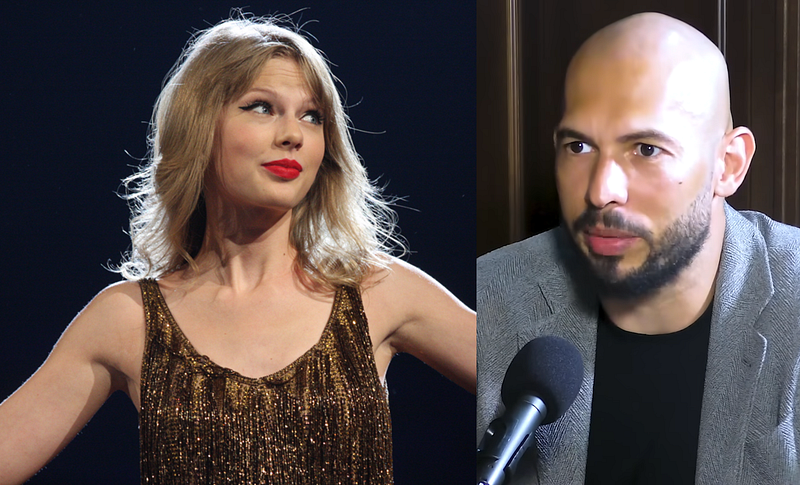

We live in a strange time. Our gods and our myths are no longer the product of imagination but of a bizarre kind of cultural power, a currency born of mass culture, social media and the age of rampant individualism.
What tells us what it means to be human now are not myths that dig for moral lessons, religions that order the world or systems in which we find a place but individuals who rise to the top of an incoherent mass of pure attention competition, the victors of the ego.
It seems obvious to point out how Andrew Tate enters this world, certainly enough people have done so. He is an embodied ego, complete with cars and money and aviator sunglasses indoors, the alpha male of this cartoon online world we have created, narrativizing success in a world that doesn’t care about you, top dog of the evolutionary hierarchy that we have now transferred onto the vacuous landscape of the Internet in which we all part reside. It is easy to see why impressionable and purposeless young men idolise him, easy to see why people despise him. As frustrating as he is to many people, he isn’t a particularly complicated phenomenon.
To a lot of people it is probably blasphemy that I would put Taylor Swift in the same category. Yet Swift, like Tate, has risen to the top of a vacuous world, and is queen of a narrow and empty culture, monetising ego and popularity with phenomenal success.
Both embody clichés of relationship dynamics and fulfill them in the most modern of sense. Both speak in the traditional language of masculinity and femininity, yet both seem to embody promiscuity and an ultimately superficial attitude to their supposed view of relationships. Both talk of relationships, Tate in the language of a kind of masculine authority, Swift in the language of idealistic romanticism that fetishises the beginnings of relationships, yet both are in their 30s and seemingly not achieving the meaningful commitment their language might seem to imply.
Both are unequivocal about wealth and success, and of the maintaining of self-image. Both are phenomenally and unashamedly wealthy, living in financial worlds utterly beyond the imaginations of most people, and whether directly in the case of Tate, or unspoken in the case of Swift, both clearly believe the massive accumulation of surplus is a justified reward for popularity.
Of course unlike Tate, Swift curates a significant popularity within the mainstream. From the constant camera cuts at the superbowl to the barrage of flattering articles and awards, Swift is the darling of mainstream pop culture. Incapable any more of coherent critique, our culture knows nothing of what art is meant to be, and since Swift is female this seems enough to applaud her endless, artless narratavising of the ego.
Tate’s dubious path to wealth naturally leaves him as more of a pariah to a mainstream that is built on the pretense of fad morality, yet arguably his power-oriented view of the world contains a kind of transparency that Swift lacks. If the world really is a meaningless power game, they are both winning at it, and anyone who looks at our culture and considers it an artistic meritocracy needs to have another look. Popularity is the power game culture has resigned itself to, Swift and Tate are high school figures in a high school world, leading their crowds of followers around the gossip-filled corridors.
The same is largely becoming true everywhere. The rise of populism in politics is essentially no different, with figures such as Trump creating an image impenetrable to critique as long as he can curate popularity with his madly devoted fanbase. Swift in her own cultural sphere curates a similar kind of immunity and ludicrously unwavering and unconditional idolisation, assuring her mediocre records such as the lyrically clichéd and uninspired Midnights are received with applause by critics and wept at by fans.
This, then, is the age of the ego. Even among the Greeks with their images of power and honour games narrativized by Homer, there is run through the idea that the bounds of the gods mark a place beyond which hubris leads to destruction. The humility of Christianity is to classical Greece a law of reality, that those who extend their ego beyond its bounds are violating their place in the world. Aidos, companion of nemesis, represented both the shame a rich person might feel in the presence of the poor, but also reflected a strange idea that extends into Plato’s wrestling with the rules of the gods, that something more common remains in spite of our inequality, and that something inherently preposterous exists in dynamics of wealth ultimately handed out by fate.
But ego believes I and only I have risen to the top of a hierarchy, the place at the top of which could not be more deserved. While for Andrew Tate this claim is direct and transparent, such transparency is more honest than than those who embody the same principles while curating an apparently superior self image. The victors of a shallow world can never be anything but shallow themselves, for in the immortal words of Swift herself, you play stupid games you win stupid prizes.