
LIFE
Tattoo For Life
What does it take to convince you to stay alive?
“Where is Slovenia?”
That was the question wittily asked in a magazine that provoked a 24-year-old Slovenian so much it stopped her from a suicide attempt.
Earlier, the young woman was ready to depart this material world with a plan to overdose herself with sleeping pills. She had had enough of the success in her life. She was neither deprived nor unloved. Yet, for inexplicable reasons, they weren’t enough.
Besieged by persistent melancholia and insatiable unhappiness, death was more becoming, more alluring. Like how most women plan their wedding, she planned her suicide with careful thought and care, replete with a note. All was well and ready, she thought, until she read that question in a magazine.
Triggered, she decided to write a letter to the magazine. As if she felt incumbent to justify herself, she wrote the letter to make the press believe she killed herself because people don’t even know where Slovenia is. This is precisely my point of how ridiculously insignificant our worthiness becomes, she thought.
Unfortunately, her plan failed. She woke up from a coma in a mental hospital named Villette. Here, she was told by her doctor she had only a few days to live due to a heart condition caused by the overdose.
Her name is Veronika and this is my favorite read titled ‘Veronika Decides To Die’ by Brazilian novelist Paulo Coelho, the same author behind ‘The Alchemist’.
‘Veronika Decides to Die’ is a story I read and reread, now and then, as a reminder to what it means to be alive. It isn’t so much to remind myself, but to reinforce the belief in the people I deal with in the areas of trauma, youths and mental health.
I read it to remind teenagers the importance of their existence in a world they’re tired of being a part of, to participate, to understand. They’ve had enough and they’re standing by the door.
I read it to find the strength to tell troubled youths, they still mattered and that I, though a stranger in their life, wanted them to be around. Veronika is a tattoo I ink on their skin. A story I often tell. This tattoo becomes a reason they agree to give life a second chance.
In the last seven years, I find myself observing and witnessing an increase in depression, suicide thoughts and attempts among the student population I deal with throughout Malaysia.
As a former educator, consultant and trainer in human communications, I traveled across the country, stretching as far as to Borneo, sometimes even to Indonesia, listening to testimonies by teachers, school counselors, parents, guardians and students, about their respective struggles. My work isn’t so much to provide solutions, but to gather data and to design remedial strategies that can best address and improve the needed empathy and compassion in the education system.
My role is not to judge, but to listen.
I listened to teachers who are overworked, exhausted and themselves require mental health support. I listened to parents grappling with bills, debts and escalating costs of living while wrestling with their failure to connect with their children. I spent a huge portion of my time with the teenagers who see themselves at the receiving end of their human existence. What they see is a different picture to the adults in their world.
Their day could be good or otherwise, but they always boomerang to the same conclusion: self-loathing, seeing themselves as a burden, misunderstood, struggling to make sense of a rapidly evolving world which even their adult caretakers are floundering to explain to them or show by example. The only currency in their life is spoken through materialism. Here’s a new smart phone. Or none.
What they crave is to be understood. They cannot be heard for they know not how to define and explain themselves. What they’re often given for compensation is freedom. What they secretly crave is affection. What they need is guidance. What they miss is to be held and hugged. Many of my students are seldom told they’re loved.
But this isn’t a youth problem. It is a human problem. I hear this too from the adults in their world. Adults too, require the same measurement of love, appreciation and to be acknowledged for being here.
This is the language that we speak yet it is the language we have lost. With this loss is the erosion of our civilization.
In its place, is a fusillade of vapid vernacular and speech patterns of social media. If role modeling is absent in the real world, we have an abundance of awful specimens in the virtual world. They come with a cost and we are paying the price dearly. Cyberbullying has escalated, so have eating disorders and hate speeches. These are just the starting points.
It was no surprise that I found myself recently turning the pages of ‘Veronika Decides to Die’. Once more, I needed sustenance of hope and soundness. I was triggered after reading a report about the exploitation of migrant workers in Malaysia.
“I came to Malaysia in 2007 because I had to help support my parents and my two younger siblings. We were poor and did not have enough money. An agent came to my village and spoke to my dad. The agent spoke to my father and told him that if I were to work in Malaysia, I would be paid 30 MYR ($6.46) a day. The agent asked for 2 million taka ($18,224.79) which we raised and paid. My father borrowed the money from friends, sold some of his cows and also sold a house he owned. The agent told me that I would be sent to Malaysia within three months of the payment, but I had to wait eight months.
Once I reached KLIA airport, no one came to meet me, so I was taken to a holding area at the airport car park. There, I had to stand in sewage because there was a burst pipe. The urine was above my ankle level, and I was forced to stand in it together with 55 others for three hours. We were in a holding area. There were many more being held in other areas. There were probably between 100 and 200 other newly arrived workers also there.
We were then kept in a house for six days. The agent had then taken our passport. On the eighth day being in the house with 55 of us, the agent told us to leave and to go away and find work ourselves. I asked for my passport, but the agent said I would only get it if I paid 1000 MYR ($215.45) because my passport was with the immigration. I bargained with him and asked for the amount to be reduced to half. I got my passport. I then found a job where I worked 10 hours a day. But after two months I was not paid a single cent. I did ask for my wages, but I was always told I would be paid next month. At the end of two months, my employer suddenly ran away. He disappeared from the site. I have gone back to the site many times but did not see him there.” — Husain, age 21, interviewed in Kuala Lumpur provided by Amnesty International
Currently as a member on the board of governors with the Malaysian Social Research Institute, I look into the plight of refugees and migrant workers. This involves thousands of men and women from Bangladesh, India, Nepal, Vietnam, Somalia, Syria and other countries in the region.
In addition to their emotional, physical and financial toll, their hardship includes suppressed forced labor, slavery and slave-like practices and trafficking-in persons, each of which is prohibited under international law.
What never ceases to amaze me is the fighting spirit of these marginalized people to live. Despite the hardship they hold on to their unwavering belief in their respective Gods. Veronika, like many of my students, was not as generous.
“If God exists, and I truly don’t believe he does, he will know that there are limits to human understanding. He was the one who created this confusion in which there is poverty, injustice, greed, and loneliness. He doubtless had the best of intentions, but the results have proved disastrous; if God exists, he will be generous with those creatures who chose to leave this Earth early, and he might even apologize for having made us spend time here.”― Paulo Coelho, ‘Veronika Decides to Die’
I often wonder how the cost of one’s life is measured, here and in other realms. It is seldom that I hear the refugees and migrant workers blame God for their misfortune. Or surrender their ticket from this Lifetime. Switch religion, yes. Detest God? Rarely.
How are they able to deceive themselves into seeing life so differently? Based on those I dealt with, they wore no tattoos but they had their faith cemented somewhere in a hope for a better future.
It is along this sentiment that Coelho weaves the magic of hope, trust and belief in ‘Veronika Decides to Die’.
In the story, Veronika’s urban trappings made her disillusioned to what happiness means. She felt trapped in a mould, typecasted and a slave to society’s routine. Her inability to be someone different suffocated her. If to be different is to be mad, she thought, then so be it. She saw herself fitting in comfortably in a mental hospital.
“Some things are governed by common sense. Putting buttons on the front of a shirt is a matter of logic, since it would be very difficult to button them up at the side, and impossible if they were at the back. Other things, however, become fixed because more and more people believe that’s the way they should be. Have you ever wondered why the keys on a typewriter are arranged in that particular order?” ― Paulo Coelho, ‘Veronika Decides to Die’
Ironically, it was only when Veronika was placed at a mental hospital, releasing her of responsibilities and expectations, and told her days were numbered, that she began to appreciate life. She finally put effort into injecting enthusiasm to explore living, including the courage to love again.
“Once in a mental hospital, a person grows used to the freedom that exists in the world of madness and becomes addicted to it. You no longer have to take on responsibilities, to struggle to earn your daily bread, to be bothered with repetitive, mundane tasks. You could spend hours looking at a picture or making absurd doodles. Everything is tolerated because, after all, the person is mentally ill.”― Paulo Coelho, ‘Veronika Decides to Die’
The truth is, her doctor who sensed her condition from the start, had tactically played with deception — by reconstructing her imagination, affecting the way she saw life. He convinced her that she was dying, and that her fragile heart condition meant she couldn’t afford to be reckless and careless. She had to be kinder to herself. But it also meant she had nothing to lose in taking new risks.
“In a few more days I’d anticipated telling Veronika that our injections had cured her heart condition. But in light of her unscheduled departure from Villette my telling that particular lie will not be required. The majority of people who attempt suicide repeat that attempt until they succeed. I took a risk in lying to her about her condition, so I decided to test the only remedy I have come to have any faith in: awareness of life. Until she finds out from some other doctor that she is perfectly healthy. She’ll consider each day a miracle. Which in my view it is.” ― Paulo Coelho, ‘Veronika Decides to Die’
Gradually, Veronika is able to face her demons and reflect on them. When asked what terrified her so much about life, she replied:
“Cowardice, perhaps. Or the eternal fear of being wrong, of not doing what others expect. A few moments ago I was happy, I forgot I was under the sentence of death; then when I remembered the situation I’m in, I felt frightened.”
I’ve heard this many times from students. Their fear of failing to please, the pressure to live up to the model their family, friends and community have designed for them. Typecasted to succeed and to avert failure. As a result they lose direction because they knew not where they were heading in the first place. All that becomes clear is to omit the confusion by efficiency. This often means to think of Death and the absolute resolution it brings.
“Am I cured?”
“No. You’re someone who is different, but who wants to be the same as everyone else. And that, in my view, is a serious illness.”
“Is wanting to be different a serious illness?”
“It is if you force yourself to be the same as everyone else. It causes neuroses, psychoses, and paranoia. It’s a distortion of nature, it goes against God’s laws, for in all the world’s woods and forests, he did not create a single leaf the same as another. But you think it’s insane to be different, and that’s why you chose to live in Villete, because everyone is different here, and so you appear to be the same as everyone else. Do you understand?”
Mari nodded.
“People go against nature because they lack the courage to be different, and then the organism starts to produce vitriol, or bitterness, as this poison is more commonly known.” ― Paulo Coelho, ‘Veronika Decides to Die’
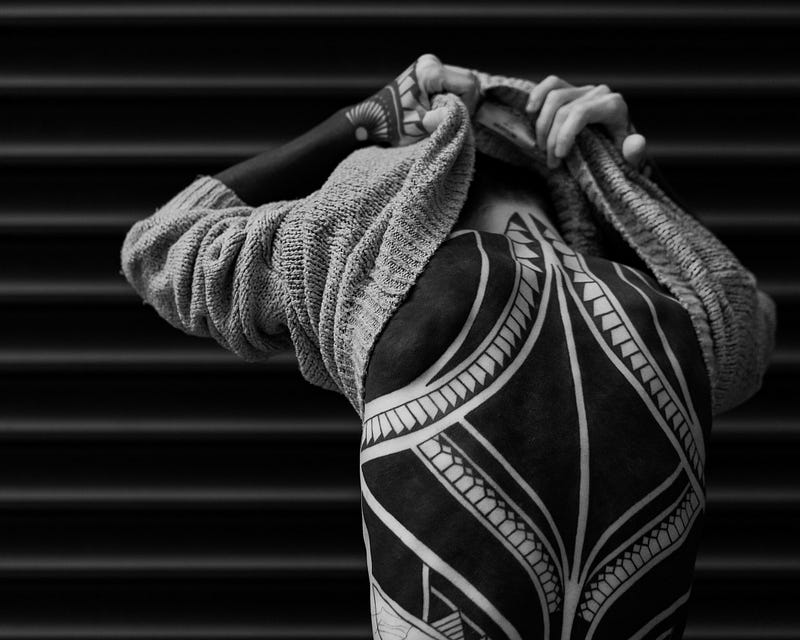
My students often flashed me their tattoos when they discussed their life. “What’s the story behind that one?” I’d ask, knowing full well they’d be eager to tell.
Each design always represented a memory, a moment, a marker of time and experience. Often to connote joy (after an achievement) or loss (separation, break up, to commemorate a dearly departed).
Storytelling plays a big role in my sessions. Students listen intently like they are five-year-olds. The age where reality starts to kick in but there is still an eager home for fantasy. For some, being read to becomes a new experience. For me, regardless of how old they are, each is like my own child. And like a mother, I want them to enjoy every waking moment as opposed to their preoccupation with thoughts of death.
I tell them the story about Veronika. About how the moment Veronika decides to die, she learns to live. Sometimes, all it takes is a doctor (or someone) and a clever deception to remind them that being mad is to be different. And with their tattoos, they are already different. They are already unique, special. If tattoos make them feel seen, then by all means I tell them, find a design that will remind them of joy, hope and strength of heart.
“Miss Natasha, how come you don’t have a single tattoo?” They ask at the end of my session.
“You guys are the yang to my yin. I see my entire stretch of unblemished skin as a symbol of gratitude and mindfulness. My designs are in my head. Each time I see my students and their tattoos, I’m reminded of the work I do and why I do it. I’m reminded of Veronika, of Coelho, of possibilities, of madness, of freedom, of life. I’m reminded of why I too should stay alive, like the day I was born.”