
SELF-AWARENESS
Tarot: A Guide in Your Pocket
Playing with a full deck
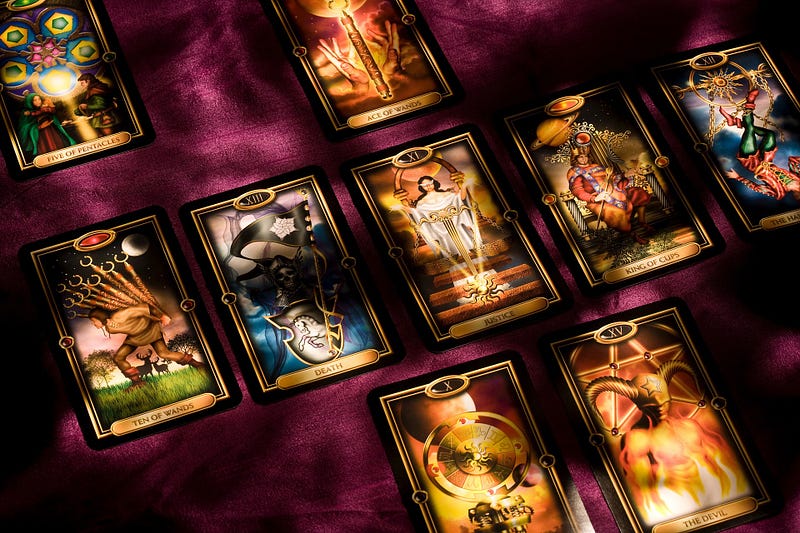
During these times of world pandemic, economic problems, environmental crisis, moral degeneration, spiritless leadership, people are looking for answers and looking for purpose. Facing challenges is nothing new, of course. Although perhaps due to the precariousness of the human race as we continue our descent into what is called the Sixth Great Extinction, there is an urgency to find answers and inner peace.
For many, the answers are not coming from the traditional religious leaders of this country. (See a Pew article on the decline of Christianity in the U.S.)
So, where does one turn for such answers to such questions as to “Who am I?” or “Why am I here?” Every religion, every philosophical system attempts to answer these questions, and all have their answers and validity. However, there exists another way that an increasing number of seekers are returning to these days, and that is the Tarot. A plethora of decks and Tarot books exist today to meet this growing interest.
I first came across the Tarot as a middle schooler in the early 70s. I do not remember too much about it, but my mother recalled me playing with these “strange cards.” I bought my first deck, The Marseille Tarot, in Macy’s of all places.
Why the popularity?
For one thing, the Tarot offers one to grow on one’s own. In this day and age of false religious leaders, cults, and “dollar-centric” therapy sessions and workshops, having a teacher that you can stick in your pocket, offering profound personal insights, is perhaps one of the reasons for its growing popularity.
Also, it is feminine.
This guidance is not based on sequential or rational thought. It connects one to one’s intuitive knowing that, for the most part, cannot be explained rationally. There has been a resurgence of the feminine principle this last century, helping to restore balance by using more of the right side, the intuitive and emotional side of the brain; instead of just the over-emphasized left, the logical side.
The Tarot is a book of wisdom, given in symbols. The left side of the brain, the “masculine” side, communicates via words. While, the “feminine” side communicates through symbols, as is seen through free-flowing poetry, surrealist art, and dreams, among some of the examples.
What is Tarot?
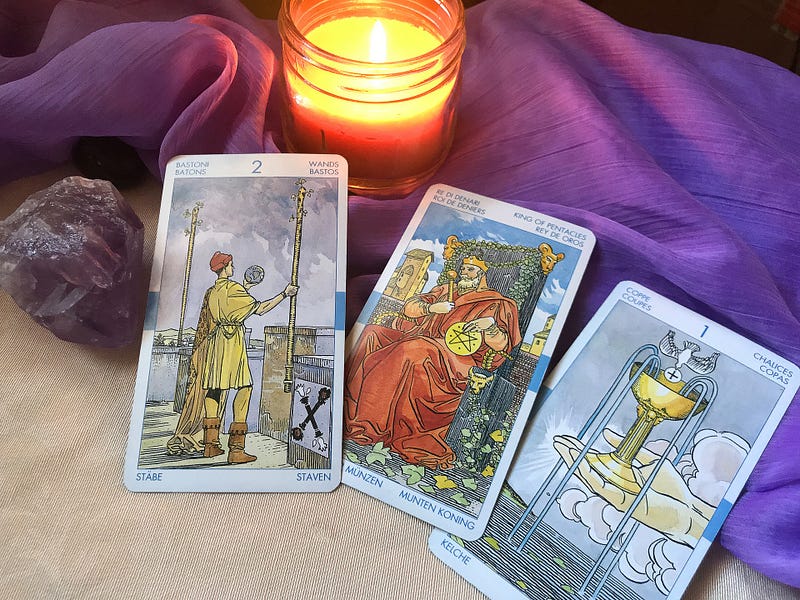
The Tarot consists of 78 cards, 22 of which are called the Major Arcana, Trumps or the Greater Powers, and 56 Minor Arcana or Lesser Powers, each with an image and number.
There is no set definition, no neat little box for the linear mind to categorize, for any card. Decks will come with suggestions for the cards’ meanings, but they are broad enough to allow for personal interpretation.
The 22 Major Arcana represent what Carl Jung, the great psychiatrist and contemporary of Freud, would call archetypes of the unconscious or various expressions of the psyche.
They could also be called a procession of the qualities of the Divine. Like a pantheon of gods and goddesses or saints. These 22 cards contain within them the most profound of teachings.
The 56 Minor Arcana comprises the majority of the deck. These are what is represented in today’s playing cards, barring the missing four Pages. The Minor Arcana contains the four elements one must work with:
- cups symbolizing water;
- rods, fire;
- pentacles or discs, earth;
- swords, air.
Each suit is numbered one through 10, with four court personalities: the Page, the Knight, the Queen, and the King. These cards represent events or arenas that the soul will be encountering, or actual personalities, each with their lessons to be learned, gifts to be gained, and poisons to be avoided.
Beware of authorities of the Tarot, who seek to cage the cards in rigid dogma.
Yet the decks vary so much.
Old-style decks will have simple 2-dimensional images in the Major Arcana and court cards, with the rest of the Minor Arcana being only the number of the particular suit. For example, the Four of Cups will only have an image of four cups in a specific configuration.
Modern decks can consist of exquisite artwork, with intricate images, for both the Major and the Minor. In many, like the Arthurian Tarot or the Alice in Wonderland Tarot Deck, the imagery is of a particular theme.
Whereas most decks will only have words on the Major Arcana, like “Justice,” “The Magician,” some packs, like The Thoth Tarot Deck, will have words, such as “Cruelty,” “Happiness,” “Success,” on the Minor Arcana as well.
I, personally, do not like cards with the qualities printed on them as they lock in the meaning. The meaning of the cards does not just come from the card, per se, but also arrives from the relationship with the other cards.
No deck is more right than another. And all decks are subject to interpretation. Even though a designer of a particular set may have had various meanings assigned to each card (which will be contained in an accompanying booklet with most decks,) it is like a poet who thinks a particular poem means one thing. In contrast, others will see a completely different meaning in it.
The critical issue is what the card or the poem stirs up and brings forth in the reader. There is no dogma, nothing rigid at all about the Tarot. That is why the Tarot is so personal and so feminine. It is fluid. And to get the fullness of the cards, the analyzing must go, this categorizing of the logical mind.
Also, one does not have to go to a reader to receive clarity from the Tarot, despite those who claim otherwise, who claim one should not read for themselves.
True, if one is attached to a specific result, one may interpret one’s reading to show the desired outcome. But this happens only in the realm of fortune-telling, which is the general misperception of the sole function of the cards. When they are used for inner wisdom and guidance, no other interpreter is needed, especially when the cards become more familiar through use.
Beware of authorities of the Tarot, who seek to cage the cards in rigid dogma.
History
The reason why there is no authority (although that’s not to say there are wise ones out there with plenty of experience with the Tarot), is since the Tarot does not follow a lineage. The exact origins of the cards are unknown.
Some say that the roots can be traced back to the East, particularly the Buddhist Tantra system, who used an ancient board game that is very reminiscent of the Tarot, which was then brought westward by the Roma people in the 10th century. Others claim that the cards originated from secret brotherhoods of Egypt, designed for initiates. Others say they found their origins in Europe.
The Tarot, like any book (whether it be holy scripture) or teacher is not there to blindly follow. It’s there to reflect upon, like a mirror; to take its counsel inside and to discriminate between which course to take.
How does the Tarot work, and what are its uses?
To the rational mind, the Tarot makes absolutely no sense. Who would trust a deck of cards, laid out randomly, to offer guidance in any important matter? No doubt, that is the reason why the predominant clients that I have had, as well as readers I have known, are not male; since males tend to be much more linear in their thinking.
However, to those who have come to see the synchronicity (a word coined by Jung) of life, that nothing happens without a reason, that there is a guiding force behind everything, the Tarot makes perfect sense. When the Universe is looked upon as not comprised of independent parts doing whatever they will, but of interdependent parts, then that connection between all things and all action can help explain the process.
For instance, some scientists are finally catching up to the mystics, as quantum physics (although physicists might not apply this meaning to their observations has shown) that no sub-atomic experiment can be objective, that the experimenter’s prejudices influence the testing. That there is no separation between the experimenter and the experiment, between subject and object.
The Tarot might be said to do the same, showing the connection between reader and cards. A reading will show what the reader already knows on a subconscious or intuitive level, being that symbology operates from that realm.
For example, suppose a man deeply desires a particular person. He is consciously aware of this desire. However, he inquires about his chances of fulfilling this desire to the Tarot. Yet the reading’s outcome is the Five of Cups (depicting a sad figure looking down on three spilled cups, while two are full and await ahead of him). Now, unless his desire has so blinded him, his subconscious has communicated to his conscious mind what it already knows and needs. To forget that person and to move on.
What might most rational people (critics, if you will) ask, what would happen if you immediately shuffled the cards? Would they be the same? Most likely not. The next reading may show the complete opposite answer. How can that be reconciled? If one lives by the premise that everything happens for a reason, then both outcomes have validity. Yet, perhaps not in the way the rational mind interprets it.
One of my more enjoyable readings was when a young woman asked about a certain gentleman, and the 8 of Cups appeared in a prominent spot. And along with the other cards pointed to the fact that like the figure in the card, she needed to go on a quest, if you will, and find inner love first.
She was not happy with this advice. So she asked about another male. I reshuffled and pulled out the same card. She began to get upset and then asked about a third. I reshuffled, and voila, the 8 of Cups. She threw down her money, and she stormed off.
The Tarot has many uses, one of those uses, and perhaps its original design is for the reader to know him or herself. The Tarot, like any book (whether it be holy scripture) or teacher is not there to blindly follow. It’s there to reflect upon, like a mirror, to take its counsel inside and to discriminate between which course to take.
Relationships, too, can be assisted through the Tarot, as it is a way of opening up communication. As any relationship progresses, issues will come up that are generally old issues reemerging. The Tarot will reveal what the blockages are and, more importantly, open up discussions. It can be an excellent tool for greater intimacy.
Another use of the Tarot, which is more of its mystical aspect, is meditation. Especially with the Major Arcana, by focusing on a particular card and then taking the image into meditation. The elements that that card represents will gradually come forward. For instance, let us say a woman wanted to bring out more of her intuitive side; she might choose the High Priestess upon which to focus. Or if she wanted more confidence and self-discipline, perhaps the Chariot.
Every quality of humanity, as well as the gods and goddesses, are represented by the Tarot, from the highest wisdom, such as compassion and love, to lowest, greed, aggression, victim playing, etc.
Of course, there is fortune-telling. Many stories exist with a Romany reading the Tarot and making predictions, usually with some dire warning or unhappy ending. However, this focuses on mere events, and the Tarot, unless the reader is very psychic, cannot go into great detail.
Yet, it can be conducive to showing probabilities. Remember, back to those quantum physicists who have now demonstrated that nothing can be predicted with a hundred-percent certainty; there exist only probabilities. The Tarot is no different.
More critical than fortune-telling, the more one delves deeper into the Tarot, one finds that the cards help one to be in the present. After all, one can never get there. Nor leave here.
But perhaps the essential use of the Tarot is that it forces one to take time alone, to turn off all the screens, and to sit quietly and reflect. To get to know oneself, to discover the greatness therein as well as the shadow.
The Tarot is a lot of fun and wonderfully insightful, when we come to it with the attitude and fascination of a child. It reminds us of the adventure we are all on.
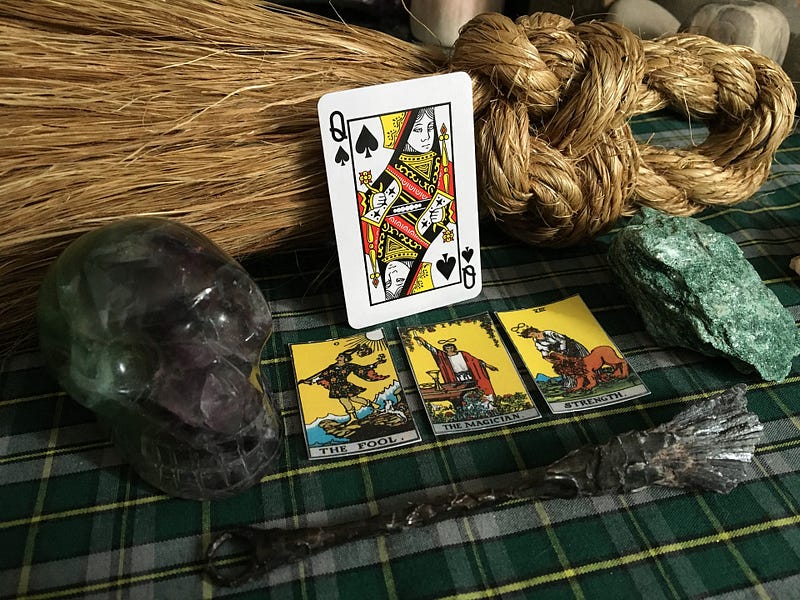
So how do you do a reading?
Simple. What deck attracts you? You might be drawn to a pack because of the artwork, or its theme, its nationality, or ethnic orientation, or period (most decks are European Renaissance in style), or because of its popularity or simplicity. The whole deck may be used or just the Major Arcana.
A layout will be needed to follow, which will designate a meaning for each card position. Booklets that come with the decks or in books on the Tarot contain many layouts. The most common is the Celtic Cross, which consists of ten cards. And of course, once you gain experience, you can create your own.
Some readers will make a prayer asking for higher guidance or will visualize a surrounding white light. At the same time, some readers will sit silently for a moment. Incense can also help prepare for a more receptive mood. Candles can add to the ambiance. In other words, it’s all very personal, and whatever allows you to be silent and open should be used.
Then shuffle. And cut. Many readers are very adamant about how all this happens. Some say one must shuffle with the left hand and cut with the left hand, splitting into three stacks to the left. Again, there is no authority with the Tarot. There is no dogma. Experiment. Do what feels right.
Finally, layout the cards, either face up or face down. Again no set rules. Facedown allows one to concentrate on each card more, while face-up will immediately show the overall pattern.
Once you place the cards, the interpretation commences. Most will want to use the supplied booklet or another book to use for interpretations. However, this method is only a continuation of the left-brain learning process that we are conditioned from an early age, that is, memorizing someone else’s ideas. Looking at other’s ideas has its place, but it doesn’t allow for utilizing your intuition when books are the source of inspiration. To be inspired is to be filled with spirit, and that comes from within.
My first Tarot teachers did not allow me to look at a book. They told me to trust in my imagination and my words.
If you are looking for counseling, meditation, or clarity, all that is needed to know in the beginning are the various elements of the suits. For example:
- cups represent water, emotions, love, imagination, dreams, and delusions;
- swords represent air, the mind, discrimination, communication, learning, cutting away and conflict;
- rods represent fire, creativity, spirit, spontaneity, passion, and forgiveness;
- pentacles represent earth, money, survival issues, health, and work.
If the cards are expressive, like the Hanson-Roberts Tarot Deck, the characters’ expressions will help supply the answers. They will come alive and communicate on a feeling level.
Keep it simple, for truth is simple. At the onset, be like a child. The more you work with the cards and do not expect great revelations in the beginning, you will not need to rely on books and readers. Then if the desire persists, add onto the initial experiences with more studies about the Tarot, as well as perhaps astrology, numerology, the Cabbalah, psychology, symbology, myths, whatever else you want. The Tarot is flexible enough to work with nearly any path.
The Tarot is a lot of fun and wonderfully insightful when we come to it with the attitude and fascination of a child. It reminds us of the adventure we are all on. And when each card is seen as sacred and treated with respect, then those who come into our lives, and who embody those energies of the Tarot will also be seen and treated as sacred, no matter if he or she takes on the role of “The Devil” himself.
After all, you want to play with a full deck, yes?
Thank you for taking the time to read this article. The following are some other insightful (or so I hope) articles for your perusal.
Visit my Author Page. You can view my artwork on Pinterest. You can follow me on Facebook.