
Tarantino’s Homage to 1960s Hollywood is Bold, Beguiling, and a Bit Problematic: Film Review
[Warning: The following contains spoilers of a film currently in wide release. Read at your own risk.]
A very brief history of Quentin Tarantino and Once Upon a Time … in Hollywood
The wildly eccentric and visionary filmmaker Quentin Tarantino was born in 1963 in Knoxville, Tennessee. Movies and television dominated his formative years. He was named after Burt Reynolds’s character from the CBS Western Gunsmoke. His father worked as an actor and producer. Following their divorce, his mother moved him to Torrance, CA (just south of Los Angeles) and indulged his love of movies by taking him to countless screenings. He dropped out of high school and held a number of jobs throughout his teens and early twenties, including usher at a porn theater and manager of a Manhattan video store. By the late 1980s, he had gotten his start in Hollywood, writing and directing short films and small acting roles like his turn as an Elvis impersonator on a 1988 episode of NBC’s classic sitcom The Golden Girls.
In 1992, he got his big break with the opportunity to write and direct Reservoir Dogs, a micro-budgeted heist film that he co-starred in alongside the likes of Tim Roth, Steve Buscemi, and Michael Madsen. The warm response to that film paved the way for what was certainly his breakthrough and arguably still his greatest film — 1994’s Pulp Fiction. With an impressive cast that included John Travolta (in his comeback role), Samuel L. Jackson, Uma Thurman, and Bruce Willis, the film won the prestigious Palme d’Or at the Cannes Film Festival, became the first independent film to gross $100 million at the U.S. box office, was named one of the 100 greatest American films of all time by the American Film Institute, and was nominated for 7 Oscars (including Best Original Screenplay, which it won). During the mid-1990s, Tarantino also wrote the screenplays to such notable films as True Romance (1993), Natural Born Killers (1994), and From Dusk Til Dawn (1996).
By the late 1990s, Tarantino was a household name. His eccentric personality and distinctive cinematic style were the source of much critical dissection and satire. Between 1997 and 2007, he wrote and directed four films — each of which had their fair share of admirers, but none of which came close to reaching the heights of Pulp Fiction. They were Jackie Brown (1997), Kill Bill: Volume 1 (2003) and Volume 2 (2004), and Death Proof (2007). His triumphant return to critical and commercial glory came with 2009’s WWII-era fantasy thriller Inglorious Basterds, which grossed $321.5 million worldwide and was nominated for 8 Academy Awards (winning one for Christoph Waltz’s brilliant turn as a Nazi colonel). Three years later, he followed with the hugely successful Western Django Unchained, which grossed $425.4 million and scored 5 Academy Award nominations. In 2015, he released the decidedly less well-received The Hateful Eight, which — despite its tepid critical reception and allegations of misogyny and racism — managed to gross $155.8 million and was nominated for 3 Academy Awards (winning one for Best Original Score).
For his 9th film (or 10th if you count the two-part Kill Bill as two separate films), Tarantino announced that he was taking on 1960s Hollywood. Specifically, he was going to tell a story surrounding the 1969 Charles Manson murders that claimed the lives of many, including Hollywood ingenue Sharon Tate. He assembled an A-list cast that included Leonardo DiCaprio (in his first lead role since he won the Best Actor Oscar for 2015’s The Revenant), Brad Pitt, and Margot Robbie. He incited a bidding war among studios for the big-budget film, which eventually landed at Sony and was given the release date and advertising campaign of a summer tentpole.
What Works in Once Upon a Time…:
The setup. Tarantino’s legendary love of movies and television has played a prominent role in virtually all of his films, so it is actually shocking to me that it took him so long to set one of his films fully in Hollywood. His passion for (and knowledge of) the time and place in which the film is set seeps into every frame of the film. Furthermore, there are few more compelling periods in Hollywood history to chronicle than the late 1960s, when the industry was undergoing a massive transition that was reflective of profound social and political turmoil in the nation.
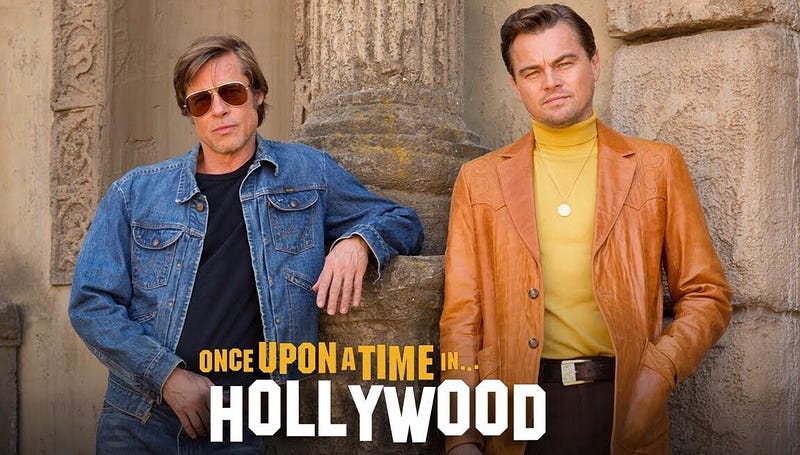
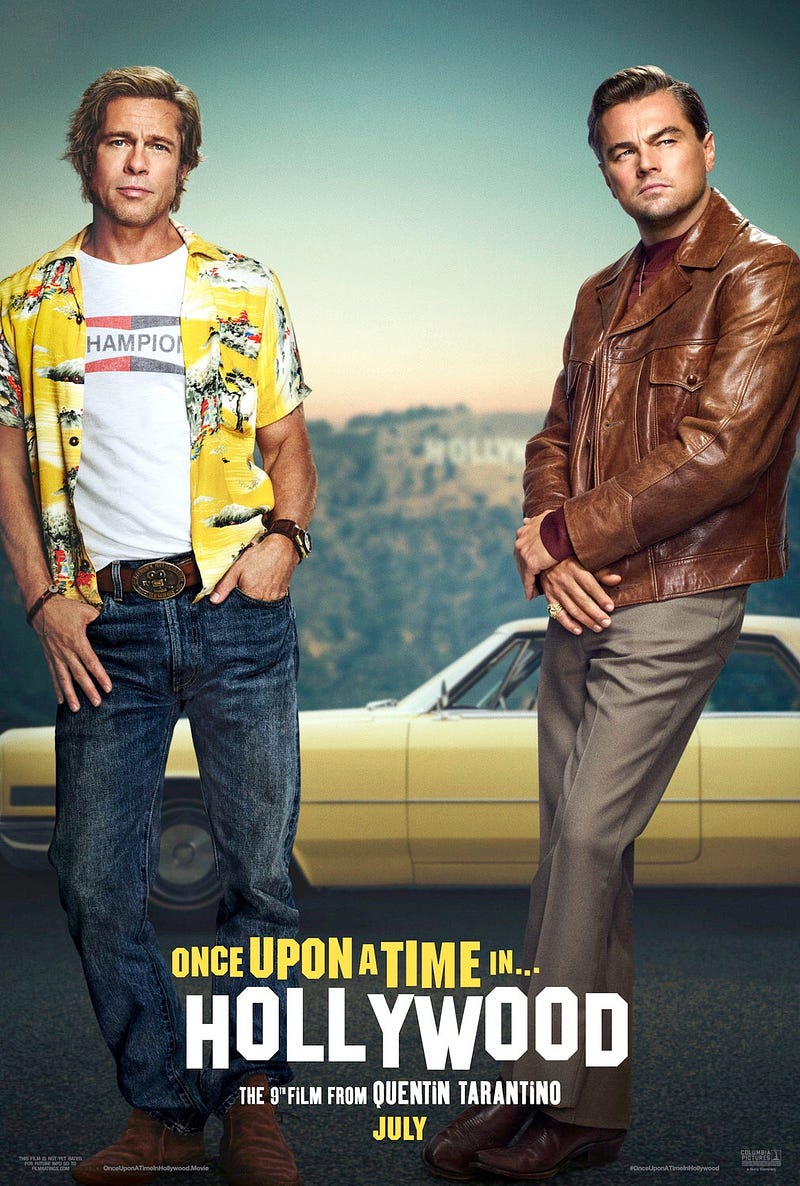
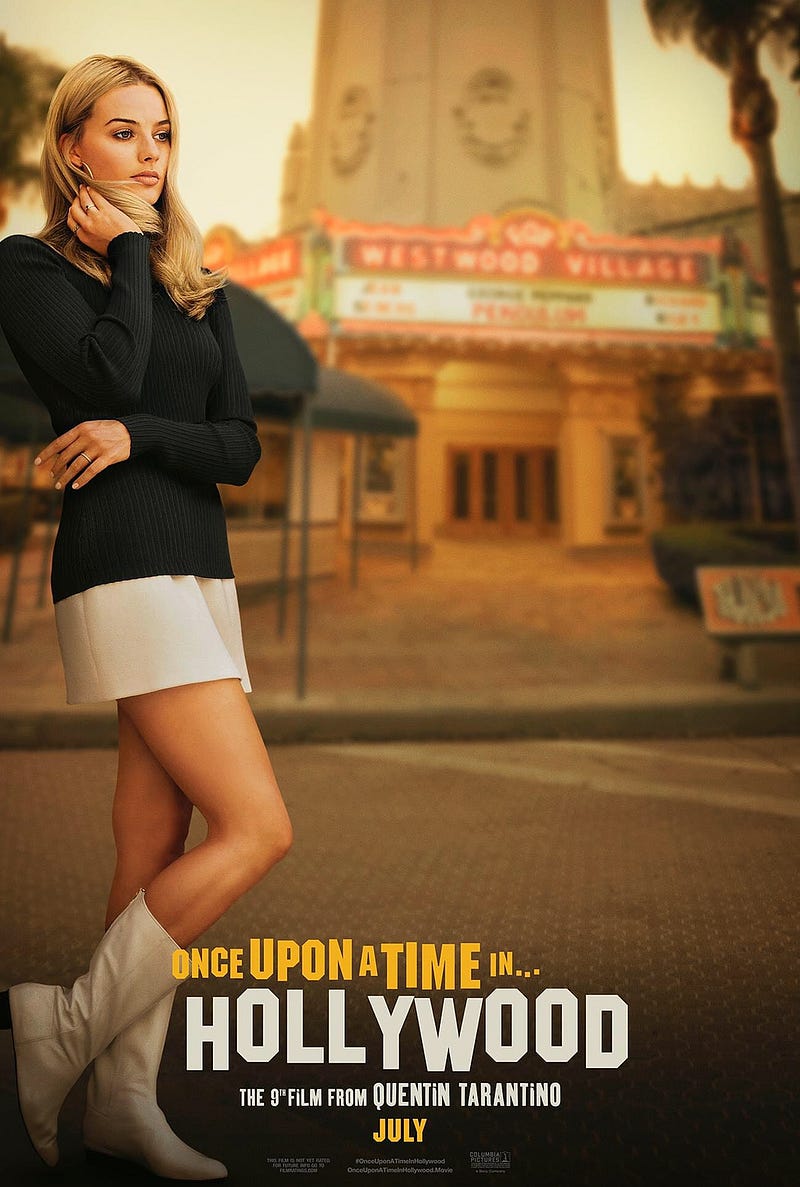
The performances. As fading 1960s Western star Rick Dalton, DiCaprio turns in another tour de force performance that (further) solidifies his status as one of the greatest actors of his generation. He flawlessly navigates the various gimmicks and meta-moments Tarantino puts his characters through (e.g., cutaways to past acting projects, lots of scenes of getting into character.) It is a surprisingly emotional turn for a Tarantino film; perhaps not since Uma Thurman in Kill Bill has a Tarantino character been imbued with such vulnerability. In stark contrast, Brad Pitt plays Dalton’s stunt man/chauffeur/best friend Cliff Booth with an exceedingly entertaining playfulness. It is his finest — and certainly most vivacious — screen performances in ages. As for Margot Robbie as Sharon Tate, she does magnificent work with precious little screen time and dialogue. (The film is arguably as much about Sharon Tate the person as Inglorious Basterds was a film about Adolph Hitler, but more on that later.) There is an extended sequence in which she goes to a historic theater in Westwood Village to watch herself on the big screen that she nails superbly. In supporting roles, Kurt Russell, Al Pacino, Bruce Dern (in a role intended for Burr Reynolds that could not be completed before his death), Emile Hirsch, Dakota Fanning, Luke Perry (in his final film role before his untimely death), Austin Butler, and Timothy Olyphant all turn in solid work. But the standouts are undoubtedly Julia Butters and Margaret Qualley as two precocious young women with loads of confidence and charisma (the former a child actress and the latter a member of Manson’s harem).
The major scenes. In addition to the Sharon Tate movie theater scene referenced above, there are at least three scenes that rank with Tarantino’s finest work. One is DiCaprio and Butters on the set of the short-lived TV Western Lancer, which features captivating acting and is one of the only times in the film that the dialogue truly sparkles (more on that below). Another is the lengthy sequence at Spahn Movie Ranch, the Manson gang’s homestead that Cliff stumbles upon. It is nerve wracking, expertly paced, and profoundly disquieting. And finally, as to be expected in a Tarantino film, he nails the wildly violent climax. The massacre that ends the film is a genuinely jolting, satisfying, bloodbath that ranks with Tarantino’s best.
What Doesn’t Work in Once Upon a Time…:
The overall pacing. With four particularly notable sequences occurring over the film’s sprawling 161 minute running time, what we get is a lot of filler. We get whole scenes devoted to how cool and beautiful Brad Pitt is (and he certainly still is at age 55), how cute his character’s dog is, the various projects Rick Dalton has done throughout his career, and the comings and goings of Sharon Tate and her famous friends. None of them are bad scenes per se, but many of them are either unnecessary or unnecessarily long. They don’t provide enough that is notable in terms of plot, entertainment, or aesthetics to justify their existence. (Perhaps were it not for the untimely death of his long-time editor Sally Menke, his most recent films would have been much cleaner and leaner.)
Much of the dialogue. The uncharacteristic restraint Tarantino brings to this screenplay should be acknowledged and encouraged, as it shows a willingness to move outside of his comfort zone and an orientation toward more mature subject matter. Unfortunately many exchanges fall noticeably flat. The highly stylized, rapid-fire dialogue and emotional monologues that traditionally dominate Tarantino’s screenplays are largely absent here and in their place is some exceedingly ordinary screenwriting. It is so bizarre to me that he chose his 1960s Hollywood-set fairy tale to try his hand at more restrained writing.
Tarantino’s regressive vision. Tarantino’s previous films have garnered significant criticism for their gratuitous violence, liberal usage of slurs (particularly the “N” word), and focus on violence committed against women. I have always been reluctant to join the chorus of his detractors because overall I have found his filmography to feature multiple examples of strong female and minority characters and I have usually felt that Tarantino’s views of good and evil are genuinely aligned with mine. However, there are several complicated elements in the film that gave me pause. First, is the de-emphasizing of Sharon Tate in the story. She is not exploited or victimized in the film but she is largely dismissed, treated as a one dimensional ingenue. Second is the bizarre throwaway subplot in which it is revealed that Cliff very well may have killed his wife. The accusation is hurled midway through the film, seemingly confirmed in a flashback, and then completely dismissed. It seems like either a blatant minimization of violence against women or an artifact of a sloppy editing process (or both). Further underscoring the issues with women is how our hero, Rick Dalton, idolizes Tate’s husband Roman Polanski, the infamous director whose rape allegations precede the #MeToo era by decades. And it is not just women that are curiously marginalized in the film, but people of color as well. The only notable non-white character is martial arts legend Bruce Lee (played by Mike Moh) who is depicted as an arrogant attention whore with a fragile ego. None of these elements lead me to believe that Tarantino is a misogynist or a racist, but they seem to play right into the hands of those who do. Ultimately, his fairy tale of the “golden age” of Hollywood is one where white heterosexual men are gods, hippies are dirty criminals, women are accessories, and minorities are punchlines. In a way, it is hopelessly predictable and regressive.
Final Words and Oscar Prospects: Of course, it is premature to discuss this film’s actual Oscar prospects given that the vast majority of likely contenders have not even reached theaters yet. But I can speak to what I think it deserves. I would nominate DiCaprio and Pitt in Best Actor and Best Supporting Actor, respectively, and would give it nominations for Art Direction, Costume Design, and Sound Mixing. But there’s another variable that comes into play besides the quality of the other films in Oscar contention — whether I still feel the same way about the film that I do now at the end of the year. Even in the 36 hours since I left the theater, I find myself oscillating between admiration and irritation, grappling with questions about why Tarantino included some things and excluded others, and replaying key scenes in my head. Perhaps it is a film that you cannot truly assess upon a single viewing.
Rating for “Once Upon a Time … in Hollywood”: 4/5 stars


