avatarMichael Haupt

Summary

The website content provides an overview of various talks on the differences between the left and right brain hemispheres and explores the impact of these differences on human behavior, culture, and society.

Abstract

The content outlines a series of presentations by experts such as Jill Bolte Taylor, Ian McGilchrist, and Robert Sapolsky, discussing the distinct functions of the brain's hemispheres and their influence on our actions and societal development. It highlights the profound insights gained from personal experiences, like Taylor's stroke, and the broader implications of brain lateralization as discussed by McGilchrist. The talks delve into the transformation of the brain during adolescence, the interplay between our compassionate and violent tendencies, and the potential for creating a more advanced and harmonious society. The content also includes multimedia elements such as images and embedded YouTube videos of the talks, providing a rich, educational experience for viewers interested in neuroscience and psychology.

Opinions

  • Jill Bolte Taylor's personal account of her stroke provides a unique perspective on the loss and recovery of brain functions, emphasizing the brain's role in shaping our identity and connections with others.
  • Ian McGilchrist argues that the divided brain has significantly altered human behavior and culture, suggesting that the hemispheres contribute differently to our perception and interaction with the world.
  • The content suggests that understanding the teenage brain's neurological transformation is key to comprehending the behavior, feelings, and thought processes of adolescents.
  • Iain McGilchrist is portrayed as a proponent of viewing the mind and brain within the context of our entire physical and spiritual existence, as well as the broader culture that shapes and is shaped by them.
  • Robert Sapolsky's research into the biology of our behaviors is presented as a way to reconcile our capacity for both compassion and violence, examining human actions across various timescales.
  • The website concludes with an invitation to explore "Postcards from 2035," a series envisioning an ideal future society, and promotes an AI service, ZAI.chat, as a cost-effective alternative to ChatGPT Plus (GPT-4).

Talks on the Differences Between Left & Right Brain Hemispheres

and how societies are shaped by a divided brain
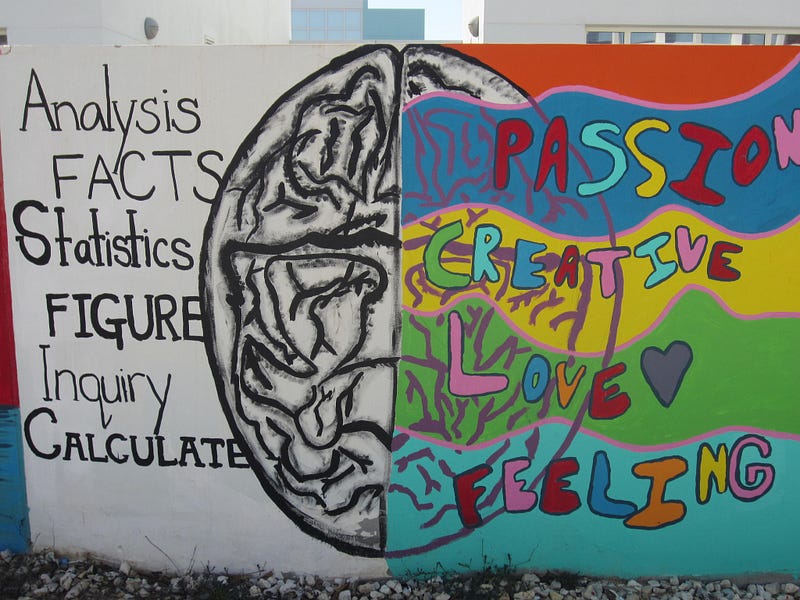
A wall mural in Bahrain, courtesy ccarlstead

2008 — Jill Bolte Taylor

Neuroanatomist Jill Bolte Taylor had an opportunity few brain scientists would wish for: One morning, she realized she was having a massive stroke. As it happened — as she felt her brain functions slip away one by one, speech, movement, understanding — she studied and remembered every moment. This is a powerful story about how our brains define us and connect us to the world and to one another.

2010 — Ian McGilchrist

Renowned psychiatrist and writer Iain McGilchrist explains how our ‘divided brain’ has profoundly altered human behaviour, culture and society.

2013 — Jill Bolte Taylor

Our brain is made up of cells and every ability we have is the product of those cells. What is going on during our teenage years that accounts for the way teenagers feel, think and behave? This presentation focuses on the neurological transformation of the brain that occurs during the teenage years:

2014 — Ian McGilchrist

Iain McGilchrist is committed to the idea that the mind and brain can be understood only by seeing them in the broadest possible context, that of the whole of our physical and spiritual existence, and of the wider human culture in which they arise — the culture which helps to mould, and in turn is moulded by, our minds and brains.

2017 — Jill Bolte Taylor

Enjoy this updated, unedited chat with Jill Bolte Taylor in 2017:

2017 — Robert Sapolsky

How can humans be so compassionate and altruistic — and also so brutal and violent? To understand why we do what we do, neuroscientist Robert Sapolsky looks at extreme context, examining actions on timescales from seconds to millions of years before they occurred. In this fascinating talk, he shares his cutting edge research into the biology that drives our worst and best behaviors.

You made it to the end! Have you come across Postcards from 2035? It’s a series of profoundly simple interlinking ideas describing life in a highly desirable society, where everything and everyone is advanced, happy, intelligent and problem-free. It’s a blueprint of the world we need to co-create. Join us.

Brain
Evolution
Empathy
Consciousness
Future
Recommended from ReadMedium