
Take Two Tablespoons of Dried Milk…
How an ancient recipe brought comfort in a time of grief
When my mother died a few years ago, lost in the fog of Alzheimer’s, I felt pretty fogbound myself.
I’d fallen out with my older sister over a myriad of issues concerning Mum’s care, my work as a freelance print journalist had gone down the internet drain, I lived alone in a fixer-upper destined never to be actually fixed up, I was partner-free, and my ambitions to be a published novelist had gone precisely nowhere.
And now my mum, my biggest supporter, my rock, my champion, was gone.
After the funeral in Scotland, I flew back to my home in upstate New York in a state of profound grief over what felt lost forever.
A few days later, several large boxes arrived from my sister in Scotland—my share of Mum’s belongings.
Among the items I inherited, along with her bone china tea service and umpteen tea towels depicting Scottish inventions and heroes, was her collection of recipe books, though none were exactly collectible items in the culinary canon.
They ranged from the mandatory (to a Scot) Dundee Homecraft Book (haggis anyone? “Take one sheep’s pluck”) to wartime relics like The Housewife’s Book (“housekeeping is not as straightforward as some people imagine…”), and assorted tomes about Scottish cuisine (no, that’s not a non sequitur).
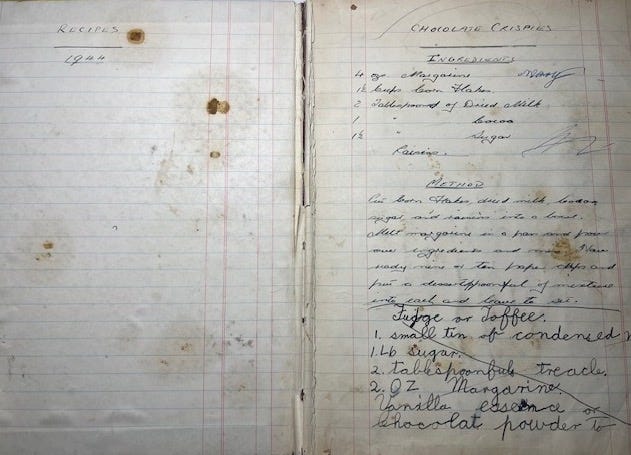
My favorite was the handwritten recipe collection she started in 1944 in a requisitioned accounts book. Rendered in elegant, cursive loops, her words glided across yellowing, blue-lined, satiny pages via the conduit of a fountain pen.
Brown splodges testified to the popularity of certain recipes, acting like gold stars in the firmament of family favorites.
Just the silky feel and musty scent of the pages aroused tactile longings for times gone by and food experiences so different from my own.
They transported me back to the house and street where we lived in Aberdeen, Scotland, known to everyone as “The Terrace,” and to a time when several generations lived under one roof. Back to a time when lives were contained within a five-mile radius that offered all the necessities including friends and family, shops, schools, churches, as well as my stonemason father’s workplace in a granite yard, to which he walked daily.
With Mum gone, I’ll never know exactly when in 1944 she recorded that first recipe for chocolate crispies, the crunchy, gooey, cocoa concoction that become my favorite as a child, but I like to imagine it was June 6, 1944— D-Day.
World War 11 had been raging for almost five years, and my 26-year-old mother was eight months pregnant with my older sister Norma.
At 7:15 am on that day across the English Channel in Normandy, my father, a combat engineer in the British Royal Engineers, was landing on Gold Beach to deactivate German mines. From there, his regiment would head north to build temporary Bailey bridges replacing those blown up by the Nazis, and to pave the way for the Allies advance north through France to Belgium and Germany.
All of which the family would learn about, like the rest of the UK, from listening to the BBC Home Service on the wireless.
By June 6, Mum had given up driving the ambulance that was part of her wartime Civil Defence duties but still walked two miles daily to her photo-processing job in a photographer’s office.
She was the family’s chronicler of events, and I picture her scribbling away at the table in the huge, bustling downstairs kitchen, pausing to stare out the window at the back garden, wondering what her husband was doing across the Channel in Normandy.
The rest of the Forbes clan swirled around her. Older sister Hetty was already a war widow with three kids under six, thanks to a Nazi bombing raid on Aberdeen. Mum’s 22-year-old brother, Arthur Jr., was ineligible for war because of a stomach ulcer, and drove a long-distance lorry.
Her father, my Grandpa Forbes, operated a bookies office, and fielded runners to take the bets, even in wartime.
Presiding over it all was matriarch Grandma Forbes — indomitable at five foot two and almost as wide, in a wrap-around apron, a halo of metal hair curlers, and never without a dishtowel in her hand — based on the theory that there were always dishes to be dried. A dog, cat, and two budgies completed the family portrait.
To my mother, recording recipes for posterity and cooking for an extended family must have offered a form of comfort and control in a world gone mad, as well as demanding a triumph of resourcefulness and ingenuity over the realities of war-time food rationing.
I can smell the phenols from the ink in her fountain pen competing with the muttony odor from a pan of Scotch broth simmering on the cooker, mixing with coal fire fumes and smoke from grandpa’s cigarette.
I can hear kids shrieking, a dog barking, budgies chirping, and Grandma’s reprimands to some unfortunate infant, animal, or husband.
Outside, squawking gulls competed with the occasional wailing air raid siren — signaling everyone to evacuate to the cellars or air raid shelters.
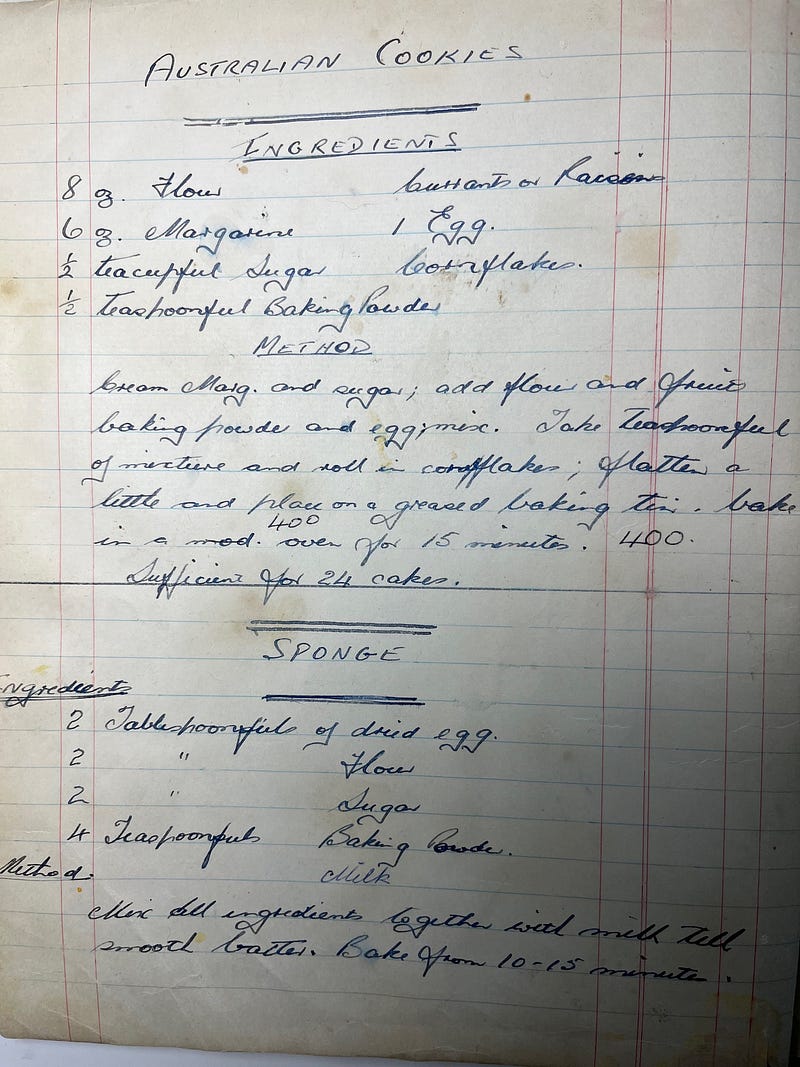
After chocolate crispies came Australian cookies — made out of dough and cornflakes; then queen cakes, sponges decorated with desiccated fruit; gingerbread; ginger snaps; cheese scones; shortbreads and puddings galore, including Eve’s — stewed apples topped with chewy sponge cake; clootie dumpling (made with suet, currants and raisins, with mixed spices and molasses, then boiled for hours in a cloth); and umpteen soups and main courses.
With so many cake and pudding recipes, you’d think the family would be waddling tubs of lard. But rationing took care of that. The Scottish diet back then was relatively healthy—unprocessed, locally produced, and pesticide-free.
Plus, the back garden produced harvests of potatoes, carrots, peas, turnips, cabbage, strawberries, blackberries, and raspberries. Wartime families were locavores without even knowing it.
After the war, Dad got demobbed in ’47 and met his daughter for the first time. By the time I arrived in the 1950s, Mum’s siblings had left The Terrace for new lives but because houses were scarce, we continued to live with Grandma and Grandpa in their giant house.
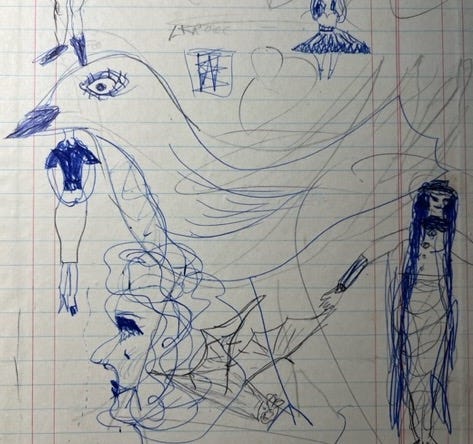
As soon as I could hold a lethal weapon, i.e., a pen, I decorated the recipe book with drawings of busty, bearded women pushing prams, and umpteen drawings of houses, cats, and dogs. My childish script recorded recipes for fudge, while my sister’s jaunty hieroglyphics logged sweet and sour pork.
Rereading these recipes from long ago, made me long for the comfort they once brought, and helped me remember who I was and where I came from. My Mum might have been gone but her spirit lived on in this recipe book.
On a whim, I decided to make a batch of chocolate crispies using Mum’s 1944 recipe — even though substituting liquid milk for dried milk would change its consistency. The results did not disappoint: I managed to recreate the sublimey gooey-crunchy-chewy taste explosion I remembered.
So what if the mixture didn’t congeal how it was supposed to, my Proustian moment was complete.
Who’d have imagined that this mix of butter, cornflakes, cocoa, sugar, raisins, and milk would bring me comfort at a time when I needed it most.
Next up: Australian cookies.
Thanks for reading!


