
Politics
Taiwan Fears the Tyranny of China as It’s Bossily Abusing the Rising Power Asymmetry with the Island.
The US can use its power to save the regional architecture of East Asia; however, would meddling with China’s core issues be without consequences for America’s national interest?
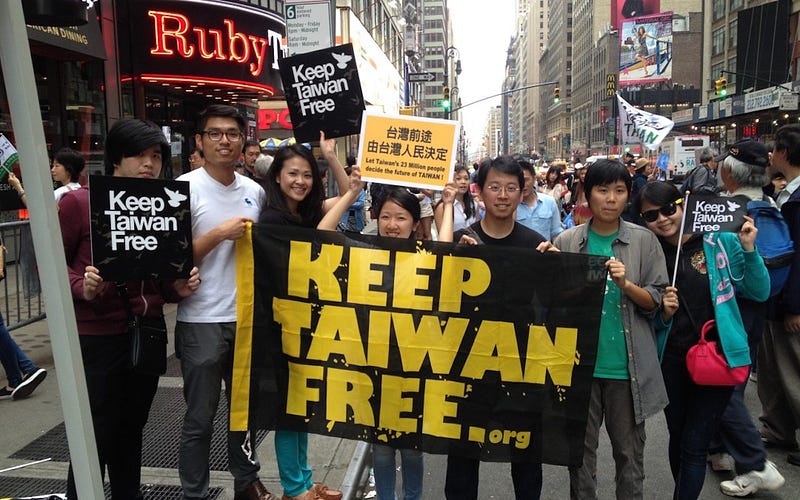
Most people are bewildered by Taiwan — by its troubled history, glorious present, and uncertain future. It is one of those places in the world sitting on a military volcano that can erupt at any time. Yet, it has an alive and kicking democracy with a booming economy and a good standard of living. They have come a long way since 1945, after the civil war ended. Their evolution to present-day Taiwan consisted of overcoming ethnic tensions between the “native Taiwanese” and “mainlanders” and focusing on people’s rights, freedom, and democracy in general. Since 1996, their most significant issue has been the division between those who want Taiwan’s independence and, on the other hand, those who are pro-China. The former group views Taiwan as an independent and sovereign nation and considers the “one-China policy” as just the residue of their colonial days.
Taiwan is diligently trying to retain its identity despite being intensely pressurized by China to surrender its position and become part of the People’s Republic of China. They have a firm conviction that they would be able to defend their country, and if required, other nations would support them too in protecting their cause. In these uncertain times, the optimism comes from the fact that they are democratic, and it’s ineluctable for democratic countries not to support Taiwan in fighting for the same, at least verbally. All the more true when the world is actively engaged in taking every possible measure to address China’s rising influence.
China has been intimidating Taiwan into acceding to its demands, which is to take control of the island. The military stalking of China, over the last few years, has ramped up due to many reasons, two of them being: 1. It is now adequately capable of doing so. 2. It wants to indicate to the world from the position of strength that it won’t be browbeaten when it comes to its core national interests, and interfering with it may only make matters severe.
At the freediving world championship in Cyprus last month, the Taiwanese flag was abruptly removed from the leader board at one of their contestant’s turns. The incident illustrated China’s unreserved intentions to arrogate the island of Taiwan to itself and protect its alleged national interest. Organizers of the event later apologized to Taiwan, citing their unpreparedness as the reason for not correctly handling political interference from China.
China also has a strong lobby at the UN, and it makes sure it collects enough allies to beat Taiwan’s request to be given a seat at the UN. Though supporting China in its authoritarian ambitions would clearly put the member-states and China in defiance of Article 1 of the United Nations charter that calls for peaceful resolution of international disputes without any breach of peace, still, there is no stopping China from advancing militarily towards Taiwan.
Taiwanese people realize the strategic significance of their country and that they are increasingly becoming just another game between America and China, and also others. Brooking institution conducted a poll in 2021 and concluded that Taiwanese are entirely aware of the military danger China poses to their land and lives, and they do see them coming at war with China. However, this does not stop them from living their lives.
China-Taiwan relations have deteriorated further in recent years, especially since the current president Tsai Ing-wen was first elected in 2016. She recently and very aptly mentioned, “when authoritarian regimes demonstrate expansionist tendencies, democratic countries should come together to stand against them. Taiwan is on the front line.”
The US does not formally recognize the sovereignty of Taiwan, and similarly, no other western nation like Germany or Britain does. The show of solidarity with Taipei is mainly to continue supporting it to defend itself and stand united against China, more than anything else.
So far, there has been doubtfulness as to whether the US would ever intervene militarily in matters concerning China and Taiwan. Biden seemed to have indicated a change in that stance which later on was cleared off by the white house official saying that there is no change in the US policy regarding Taiwan, and it still acknowledges “One China Policy.”
Britain has also opposed China’s military advancement in Taiwan, calling it “unwise” to shake the entire region. Upon being asked regarding China, British Defense Secretary told reporters at Brussels, “You’re in danger of destabilizing the region; you’re in danger of provoking further conflict in other disputed areas.”
The discreetness and ambiguity in America’s stand on Taiwan have not only made Sino-American relations more complicated, but it also raises an important question on America’s commitment to democracy. Moreover, it increases the apprehensions of Taiwanese people as they are well aware of the role America can play in their struggle against China.
Should America’s Taiwan policy be in consonance with the principles of democracy and human rights or shall it only support Taiwan to the extent of making them capable of fighting its own war??
It is too idealistic to desire that the US shall disdain all the rules of Machiavellianism/realpolitik to support Taiwan against China, particularly when China has already been cheesed off by the strengthening of the bond between the US and Taiwan under Biden and Trump.
As the power equation between Taiwan and China is becoming increasingly unequal, it would be in the best interest of Taiwan to remain within the orbit of mutual persuasion with China. At the same time, it needs to intensify its critical relationships like one with the US to feel less vulnerable under the given circumstances. It would be suitable for Taiwan to negotiate with China with an open mind considering China’s capability to call the shots in any equation. It has to have a strategy defining its goals and “possible compromises.” There is no place for complacency; Taiwan has to try everything to maintain the status quo if they wish to escape unification with China, including doing well economically and politically. Most importantly, they need to strengthen their military capacity, which can bring a sense of national security amongst its citizens as well as lasting peace over the Taiwan Strait.
I will close the write-up with the apt words of Wu Rwei-ren, a Taiwanese historian at the Academia Sinica. He defines “the cries of Justice” by the Taiwanese people as “the voice of people who have been striving hard to prove that they are not only free but also worthy of being free.”
References
1. Bush, R. C., & Brookings Institution. (2013). Uncharted strait. Washington, DC: Brookings Institution.
2. In Lee, S., & In Williams, J. F. (2016). Taiwan’s struggle: Voices of the Taiwanese.
3. Brook, T. (2020). Great state: China and the world.