Table Salt vs. Sea Salt
A closer look at Jillian Michaels’ claim that regular table salt is healthier than sea salt
I recently watched a video that Jillian Michaels has on Instagram and IGTV in which she claims that regular iodized table salt is better for us than sea salt.
Jillian Michaels: The truth about Himalayan Sea Salt
As someone who boasts a cupboard full of sea salt, Himalayan salt, Kosher salt, black salt, and regular iodized table salt, I was intrigued by her claim. So, I decided to do a deep dive and get the scoop on this different way of looking at this common condiment.
Claim One
Salt has some health benefits
I may sound a bit naïve here, but I wasn’t fully aware that salt had any health benefits. All I have ever heard is that we need to cut our salt consumption because it is so unhealthy for us.
Apparently, Jillian is correct on this claim. According to an article I read in the Washington Post¹, sodium is necessary to prevent dehydration, it helps our cells function, and is needed for proper transmission of nerve impulses. It may even also help reduce stress and calm us down a bit.
Jillian also mentions the daily recommended requirement of sodium intake is generally around 2,300 milligrams per day, dependent on a variety of factors. The American Heart Association² somewhat agrees with her. The AHA does say that 2,300 milligrams is what is recommended now, but they are leaning more towards 1,500 milligrams per day to improve blood pressure and heart health.
Claim Two
The minerals in other salts are negligible
I personally have heard and read numerous times about the supposed benefits of the minerals found in other salts that are not available in iodized table salt. In Jillian’s video, she states that the amount of trace minerals in sea salt are insignificant and negligible.
I had to research this more myself! And yep, Jillian is correct again.
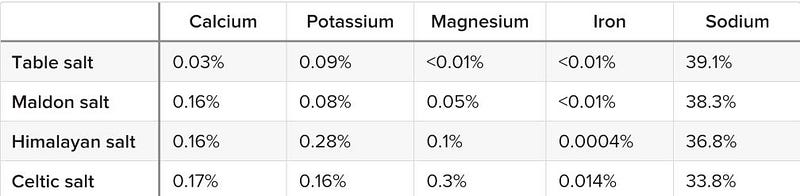
According to an article at Healthline.com³ that I read, the amounts of minerals found in some of the different varieties of salts she mentioned are inconsequential, as you can see in the chart above.
…the mineral content of the various salts is far from a compelling reason to choose one salt over another. These levels are negligible compared to what you obtain from food. — Healthline.com
In addition, ScienceBasedMedicine.org⁴ states that “…only about a quarter of the minerals in Himalayan pink salt are nutrients that the human body can or might be able to use. The other three quarters are not recognized nutrients and would be better classified as contaminants. They have no known health benefits, and many of them are known to be harmful.”
Claim Three
There are unhealthy things unintentionally added to sea salt from our oceans
When Jillian mentions different types of “things” that may be in sea salt from the ocean, it made sense but wasn’t something I really wanted to hear. Sadly, she is correct this time as well.
Both Healthline.com³ and the Guardian.com⁵ state that microplastics are found in sea salt more prevalently because of the excessive amounts of plastics found in our oceans.

Yet another reason why we need to clean up our oceans. But that is a story for another time, so I digress…
Claim Four
The iodine in regular table salt has health benefits
I have seen the two different types of salt in the grocery store — regular salt and iodized salt. However, I never really pondered the difference or considered that the latter may have additional health benefits.
Once again, Ms. Michaels is correct. As reported by the National Institutes of Health⁶, our bodies require iodine to form thyroid hormones. These hormones help control our metabolism, plus they aid in proper brain and bone development during pregnancy and infancy.
There are quite a few issues that can result from an iodine-deficiency, including:
- Issues with fetal and infant development
- Issues with cognitive function during childhood
- Fibrocystic breast disease
- Radiation-induced thyroid cancer
To sum this all up, pretty much everything Jillian Michaels claims in her video⁷ is true. Regular, iodized table salt is healthier (and cheaper!) for us than sea salt. Looks like I need to go and clean out my salt cupboard and stop wasting money on the fancy salts!
Sources:
- https://www.washingtonpost.com/national/health-science/we-eat-a-lot-of-salt-but-scientists-say-there-are-good-reasons-for-that/2015/05/04/69ff7058-c806-11e4-a199-6cb5e63819d2_story.html
- https://www.heart.org/en/healthy-living/healthy-eating/eat-smart/sodium/how-much-sodium-should-i-eat-per-day
- https://www.healthline.com/nutrition/different-types-of-salt#minerals
- https://sciencebasedmedicine.org/pink-himalayan-sea-salt-an-update/
- https://www.theguardian.com/environment/2017/sep/08/sea-salt-around-world-contaminated-by-plastic-studies
- https://ods.od.nih.gov/factsheets/Iodine-Consumer/
- https://www.instagram.com/tv/CEAQsahJlds/


