avatarDaniel Christian Wahl

Free AI web copilot to create summaries, insights and extended knowledge, download it at here

1961

Abstract

io-ecological-systems.</p><p id="1f0c">The overall pattern of life’s evolution on Earth and its pattern of ‘creating conditions conducive to life’ can help us navigate the necessary change we now have to make. The generations alive today are called to fundamentally redesign the human impact on Earth from being mainly degenerative and exploitative to being regenerative and healing. We have to achieve this transformation at local, bioregional and global scales within the next three decades if we hope to avoid cataclysmic climate change and the possibility of short- or mid-term human extinction.</p><p id="ab51">Once we begin to understand the fundamental unity and interdependence of nature and culture and take a regenerative development approach to ‘design <i>as </i>nature’ we can be informed by systemic bio-inspired design. This will enable us to see the rise of the Regeneration as part of a phase transition in the complex dynamic systems that is life as a planetary process.</p><p id="9d1c">We are at maturation point in human evolution where collaborative advantage at the species level has become a more important selection pressure than competitive advantage at the level of single individuals. We are at the cusp of a transformative leap in human evolution, which can also be understood as a species level rite of passage that — if we make it — will see us step into mature membership in the community of life on Earth.</p><p id="0c70">The promise ahead is that we will no longer be eroding life’s collective inheritance but learn to restore healthy ecosystems functions and planetary health for the benefit of all of humanity and the wider community of life. Life is a syntropic force that creates conditions conducive to life, and as life, we are capable of doing the same.</p> <figure id="09ab"> <div> <div> <img class="ratio" src="http://placehold.it/16x9"> <iframe class=""

Options

src="https://cdn.embedly.com/widgets/media.html?src=https%3A%2F%2Fwww.youtube.com%2Fembed%2FaFmhNqhEPjM%3Ffeature%3Doembed&amp;url=http%3A%2F%2Fwww.youtube.com%2Fwatch%3Fv%3DaFmhNqhEPjM&amp;image=https%3A%2F%2Fi.ytimg.com%2Fvi%2FaFmhNqhEPjM%2Fhqdefault.jpg&amp;key=a19fcc184b9711e1b4764040d3dc5c07&amp;type=text%2Fhtml&amp;schema=youtube" allowfullscreen="" frameborder="0" height="480" width="854"> </div> </div> </figure></iframe></div></div></figure><p id="ce10"><b>In Gratitude:</b> This webinar will be offered on February 25th, at 8pm CET, 7pm GMT, 4pm Brazil, 2pm EST and 11am Pacific. I want to thank Tatjana Lorenz and her wonderful team at the Goethe Instiute Sao Paulo for making this possible. The webinar will be in English with simultaneous subtitles in Portuguese. I also want to thank Flavia Vivacqua and Taisa Mattos for organizing my upcoming tour of Brazil and for making the introductions to Isabel Valle and Camila Rocha at <a href="https://www.bambualeditora.com">Bambual Editora</a> who are working hard to have my book <a href="https://www.bambualeditora.com/pre-venda-daniel-wahl">Designing Regenerative Cultures available in Portuguese</a> in time for my visit in March.</p><p id="88a0"><a href="https://www.facebook.com/events/315675842405483/"><b>Link to Facebook events page of the webinar</b></a></p><p id="1bd6"><a href="https://docs.google.com/forms/d/e/1FAIpQLSeLPwyO5_gM_bVs-3eBvVZ6Pjs4QTnZMY3GWU3rxWl7fj84ng/viewform"><b>Sign up here</b></a><b> for the Webinar</b> on Monday, February 25th, 2019</p><p id="accf"><a href="https://www.designregenerativo.org"><b>More information about the talks, 1-day workshops and 3-day course</b></a><b> I will be offering in Brazil (Sao Paulo, Rio de Janeiro, and Brasilia) this March.</b></p><figure id="2b8c"><img src="https://cdn-images-1.readmedium.com/v2/resize:fit:800/1*a8pJUw9GIKFWZpahXEpd-Q.jpeg"><figcaption></figcaption></figure></article></body>

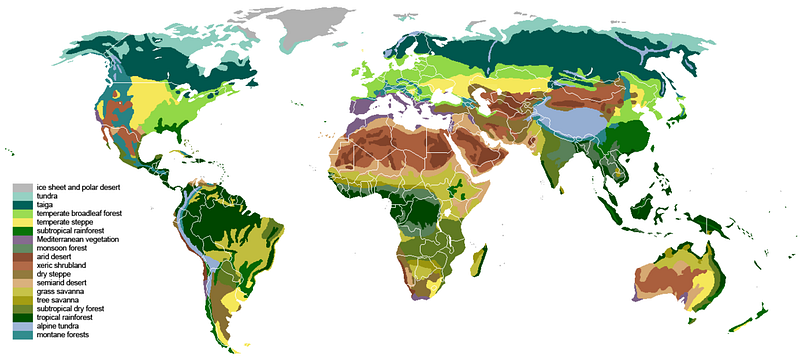
Matching our human patterns of how we meet our needs and create shared abundance for all with the natural patterns defined by watersheds, bioregions and biomes is part of the fundamental redesign of the human impact on Earth from degeneration to regeneration (image source)

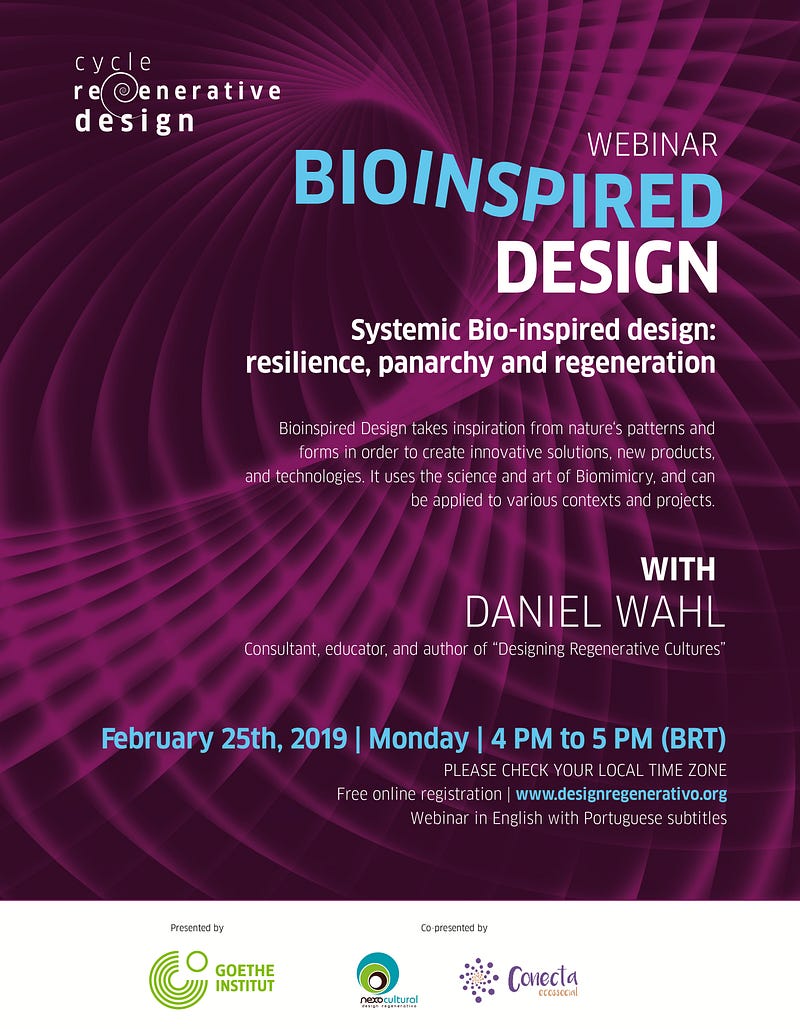
Systemic Bio-inspired design: resilience, panarchy and regeneration

In this webinar we will focus on the third level of biomimicry. Rather than exploring how forms, functions and processes in nature can inspire innovations in design, we will look at biomimicry at the systems level. What can we learn from change dynamics and resilience in ecosystems for the turbulent socio-cultural transitions we now face in response to climate change and a series of converging crises that threaten the survival of our species?

We will take a deep dive into resilience theory through the ‘adaptive cycle’ based on over 50 years of studying change in ecosystems and reflect on how this pattern might be informative to the breakdown and breakthrough that we are now called to confront and create in our human systems. The ‘panarchy’ of nested patterns of transformative change at different scales can also help us understand what it means to work ‘glocally’ (globally and locally) on facilitating the necessary transition ahead.

We will explore the deeper meaning of resilience in ecosystems and also in socio-ecological-systems. This will give us an opportunity to reflect on the role that the human capacity for anticipation, foresight and future state visioning plays in enabling transformative resilience in socio-ecological-systems.

The overall pattern of life’s evolution on Earth and its pattern of ‘creating conditions conducive to life’ can help us navigate the necessary change we now have to make. The generations alive today are called to fundamentally redesign the human impact on Earth from being mainly degenerative and exploitative to being regenerative and healing. We have to achieve this transformation at local, bioregional and global scales within the next three decades if we hope to avoid cataclysmic climate change and the possibility of short- or mid-term human extinction.

Once we begin to understand the fundamental unity and interdependence of nature and culture and take a regenerative development approach to ‘design as nature’ we can be informed by systemic bio-inspired design. This will enable us to see the rise of the Regeneration as part of a phase transition in the complex dynamic systems that is life as a planetary process.

We are at maturation point in human evolution where collaborative advantage at the species level has become a more important selection pressure than competitive advantage at the level of single individuals. We are at the cusp of a transformative leap in human evolution, which can also be understood as a species level rite of passage that — if we make it — will see us step into mature membership in the community of life on Earth.

The promise ahead is that we will no longer be eroding life’s collective inheritance but learn to restore healthy ecosystems functions and planetary health for the benefit of all of humanity and the wider community of life. Life is a syntropic force that creates conditions conducive to life, and as life, we are capable of doing the same.

In Gratitude: This webinar will be offered on February 25th, at 8pm CET, 7pm GMT, 4pm Brazil, 2pm EST and 11am Pacific. I want to thank Tatjana Lorenz and her wonderful team at the Goethe Instiute Sao Paulo for making this possible. The webinar will be in English with simultaneous subtitles in Portuguese. I also want to thank Flavia Vivacqua and Taisa Mattos for organizing my upcoming tour of Brazil and for making the introductions to Isabel Valle and Camila Rocha at Bambual Editora who are working hard to have my book Designing Regenerative Cultures available in Portuguese in time for my visit in March.

Link to Facebook events page of the webinar

Sign up here for the Webinar on Monday, February 25th, 2019

More information about the talks, 1-day workshops and 3-day course I will be offering in Brazil (Sao Paulo, Rio de Janeiro, and Brasilia) this March.
Sustainability
Sustentabilidade
Design
Education
Systems Thinking
Recommended from ReadMedium