System design for dummies — part 3 (Design a donation app)
This is the final part of a 4 part series on cracking the system design interview. Part 0 provided an overview of this article series, part 1 focused on the content you need to master to nail the interview and part 2 focused on the format you should follow during your system design interview.
In this final part I’ll provide a real life example of a system design problem — designing a donation app. I lifted this problem from this discussion on Leetcode. Here is the problem statement:
- You are required to design a donation app for a 3 day charity event across the US where you are expecting 3 million donations.
- You should accept details like customer name, credit card details etc.
- No pay specific knowledge is required (presume that you’d integrate with a 3rd party pay provider like Stripe or Braintree).
If you are a visual learner like me & prefer videos to words, you can skip ahead to watching the video (it’s listed at the bottom of this post) and then come back to the article. I do recommend reading through the entire article as it covers some key concepts that I didn’t cover in the video.
Understanding requirements/goals
Focus on understanding the requirements to establish the bounds of the problem. Focus on the functional requirements (these would typically be specified in a PRD) as well as the non functional requirements.
For functional requirements, some of the questions you can ask are — Will the users be logged in? Will they be using an app? What’s the user experience if the payment fails or succeeds? Can the user view their past donations?
Note that if you are a senior candidate, you are expected to own the problem & it’s preferable that you come up with your own assumptions rather than expecting the interviewer to define constraints for you.
For this problem, I’ve chosen to focus on donations and largely ignored how details about the charity are surfaced in the app.
The non-functional requirements will typically help establish the bounds/constraints of the problem. Use back of the envelope calculations to get the RPS (requests per second). 3 million donations over 3 days translates to 10 RPS. The shape of the traffic should be a consideration — e.g. most of the traffic for the donation app will come during the day time, and there might be further spikes in case of celebrity endorsements. For scale, we should build a system that can handle 100 RPS. To wrap up this section, you should comment on availability (improved via redundancy), latency (not super important here), throughput (improved via partitioning), consistency (eventual, read after write).
Data modeling & APIs
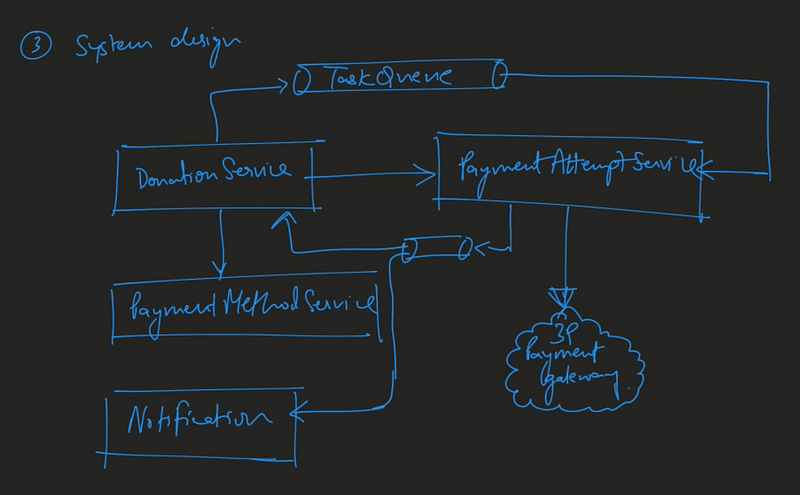
The main entities are User, PaymentMethod, Donation, PaymentAttempt which represent different micro-services (i’ve ignored Charity to reduce the scope). Draw out the entities & establish the relationship between them.
Note that Donation & PaymentAttempt could be tables within a single micro-service which would allow us to leverage on the ACID properties of relational databases & provide us with transactionality. However, it’s common to follow the single responsibility principle & have the Donation service be separate from the PaymentAttempt service. This is justifiable if the PaymentAttempt service would be called by services other than the Donation service (e.g. a Shopping service). If we create a PaymentAttempt micro-service, it would be important not to leak donation related information into the PaymentAttempt service. For e.g. the donation_id would be renamed to something more generic like auxiliary_id (the id is called the donation_id in the video and needs to be corrected).
The biggest challenge in micro-service architecture is eventual state consistency. For e.g. if the payment attempt succeeds, we’d need to notify the Donation service so that the status of the Donation entry can be updated. If the webhook/event never reaches the Donation service, we risk being in an inconsistent state.
System architecture (component diagrams)
I recommend calling the 3rd party payment provider when the user is “in-session” (in-session means that the user is online & attempting to make the donation live). In the happy path the client would receive a status of 200 with donation status SUCCEEDED in real time. However, to design a system that is robust, we should enqueue retries if the 3rd party provider is unavailable & we receive a transient failure response. Retries can happen offline & we’d need to keep the overall state of the donation in sync with the status of the latest payment attempt.
Failure scenarios
Failure can happen at multiple points. Network blips can cause timeouts or databases can go down. We should also monitor for data inconsistencies. We should also rely on idempotency to ensure that a single donation does not result in multiple payment attempts.
Leader nodes can fail & one of the replicas will need to be promoted to be primary. Scenarios like split-brain should be prevented and replication lag should be monitored for.
Scaling
Partitioning can increase throughput. Partitioning by hash of the user_id is better than partitioning by range as range based partitioning can lead to more hot spots (e.g. imagine that a celebrity tweets and thousands of new users create accounts and start donating — they will all hit the same partition if user_ids are generated in an increasing order).
Video
Hope that you’ve enjoyed the article series & the video (sorry for the scratchy background noise — unfortunately it’s a part of the app I used to record the video).
If you have questions about the solution I presented or if you have suggestions on how this design could be improved please feel free to leave a question or comment. If you found this article useful, please consider following me on medium or reposting this article on social media. You may also be interested in reading my article called the LeetCode phenomenon.


