
System Architecture : Deep Dive into 1M RPS API Design
Technology-agnostic design for high-throughput systems, ensuring low latency, high availability, and cost efficiency

Problem statement
Designing an API capable of processing 1 million RPS is a complex challenge that requires efficient request distribution, optimized data access, asynchronous processing, and dynamic scaling. Traditional monolithic architectures struggle at this scale due to single points of failure, database bottlenecks, and limited horizontal scalability. System should have following features
Key Features of the system
a. High Throughput Handling: The API must efficiently process 1 million requests per second (1M RPS) while ensuring minimal queuing and congestion.
b. Low Latency Responses: The system should maintain response times within 10–50ms, optimizing request execution paths and caching strategies to minimize delays.
c. Stateless API Design: API servers should be stateless, ensuring horizontal scalability, independent request handling, and seamless traffic distribution across instances.
d. Read & Write Operations Support: The API should support both read and write operations while optimizing for high concurrency, sharded storage, and data consistency strategies.
e. Security & Access Control: The system must implement rate limiting, authentication, and authorization mechanisms to prevent abuse and unauthorized access.
f. Real-Time Monitoring & Logging: The API should provide real-time observability with logging, distributed tracing, and anomaly detection for proactive issue resolution.
Key Challenges (In-Depth Analysis)
Designing an system whose APIs are capable of handling 1 million requests per second (1M RPS) is a massive challenge requiring deep considerations across scalability, availability, performance, fault tolerance, consistency, and cost efficiency. Let’s dive into each aspect
1. Scalability — Can the System Handle Growth Dynamically?
At 1M RPS, the system must scale seamlessly to handle fluctuating demand, including:
Peak Traffic Surges: The system must gracefully scale up during traffic bursts and scale down to optimize costs during idle times.
Horizontal vs. Vertical Scaling:
- Vertical scaling (Scaling Up): Limited approach, as adding more power to a single machine quickly hits hardware limits.
- Horizontal scaling (Scaling Out): Preferred approach, distributing load across many smaller instances.
Stateless vs. Stateful Scaling:
- Stateless services scale easily by adding more identical nodes.
- Stateful components (databases, caches) require careful replication and partitioning.
Scaling Strategy
✅ Auto-scaling mechanisms dynamically add or remove instances based on demand. ✅ Microservices-based decomposition ensures different parts of the system scale independently. ✅ Decoupling compute from storage (e.g., event-driven, distributed processing) prevents bottlenecks.
2. Availability — How Do We Ensure 99.99% Uptime?
Downtime at 1M RPS translates into significant revenue and user loss. The system must have:
No Single Point of Failure (SPOF): Redundancy in every layer (API servers, caches, databases).
Geo-Distributed Multi-Region Deployment:
- Deploying across multiple regions ensures system availability even if one region fails.
- Active-Active vs. Active-Passive Replication for ensuring failover mechanisms.
Self-Healing Mechanisms:
- Auto-recovery for failed instances: Detect and replace unhealthy nodes automatically.
- Circuit breakers and failover mechanisms: Redirect traffic if a service becomes slow/unresponsive.
Availability Strategy
✅ Deploy across multiple availability zones (AZs) and regions to prevent downtime. ✅ Graceful degradation: Allow partial feature availability rather than full system failure. ✅ Monitor and auto-recover failing services using automated health checks.
3. Performance — How Do We Ensure Low Latency at High Scale?
At 1M RPS, even 1ms of delay per request results in a massive performance hit. Optimizing performance means:
Reducing unnecessary database queries:
Caching at multiple levels (CDN, API, DB, In-memory) significantly reduces response times.
Minimizing inter-service communication overhead:
- Optimizing request-response paths (e.g., fewer database calls per request).
- Reducing payload size (e.g., binary serialization instead of JSON).
Efficient Load Balancing: Smart routing of requests based on real-time server health and latency metrics.
Efficient data access: Sharding, indexing, and precomputed aggregations to minimize query latency.
Performance Strategy
✅ Multi-tier caching to reduce load on primary systems. ✅ Parallelizing expensive computations to utilize CPU/memory more efficiently. ✅ Optimized query execution plans to prevent unnecessary database scans.
4.Fault Tolerance — How Do We Prevent Cascading Failures?
At massive scale, failures are inevitable. The key is containing the impact of failures to prevent cascading system-wide outages.
Designing for Partial Failures: If one service fails, others should continue working gracefully.
Circuit Breakers & Rate Limiting:
- Preventing overloads on downstream services by rejecting requests early.
- Rate limiting and backpressure mechanisms help stabilize services.
Retry & Idempotency:
- Retries should be intelligent (e.g., exponential backoff, jittering) to avoid thundering herd problems.
- Idempotent API design ensures that duplicate requests do not cause inconsistent data.
Fault Tolerance Strategy
✅ Redundant architecture (Active-Active/Active-Passive Failover) to minimize downtime. ✅ Circuit breakers & throttling to prevent cascading failures. ✅ Eventual consistency and retry mechanisms for robustness.
5. Consistency — Managing Trade-offs Between Strong and Eventual Consistency
Handling 1M RPS requires balancing consistency vs. performance:
Strong Consistency (e.g., ACID transactions) is expensive and slow at high scale.
Eventual Consistency (e.g., eventual data synchronization across replicas) offers better performance but requires handling temporary data staleness.
Where do we need strong consistency?
- Critical financial transactions, authentication, and security-sensitive operations.
- Use distributed locks sparingly (expensive at scale).
Where is eventual consistency acceptable?
- Social media timelines, analytics, search indexing, and caching layers.
Consistency Strategy
✅ Use eventual consistency where possible for performance optimization. ✅ For strong consistency, use distributed consensus algorithms (Raft, Paxos, 2PC sparingly). ✅ Design for idempotency to prevent duplicate operations in eventual consistency scenarios.
Architectural Approach
A highly scalable system should be designed using layered architecture to distribute the load efficiently and provide isolation of concerns. Below are the fundamental building blocks of such a system.
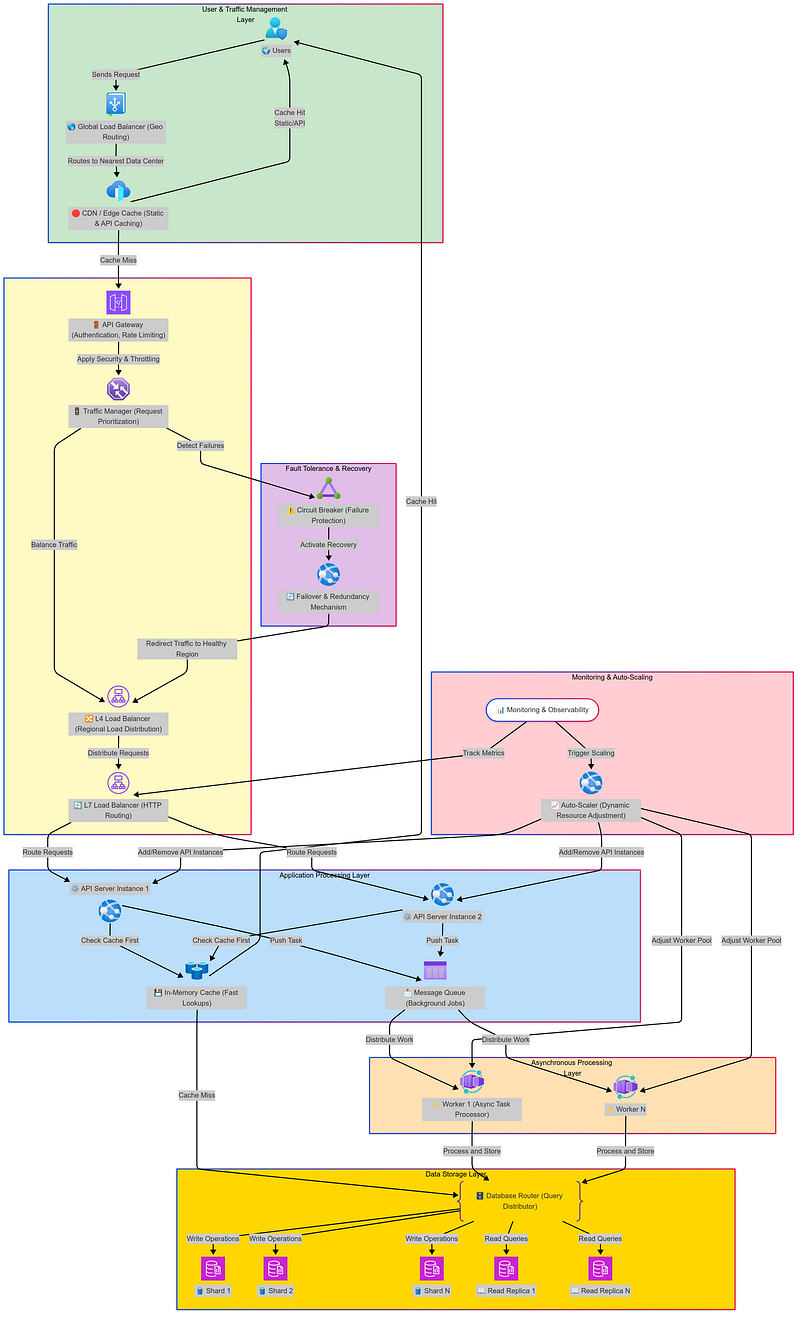
The architecture proposed above follows a Distributed, Layered, and Scalable Microservices-based Architecture. It incorporates modular, loosely coupled components to efficiently handle high throughput (1 million requests per second) while ensuring scalability, availability, performance, and resilience.
The above layered architecture and API workflows are designed in a technology-agnostic manner, ensuring adaptability across various cloud platforms, frameworks, and infrastructure choices. This design is not tied to specific technologies but instead focuses on core principles of scalability, availability, performance, and fault tolerance to achieve 1 million requests per second (1M RPS).
What Type of Architecture is Proposed?
1. Distributed Microservices Architecture
- The system is decomposed into multiple stateless microservices that scale independently.
- Each service focuses on a single responsibility (API processing, caching, data management, background jobs).
- Enables horizontal scaling by distributing the load across multiple instances.
2. Layered Architecture (Segregated Concerns)
The system is designed using logical layers, each focusing on specific responsibilities. Below is a detailed breakdown of each layer and its role in achieving high performance, fault tolerance, and efficiency.
2.1. User & Traffic Management Layer
This layer efficiently distribute incoming traffic while offloading redundant requests.
Key Components:
a. Global Load Balancer (GLB) : Routes incoming requests to the nearest or least busy data center. Uses geo-based routing, latency-based routing, or weighted round-robin strategies. Ensures regional failover in case of a zone outage.
b. Content Delivery Network (CDN) : Caches static assets, API responses, and frequently requested data at the edge. Reduces latency by serving requests without hitting the backend. Supports DDoS protection and request rate-limiting at the network edge.
How It Handles 1M RPS:
✅ Reduces backend load by serving cached responses. ✅ Balances traffic efficiently across multiple regions. ✅ Prevents overloading API servers with unnecessary requests.
2.2. API Gateway & Traffic Control Layer
This layer securely manage and regulate traffic before processing.
Key Components:
API Gateway : Handles authentication, authorization, and request transformation, Implements rate limiting and access control to prevent abuse, Logs all incoming requests for observability.
Traffic Manager : Implements priority-based traffic routing (e.g., prioritizing authenticated users over bots), Prevents overloading backend services by queueing excess requests, Routes traffic based on request type (e.g., read requests may hit a cache, while writes go to a database).
Load Balancers (L4 & L7) : Ensures API server load is evenly distributed. Use Layer 4 (TCP) and Layer 7 (HTTP) load balancing to optimize routing based on request type.
- L4 Load Balancer distributes TCP connections across regions.
- L7 Load Balancer routes HTTP requests to specific microservices.
How It Handles 1M RPS:
✅ Prevents abuse and enforces security at scale. ✅ Distributes API load across multiple backend instances. ✅ Implements intelligent routing to optimize performance.
2.3. Application Processing Layer: This layer executes business logic and processes API requests efficiently.
Key Components:
Stateless API Servers : Handle incoming requests without storing session data, allowing easy horizontal scaling, Optimize request execution using connection pooling, batch processing, and efficient serialization.
Multi-Tier Caching :
- API Layer Cache: Stores precomputed results from expensive computations.
- Database Cache: Reduces redundant database queries by caching frequent lookups.
Optimized Request Handling :
- Implements gRPC for internal service communication to improve throughput.
- Uses asynchronous processing where applicable to minimize blocking operations.
How It Handles 1M RPS:
✅ Stateless architecture enables horizontal scalability. ✅ Caching prevents redundant database queries. ✅ Optimized request execution reduces processing time.
2.4. Data Storage Layer : This layer Store, retrieve, and manage data efficiently under high concurrency.
Key Components:
Database Sharding : Distributes write-heavy workloads across multiple partitions, Uses hash-based, range-based, or key-based partitioning, Prevents any single database node from becoming a bottleneck by distributing database load by partitioning data across multiple nodes.
Read Replicas : Handles read-heavy queries separately from writes. Reduces load on primary database shards by Offloading read-heavy queries to secondary instances.
Distributed Indexing & Query Optimization : Uses proper indexing, partition pruning, and query batching to optimize performance, Avoids full table scans and slow joins.
How It Handles 1M RPS:
✅ Sharding prevents overload on a single database node. ✅ Read replicas scale read-heavy operations efficiently. ✅ Optimized indexing reduces query execution time.
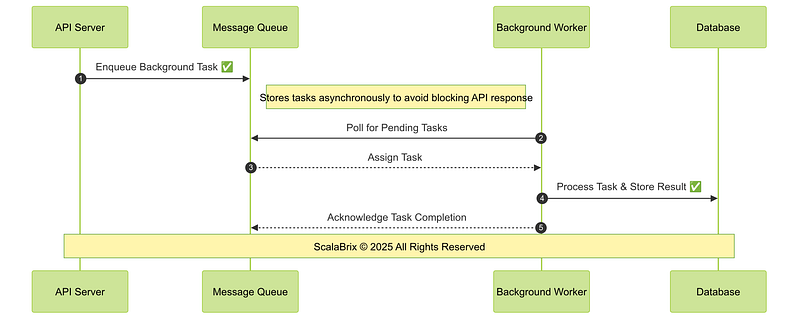
2.5. Asynchronous Processing Layer : This layer Offload time-consuming tasks from real-time API responses. This offload heavy operations (e.g., notifications, analytics updates) to background workers.
Key Components:
Message Queues : Uses Kafka, RabbitMQ, or SQS to queue tasks without blocking API requests, Handles event-driven workflows (e.g., sending emails, logs, notifications).
Worker Nodes : Processes queued tasks asynchronously, Scales independently based on workload intensity.
Event-Driven Processing : Implements event sourcing and CQRS for real-time updates, Ensures that eventual consistency does not block primary API execution.
How It Handles 1M RPS:
✅ Removes non-critical operations from the request-response cycle. ✅ Ensures real-time processing without slowing down API requests. ✅ Allows independent scaling of compute-heavy background tasks.
2.6. Monitoring & Auto-Scaling Layer : This layer ensures proactive issue resolution and optimal resource allocation.
Key Components:
Real-Time Monitoring : Tracks latency, throughput, error rates, and system health, Implements centralized logging and distributed tracing.
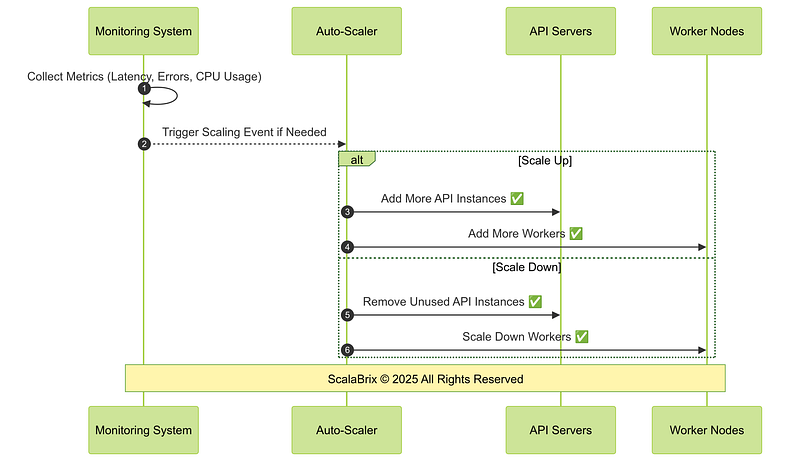
Auto-Scaler : Dynamically adds or removes API servers based on CPU, memory, or RPS metrics, Ensures cost-effective resource utilization.
Alerting & Anomaly Detection : Uses machine learning-based anomaly detection to identify irregular traffic patterns, Triggers automated recovery actions.
How It Handles 1M RPS:
✅ Detects issues before they impact users. ✅ Automatically scales resources to match traffic demands. ✅ Reduces operational overhead by self-healing failures.
2.7. Fault Tolerance & Disaster Recovery Layer : This layer ensures business continuity despite failures.
Key Components:
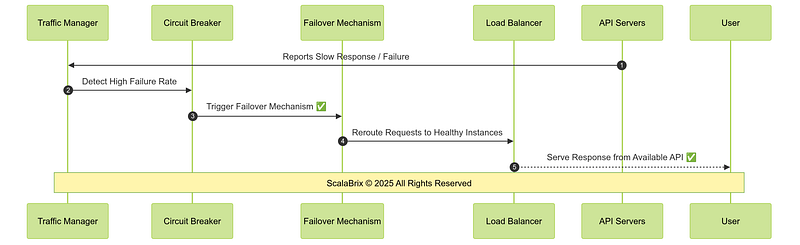
Circuit Breakers : Prevents cascading failures by blocking traffic to failing services, Implements timeouts and retries for automatic recovery.
Failover & Redundancy : Uses active-active or active-passive failover for disaster recovery, Automatically reroutes traffic to backup services if primary instances fail.
Multi-Region Replication : Ensures data is synchronized across multiple regions, Provides geo-redundancy to prevent complete outages.
By separating concerns into distinct layers, this design improves scalability, performance, fault tolerance, and maintainability.
3. Event-Driven & Asynchronous Processing
- Message queues and background workers handle non-blocking, asynchronous tasks (e.g., logging, notifications, data updates).
- Improves API response times by moving time-consuming operations to the background.
- Enhances fault tolerance — tasks can be retried in case of failures.
4. Distributed Database Architecture
- Sharding (Horizontal Partitioning) to divide data across multiple nodes for parallel query execution.
- Read Replicas to distribute read-heavy queries and reduce load on primary databases.
- Caching Strategies (Edge caching, in-memory caching) reduce direct database calls.
5. Auto-Scaling & Elastic Resource Allocation
- Kubernetes-based scaling adds/removes API instances, cache nodes, and workers dynamically.
- Predictive scaling based on monitoring data ensures smooth handling of peak loads.
- Load balancers dynamically distribute traffic across available resources.
6. Resilient & Fault-Tolerant Design
- Circuit breakers & failover mechanisms prevent cascading failures.
- Multi-region deployment ensures redundancy in case of regional outages.
- Graceful degradation — The system continues running even if some components fail.
3. Ensuring Scalability
Scalability is key to handling 1M RPS efficiently. The following strategies help in achieving it.
3.1. Horizontal Scaling : Instead of making a single node powerful, scaling out by adding more instances ensures a distributed load.
- Elastic Scaling: Automatically adjusts resource allocation based on traffic.
- Service Replication: Distributes requests across multiple service instances.
- Decoupling Services: Allows independent scaling of different system components.
3.2. Caching Strategies : Caching minimizes direct load on compute and storage layers.
- Edge Caching: Stores frequently requested responses close to users.
- Application-Level Caching: Temporarily holds data in fast-access memory.
- Database Caching: Reduces repetitive queries to the underlying data store.
3.3. Efficient Query Processing : Database operations are optimized to handle large-scale traffic.
- Partitioned Queries: Distribute read and write operations across multiple nodes.
- Batching & Aggregation: Reduces the number of direct queries.
- Index Optimization: Speeds up data retrieval.
4. Ensuring Availability
To maintain 99.99% uptime, the system should be built with redundancy and fault-tolerance in mind.
4.1. Distributed Deployment : Running the system across multiple locations/regions ensures high availability.
- Multi-Region Setup: Prevents downtime due to localized failures.
- Geo-Replication: Synchronizes data across different locations.
4.2. Fault Isolation & Recovery : Ensuring that failures do not impact the entire system is crucial.
- Graceful Degradation: Reduces features instead of failing entirely.
- Circuit Breakers: Prevent cascading failures by detecting slow components.
- Automated Recovery: Quickly replaces failed components.
In-Depth API Workflow for Handling 1M RPS | API Workflow Overview
The API request lifecycle can be broken down into the following key stages:
- Traffic Distribution & Load Balancing (User & Traffic Management Layer)
- Request Processing & API Execution (API Gateway & Application Layer)
- Data Access & Storage Optimization (Data Storage Layer)
- Asynchronous Processing for Non-Critical Tasks (Asynchronous Processing Layer)
- Observability & Auto-Scaling (Monitoring & Auto-Scaling Layer)
- Fault Tolerance & Disaster Recovery (Resilience Layer)
Each of these stages optimizes the handling of high-throughput traffic, ensuring the system scales effectively while maintaining low latency.
Step 1: Traffic Distribution & Load Balancing (User & Traffic Management Layer)
Objective: Ensure efficient request distribution, prevent overloading, and reduce response latency.
✅ Process Flow:
- User initiates an API request (e.g.,
GET /dataorPOST /transaction). - Global Load Balancer (GLB) directs traffic based on geo-location, latency, and availability.
- Content Delivery Network (CDN) & Edge Caching intercepts the request:
- If cached, the CDN serves the response instantly to reduce backend load.
- If not cached, the request is forwarded to the API Gateway.
4. API Gateway receives the request and performs:
- Authentication & Authorization (e.g., OAuth, API keys).
- Rate Limiting & Throttling (prevents abuse and overload).
- Logging & Analytics (for observability).
5. The Traffic Manager decides whether to route the request to a cache, API server, or background processing queue.
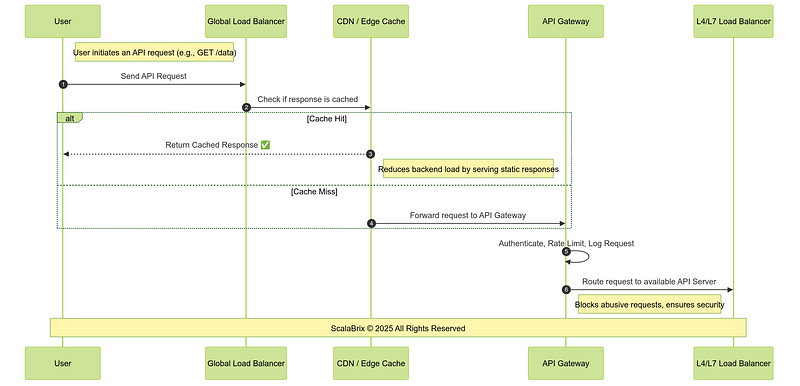
🚀 Optimizations to Handle 1M RPS: ✔ Edge caching offloads 60–80% of traffic from backend services. ✔ Load balancers distribute requests dynamically across multiple API servers.
Step 2: Request Processing & API Execution (Application Layer)
Objective: Ensure high-throughput request processing with minimal latency.
✅ Process Flow:
- The L4 Load Balancer routes requests to the closest available L7 Load Balancer.
- The L7 Load Balancer intelligently routes API requests based on request type:
- Cacheable requests → Check in-memory cache before hitting the database.
- Non-cacheable, transactional requests → Forward to API servers.
3. The API Server (stateless microservice) processes the request:
Decodes the request and validates parameters. Queries in-memory cache (e.g., Redis) to check if data exists. If cache hit, return the response immediately. If cache miss, query the Database Router for fresh data. If the request is write-heavy, ensure data consistency via sharding.
4. API servers communicate with other microservices (via gRPC or HTTP) if required.
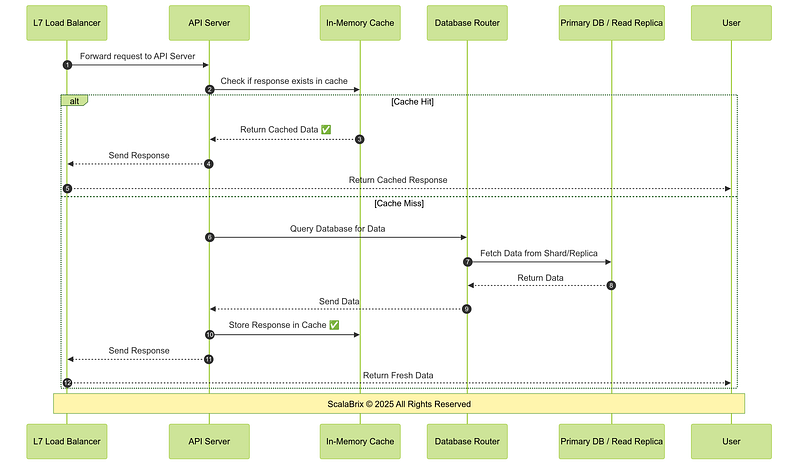
🚀 Optimizations to Handle 1M RPS: ✔ Stateless API design ensures horizontal scaling with no dependency on local sessions. ✔ Multi-tier caching (CDN, API, DB) reduces backend requests and improves response time. ✔ gRPC for internal microservices communication (faster than REST).
Step 3: Data Access & Storage Optimization (Data Storage Layer)
Objective: Efficiently handle database queries, sharding, and replication to prevent bottlenecks.
✅ Process Flow:
- If the request requires fresh data, the API server queries the Database Router.
- Database Router determines whether the request is:
- Read-heavy request → Routes to Read Replicas (to reduce primary DB load).
- Write-heavy request → Routes to Primary Database Shard based on sharding key.
3. The appropriate sharded database node handles the request.
4. If necessary, database replication ensures eventual consistency.
5. The response is returned to the API server, which caches the result for future requests.
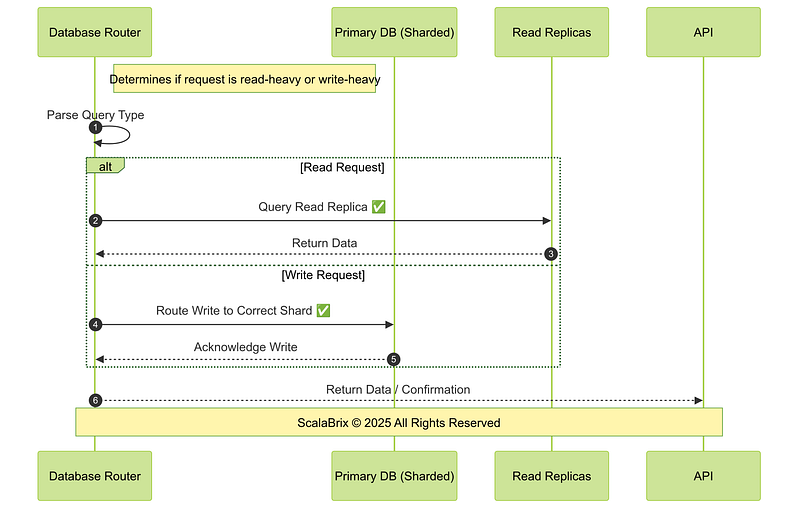
🚀 Optimizations to Handle 1M RPS: ✔ Sharding distributes write-heavy workloads across multiple database nodes. ✔ Read replicas handle high read concurrency without overloading the primary DB. ✔ Indexing and query optimization (e.g., partition pruning, batched queries).
Step 4: Asynchronous Processing for Non-Critical Tasks (Asynchronous Processing Layer)
Objective: Offload non-time-sensitive tasks to avoid blocking the main API request flow.
✅ Process Flow:
- If the request involves background tasks (e.g., sending emails, analytics, notifications), API servers push events to a Message Queue (Kafka, RabbitMQ).
- Worker Nodes consume tasks asynchronously and execute them in the background.
- Workers store results in the database without affecting real-time API response times.
🚀 Optimizations to Handle 1M RPS: ✔ Decouples non-essential tasks from the main request-response cycle. ✔ Workers auto-scale independently based on queue depth. ✔ Message queues prevent system overload by handling requests in a controlled manner.
Step 5: Observability & Auto-Scaling (Monitoring & Auto-Scaling Layer)
Objective: Monitor system health, detect anomalies, and scale resources dynamically.
✅ Process Flow:
- Monitoring Service collects metrics like latency, error rates, CPU/memory usage.
- If thresholds are exceeded, the Auto-Scaler triggers:
- Scaling API servers (increase/decrease instances).
- Scaling worker nodes based on background queue size.
- Adjusting database read replicas to meet demand.
3. If a failure is detected, automated alerts notify engineers via monitoring tools.
🚀 Optimizations to Handle 1M RPS: ✔ Proactive scaling prevents downtime during peak loads. ✔ Auto-scaling optimizes resource usage to prevent unnecessary costs.
Step 6: Fault Tolerance & Disaster Recovery (Resilience Layer)
Objective: Prevent cascading failures and ensure system recovery with minimal impact.
✅ Process Flow:
- If an API server is slow or unresponsive, the Circuit Breaker redirects requests to healthy instances.
- If a database shard fails, the Failover Service reroutes queries to a backup replica.
- If a data center outage occurs, the Global Load Balancer redirects traffic to another region.
- Regular backups and snapshots ensure no data loss during failures.
🚀 Optimizations to Handle 1M RPS: ✔ Circuit breakers prevent cascading failures. ✔ Multi-region deployments ensure system resilience. ✔ Self-healing infrastructure auto-replaces failing nodes.
🔍 Conclusion
Designing an API capable of handling 1 million requests per second (1M RPS) requires a scalable, fault-tolerant, and performance-optimized architecture. By implementing a layered approach, the system efficiently distributes traffic, processes requests with caching and asynchronous execution, and ensures resilient data storage with sharding and replication. Auto-scaling and real-time monitoring dynamically adjust resources, while failover mechanisms and circuit breakers enhance reliability. This generic, technology-agnostic design provides a robust foundation for high-throughput systems, ensuring low latency, high availability, and cost efficiency at an extreme scale. 🚀
Refer to following for more system design concepts to gain in depth understanding about distributed systems.
🖥️📐🔍📝 System Design Concepts for Interviews
Happy System Designing !!!!🤖💻🎉🛠️🌟📐🚀✨. Clap and Follow link to support more such content.


