Synesthesia
a short story of sound and light
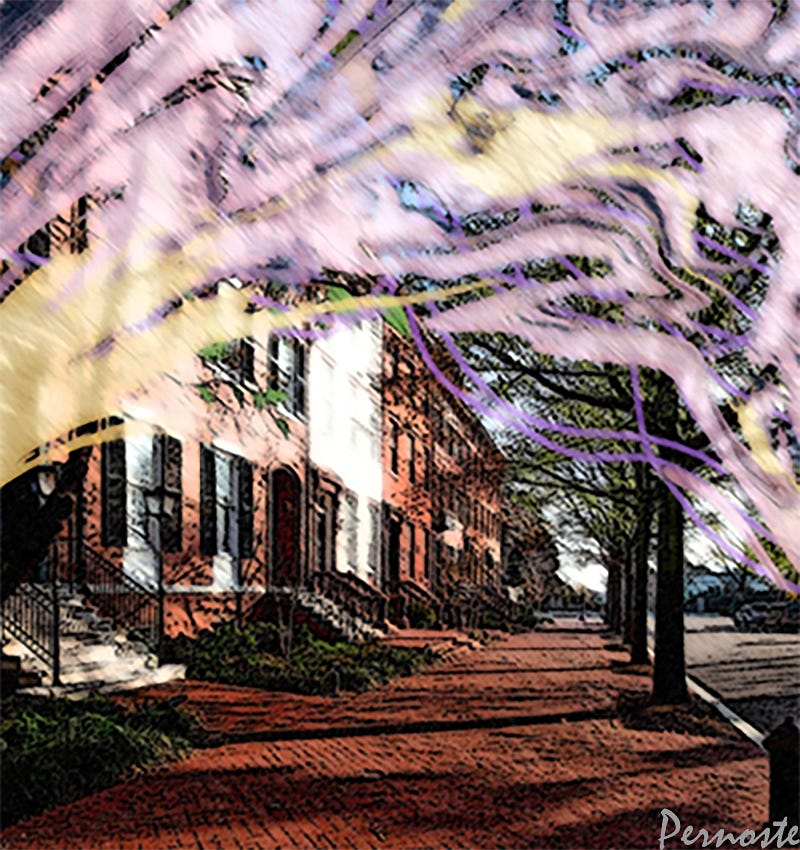
If I’m quiet in the morning, I can see the sun, simple, beautiful, and yellow-white outside our window. And, like the sunlight, in and out among the leaves, the robins hop until they brightly sing in tendrils of color with each cheep, cheep, cheep.
Sasha is still sleeping quietly in our bed, her soft breathing creating cascading rings of bright yellow, quickly disappearing to be replaced by the next, and the next. I see faint plumes of red from her heartbeat, at her long neck, her delicate wrists.
Her eyes open, and she looks quietly to me, so beautiful, so beautiful, and she smiles knowingly.
She moves her fingers quietly, expertly, questioning, Nathan, must you go every day there, love?
I sign back to her, It’s important, Sasha. Even in my mind sometimes, I taste her name as rich chocolate.
I close my eyes, so we can speak aloud, and I jump back into the bed with her, kissing her joyfully, loudly, listening to her giggle. Under the sheets I run my eager hands across her body, so naked, smooth, warm, overwhelming my senses with vanilla, cardamom, fresh pine needles. The sheets along the back of my hands release sensations of warm baking bread, and her hands on me, always always roses.
“Should I go with you, love, help you get there?” she asks me, but I kiss her beautiful words away, and when she is quiet, I open my eyes to see her.
She’s flushed and happy, her long black hair concealing, only partially, her beautiful face, which is still smiling. She holds her breath so I can see her clearly and I nearly cry at the generosity of her spirit.
I close my eyes again to speak, “No, Sasha, it’s OK. You need to organize my paintings. He’s coming again today, and we need the money.”
Due to my condition, I can’t see my paintings in all the sound and fury of moving them around, even when I wear my best sound-cancelling ear plugs, for my hearing only becomes more sensitive. I walk past my paintings, through my studio, abstract art for most people, memories for me.
A tree full of birds is a light show of nature, a night at an outdoor concert, an explosive Armageddon, the face of my beloved, speaking, a miracle in light.
— — — — — — -— — — -֎ — — — — — - — — — — -
Walking as softly as I can walk in leather-soled shoes, I move lightly down the stairs of our apartment building, exiting through the back and to the alleyway. I walk the side streets as much as possible, but I will need to go on Main Street and face the rush and terrible roar of life. I like the early morning, when it’s quiet, so quiet, so I can visit my great grandmother at The Willow… before the crowds, and the traffic, get too bad.
The side streets are lined with old brownstones and pin oaks, sugar maples, lindens and ash trees, all lit by their auras of movement and sound. The humming of the overhead power lines creates jagged lines of purple above me, and the whistling of the wind rises suddenly to create twisted pink licorice halos among the tree branches.
The distant sounds of vehicles bounce in lavenders off the brownstones and trees, but only dimly, only echoes. When a car suddenly thunders past, I’m blinded by rolling waves of cobalt blue light that nearly suffocates, and I close my eyes to the world around me. I’ve memorized the streets, so I walk, blind, until I hear increased activity at the corner of Main.
I stop at the sign, M-A-I-N_ S-T-R-E-E-T, admiring the squishy marshmallow feel of the M, the rock hardness of the T’s, the femininity of E’s and the I. They all smell like candy to me… are like happy little children.
There are few cars on Main Street this early, but I turn left, picking up my pace to walk while I can still see well. An electric car comes, and with it, plum ripples of light cover the street, cover my feet, as it passes. Then two more cars pass by in thunderous waves of thick dark blues and bright persimmon.
For a moment, these lights block out the sky and obscure most of my field of view. I stop suddenly, as I often do in my distractions.
“Excuse me,” a woman says in blanched almond, blinding me as she hurries past. I close my eyes, thinking maybe I should have brought my ear-plugs.
But I need to desensitize myself, so I must suffer, daily, the sensory overload to learn to cope.
“I have to live in the world,” I whisper to myself in rich shades of the faintest burgundy. Saying the word “world” leaves the strongest taste of earth in my mouth. “Society,” I say, now tasting peppermint. “I have to live in society.” Peppermint and overtones of honey.
My route is planned carefully through years of exploration, though I’m ever improving it in my desire for peace. There are some benches along the way to gather my wits, to rest my eyes, to not look so damned strange.
“Feeb,” I hear a teenager say as I forget myself in staring at a stop sign. STOP is a mix of the smell of sweet jasmine and bubble gum orbs of light.
But it’s the “o” that traps me, for it is mesmerizing in its profound gentleness and taste of whiskey.
I quietly breathe the letter out, “oooooooooooooo,” and I see the most beautiful ambers while tasting a lovely aged bourbon. Would a policeman smell it on my breath? I wonder, until more cars pass by me in an unpleasant supernova of orange and cyan that surrounds me. I close my eyes.
I turn right on Calilyn St, and my mind thinks calla lilly, soft in texture in my mouth and full of pepper. Better than Calilyn, which is too dingy, like sour breath and aspirin.
It seems I’m tasting my way, all the way, to my grandmother.
Soon, on the side streets, because of the hour, I am freed from most of the disturbing sounds, and I can enjoy the taste of the houses, the sight of the beautiful breeze that sings, and I hear what the birds say in colors and textures.
I feel peace in these solitary quiet moments, in the same way I feel peace with Sasha, when she is quiet and warm in my arms.
I close my eyes and walk blind when I notice squirrels up ahead. Their name tastes in my mouth of mothballs and onions, and their chitters are electric porcupine quills in my eyes. I squint just to be able to see The Willows, as I pass the squirrels. They are blessedly quiet today, but I nearly run the rest of the way. I’m mentally exhausted.
I look through the glass door, inside to Wendy at the desk, signing to her. “Can I come in?”
“Wendy,” I breathe, enjoying the taste of apricots in her name. She holds up one hand to halt me and quickly runs out of the reception area, to the back, returning in just a few seconds to wave me in. She always warns everyone when I’m here so they will be a little more quiet.
Wendy signs, “She’s awake. She has eaten already.” She accidentaly taps the desktop, as if punctuating her sentence with a bright strawberry streak of light. I jump. “Sorry,” she signs.
I smile and sign, “Thank you!” As my soft footsteps release wooly green light over the tile floor.
Great Grandma Genevieve, beautiful as ever, sits in her chair by the window in her small room. At 95 years old, she is smaller, it seems, every day. Her silver hair catches the rays of early sun in a way I rarely can see so clearly, so beautifully, because she is very still in the sunlight right now.
She doesn’t turn, not at first, because she cannot hear well, but when she does turn, I see her subtle smile.
I close the door quietly to block the delicate light coming from the hallway from faint conversations, slow footsteps, bright tapping of canes and the dull glows of wheel chairs rolling. Still I see the lights dimly popping through the door, as though someone is knocking, knocking, knocking.
I smile at her and take her hand, and she talks to me. Nobody else really knows that she is very awake and aware, or at least they didn’t until they started asking me.
She has never been able to speak, since childhood, something to do with the faint scar on her neck. So she talks in tattered breaths and silent syllables, but I see them as shapes and words that float about her.
Great grandma says she loves me, and she is so happy that I came. She asks if her name still tastes like apple pie, and I chuckle in stutters of pink bubbles.
“Yes,” I say aloud, in quiet but bright tangerine.
She slowly tells me about her day since last I saw her. She is feeling her age and wishes she had had apple pie for breakfast rather than the terrible eggs this morning. “At my age,” she says in silent whispers, “I should live on desserts.”
I take out my tablet of paper and my sharpie, writing would you like apple pie tomorrow for breakfast? The scratching sounds of the sharpie create faint graphite lines that touch the ceiling.
“Yes,” she says with her tiny sounds and subtle hand motions, “warm and with vanilla ice cream.” I see it in floating words and white light and scents of vanilla, reminding me of Sasha’s skin. And I see her laughter, in the air and in her eyes.
It’s almost like she reads my mind. “Is your sweet and beautiful girl taking good care of you?”
Sasha is so perfect, I write, and she smiles.
We talk for a while, until she tires. She tells me she will pass soon, and that I will be free. “A young man like you should be free, Nathan. Not always visiting an old woman,” she says.
When I begin to cry, she tells me, “If you can talk to me now, maybe you’ll see me when I’m gone, too.” I squeeze her hand tightly… and squeeze my eyes closed to stop the tears.
I wait until she falls asleep in her chair, and then I just watch the light of her in her breaths, and the faint red plumes of her heartbeat, until I ready myself emotionally to leave.
On my way out, I tell Wendy that Great Grandma Genevieve didn’t like the eggs and that she wants warm apple pie with vanilla ice cream tomorrow for breakfast.
Wendy laughs, involuntarily, in spasms of indigo and cherry lights. “Even I could tell she didn’t like the eggs,” she signs. “Pie it is.”
— — — — — — - — — — -֎ — — — — — — — — — — -
The walk home I expect to be much more painful, so I get out my white and red cane, and I close my eyes completely when I reach Main Street. I would not be able to see anyway, for the cacophony of light all around would envelope me entirely.
It would feel like madness.
It is still pretty early in the morning, but there are many more people in the streets now. I can hear them loudly as I move very slowly and deliberately down the sidewalks, the “tap, tap, tap” of my cane almost deafening to my sensitive ears. It’s all for show, mostly, to get people to make way for me.
In the black and peaceful quiet of my mind, and the automatic mathematics of blind navigation, I find the freedom to think of Great Grandma Genevieve, who had once lived next door to us. She adopted me when my Mama died… like a mother to me. She taught me to cope with severe Synesthesia, and even figured out how to talk to me, practicing for hours with me, without sound, saying it was much like her childhood, laughing. I cannot imagine being without her gentle soul.
I can open my eyes once I leave Main Street, for the final leg of my regular walk home. I always stop for a moment in the park to see the large statue of the Virgin Mary in little Sunet Park, near where I live.
I sit with her in the quiet of the park, amongst the lights of the breeze and the birds, and she speaks to me in quiet consoling words, in rays of royal blue and scents of hyacinth.
Based on an early rough draft originally published at https://vocal.media (no longer there).
Check out our other writing on Medium.