
Synchronicity, Intuition & Meaning- Is There an Ultimate WHY?
“We are in the middle of the 2,021st year of the Common Era, a sliver of time that amounts to a mere one-150,000th of the lifespan of our species, one-10,000th of the epoch of our civilization, one-500th of the Age of Science, and one-100th of the Age of Einstein, who discovered that space and time are indivisible.
To think that you or I or any of the other nearly eight billion people alive today, or anyone among the 100 billion people who lived before us, has (or had) enough knowledge to know where the universe came from, how life began, the nature of consciousness, the existence of God, the afterlife, and the soul, or what the future holds for humanity, would be hubris enough to make a Greek god blush. “
Adapted from a quote by Michael Shermer
This is the first part of a series on Synchronicity, Intuition & Meaning, which was triggered by a Clubhouse session with some 74 participants this week on our Integral Leadership Club. What follows is an extended version of the 30 minute introduction I gave before others shared their own experiences. Further articles will dig deeper into how scientific research is now validating what we used to call the “paranormal”, revealing it to be far more “normal” than previously understood.
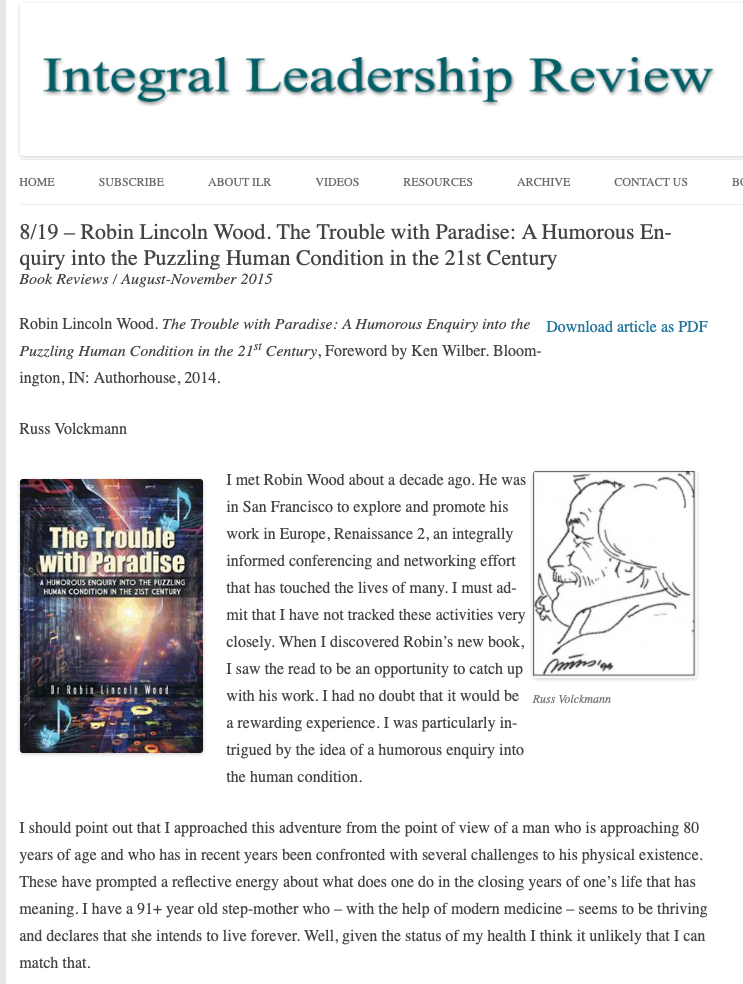
A few years ago I wrote a book called “The Trouble with Paradise — A Humorous Enquiry into the Puzzling Human Condition in the 21st Century”, with a humorous foreword by my friend Ken Wilber. See the first few paragraphs of a review below, and read the full insightful review by my late friend Russ Volckmann, legendary founder of Integral Leadership Review.
So, what does all this have to do with synchronicity, intuition and meaning?
There are dozens of excellent books on this topic, starting with the works of the legendary psychiatrist Carl Jung. Jung’s view was that, just as causal connections can provide a meaningful understanding of the psyche and reality, so too may acausal connections. Events connected by meaning need not have an explanation in terms of causality, which does not generally contradict universal causation but in specific cases can lead to prematurely giving up causal explanation. The three identifying aspects of synchronistic events are
A. Meaningful coincidence,
B. Acausal connection, and
C. Numinosity.
Jung similarly proposed three categories of synchronistic phenomena, as when there is either (1) a meaningful correspondence between a mental state and a simultaneous physical event, (2) a meaningful correspondence between a mental state and a physical event outside the individual’s perception, or (3) a meaningful correspondence between a mental state and some future event.
Who are the 21st century “paradigm-busters” blazing a path to a more coherent and useful explanation of what our world is, how it works and what becomes possible through this new understanding?
The physicist David F Peat, a colleague of the quantum physicist David Bohm, who worked with Einstein and other greats in the world of physics, has also spent a lifetime exploring the “implicate order”, a term Bohm used to describe what humans perceive as their own interior lives and experiences. Bohm described the objective, exterior realm as the “explicate order”. There are both causal and acausal effects in the interaction between implicate and explicate. Consciousness is both causal, and a response to/reflection of life conditions and events- in effect the two are inseparable in our lived experience.
This is a difficult concept to swallow for reductionist materialists for whom only exterior surfaces exist, living in a flatland of a 3-dimensional worldspace with time as the 4th dimension. Even string theorist physicists posit ten or eleven dimensions in our universe- why limit ourselves to four?
When one is dealing with the link between “objective” exteriors and “subjective” interiors, it pays to understand how to explore and research interiors- a set of skills reductionist materialists either do not possess or would rather pretend do not exist. But that is a topic for a future blog :-)
A Danish journalist once asked me to explain myself in a sentence- this is what I said:
“I am a scientist who explores both the exteriors and interiors in our universe, looking for evidence of the sources of intelligence, wisdom and love and how our human and planetary connection to those sources can help us transform what it means to be human in the 21st century.”
The Progression of the “Interior Sciences”
Since we evolved self-reflective consciousness a few hundred thousand years ago, humanity has sought to understand itself, it’s origins and our place in the universe. We have invented increasingly complex stories about our origins- every single tribe on earth from small hunter gatherer bands to larger nations of tribes, has it’s own specific origin story, gods and rituals honouring their ancestors. These stories have several functions. They explain WHO we are (identity), WHERE we came from (our origins), WHY we are here (our foundational religious, spiritual or even atheistic beliefs), and HOW we should live our lives as a result (our culture, values and mores).
The advent of monotheism that occurred some time after the dawn of the agricultural revolution, simplified things a little- one God instead of many gods- enabling larger, more complex societies to emerge and expand around the globe. The answers to WHO, WHERE, WHY and HOW became more standardised, encapsulated in various forms in a dozen or so world religions that are still with us today.
We humans are pattern recognizing creatures. We also seek meaning. We invent and share stories to connect, compress, remember and share our collective knowledge. This shared knowledge enables us to adapt to different life conditions and maintain a “golden thread” that links the past to the present in some meaningful way. And more recently, to link the past and present to the future.
As the quote this article begins with says, we’ve learned an awful lot about ourselves as a species, our universe and everything in between in a few hundred thousand years. We have co-evolved with our religions, sciences, technologies, nature and each other to the point where we can come up with some pretty robust answers and solutions to the perennial challenges and questions life poses. Yet, we have actually only just begun our quest for ultimate answers, and it is quite possible there are some questions which are unanswerable, so a large dose of humility is required in explaining the remaining mysteries of life, the universe and everything.
Which is a good place to start when we explore the phenomenon of synchronicity and it’s sister phenomena, often described as the paranormal and the psychic. While a healthy dose of scepticism is in order when dealing with mysteries, we should also remember to retain an open mind to new evidence and anomalies in existing scientific theories.
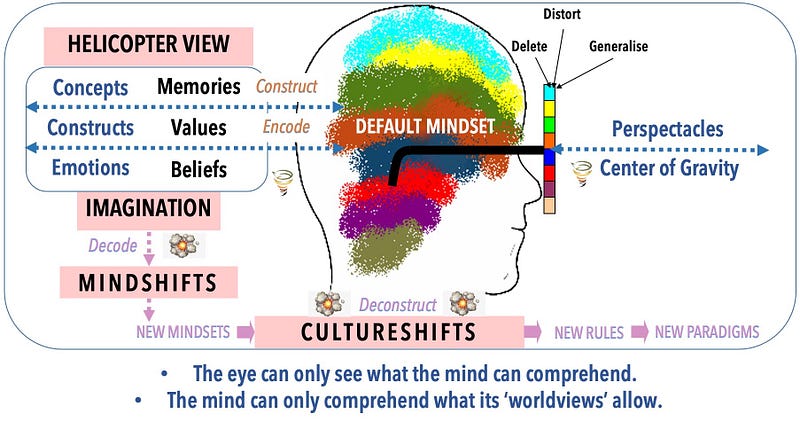
In an earlier Medium article: “On How Mindshifts, Cultureshifts & Worldshifts Catalyze Regeneration”, I summarized the four basic stages of human evolution in a simple model based on the latest cognitive science, shown in the following diagram:
DISTINGUISHING BETWEEN NEW-AGE MAGICAL THINKING AND HARD SCIENTIFIC EVIDENCE AND MODELS
There are roughly 400 scientifically validated studies and schools of research that map human development — they align around the eight stages of development I describe in that article using the above diagram. The key point here is that each stage of development interprets life events through it’s own “perspectacles”, filtered through their default mindset. Pre-modern magical and mythical mindsets have very different explanations for synchronicities to modern and post modern mindsets. Hyper rational modernists can often reject anything out of hand that does not have adequate “proof”, resulting in reductionist materialist worldviews that reject the growing hard scientific evidence for paranormal and psychic phenomena.
Post-modern and integral worldviews are more open to exploring paranormal and psychic phenomena including synchronicity, though some “green” worldcentric post-modernists have been known to be a little “new-agey” as they consume books and courses about “The Secret” and other works in this genre, which essentially promises its readers that they can attract anything they want in life simply by tuning their vibrations.
So, in this spirit of openness and curiosity, let me tell you about my own explorations into synchronicity and similar phenomena. There are some basic concepts that are essential to understanding how this all works, which explain the three key nested concepts in the diagram below: resonance (energy), alignment (information) and coherence (meaning). Aristotle’s maxim: “KnowThyself”, now comes in an integral version, too. Remember, all these processes and perspectives are synchronous, and it is possible to experience this “instantaneous apprehension of the totality” with practice. Therein lies the secret to synchronicity, which we only become fully conscious of in such higher states.
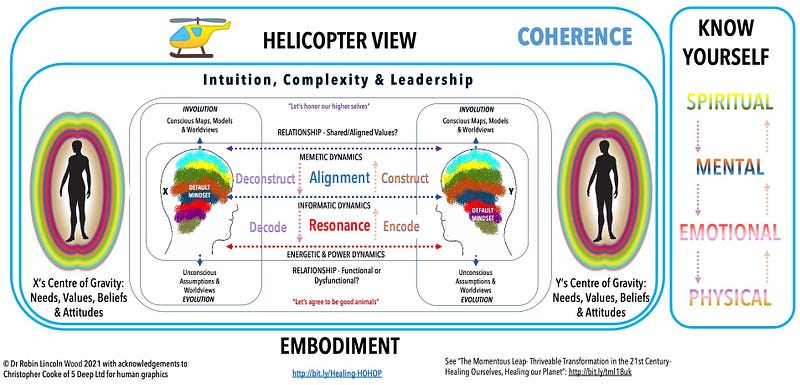
FIELDS OF ENERGY- RESONANCE- we’re all familiar with tangible fields we can walk through or play games on, but most of us are less familiar with intangible, let alone invisible, fields of energy, information and meaning, as illustrated in the diagram above. We each experience the world at the physical, emotional, mental and spiritual levels. Even if we claim not to be religious or even spiritual, we still make assumptions about the ultimate questions of life, even if those end up with claim that the universe and life in it are simply the meaningless product of blind evolution through random mutations.
I ask you to consider for a moment, several phenomena in nature which are very difficult to explain from a purely materialistic perspective. Think of the lizards that lose and then regrow their tails, or the earthworm you accidentally cut in half while gardening, where both halves grow back into a fully functioning earthworm. How does that happen?
Evolutionary biologist Rupert Sheldrake has been exploring phenomena such as this for several decades. Sheldrake calls it “morphic resonance”: “the idea of mysterious telepathy-type interconnections between organisms and of collective memories within species” and accounts for phantom limbs, how dogs know when their owners are coming home, and how people know when someone is staring at them.
In one particularly hardy type of worm, recent scientific research has identified the master control gene responsible for the regrowth of the three-banded panther worm. Cut crosswise or diagonally — and each segment will regenerate just fine, says Mansi Srivastava, a professor of organismic and evolutionary biology at Harvard University. Within eight days, you’ll have two or three fully functioning new worms, mouth, brain and all.
Plato, long before Freud, recognised that self-knowledge is a hard-won and provisional achievement
If we know ourselves reasonably well at the physical and emotional levels, we can sense energetic dynamics in and around what are now referred to as our human energy field, even if we cannot regrow limbs. You are a living energy field. Your body is composed of energy-producing particles, each of which is in constant motion. So, like everything and everyone else in the universe, you are vibrating and creating and receiving energy.
The field of vibrational medicine, sometimes called energy medicine, seeks to use the vibrational energy generated by and around your body to optimize your health. To many people, the concept of energy fields in the body may sound more spiritual than medicinal. More research must be done to understand how electrical and magnetic energy in the body stimulate chemical processes. But there’s growing evidence that these energies can be used to influence your health outcomes.
I’ve used various technologies over several decades in my exploration of information medicine, and also worked with leading Italian oncologists who have successfully treated dozens of kinds of cancers in random blind trials where the efficacy of the information medicine protocols has been proven beyond a shadow of a scientific doubt.
One of the most effective treatments I’ve used over the years, is based on bioresonance. The scientist and engineer Paul Schmidt has designed a range of machines and treatments that increase one’s well-being by determining and harmonising resonance frequencies, including “range value testing”, during which all the relevant resonance frequencies of the organism of humans and animals are identified and subsequently harmonised.
FIELDS of INFORMATION- ALIGNMENT- The relationship between the human body, emotions, thoughts and spiritual experiences, and the various energy and electromagnetic fields we form a part of, is highly complex. To use a simple metaphor, prior to fully digital media via the web, we used to have to tune analog radios and televisions to the incoming signals from the transmitters that emitted the content we watched and listened to.
The human body, emotions and mind are both transmitters and receptors of various kinds of content at various frequencies. You may have seen the movie: “Men Who Stare at Goats” with George Clooney, Ewan McGregor, Jeff Bridges, and Kevin Spacey. The film is a fictionalized version of Jon Ronson’s 2004 book of the same title of an investigation into (successful) attempts by the U.S. military to employ psychic powers as a weapon.
Physicists Russell Targ and Harold Puthoff, parapsychology researchers at Stanford Research Institute(SRI), are generally credited with coining the term “remote viewing” to distinguish it from the closely related concept of clairvoyance. Seeing remote or hidden objects clairvoyantly with the inner eye, is something I have personally done with success in remote viewing experiments organized by various university research programs. When sceptics attempt to reproduce these results, they consistently fail- “proving” their position that paranormal phenomena do not exist. What a surprise!
Psychic phenomena can only be reproduced through energetically sensitive and willing subjects. Like any skill, this takes practice, and the ability to calm the mind into a deep, meditative state. I have several friends who are unable to meditate at all. Some won’t even/can’t close their eyes when invited to do so in small group exercises requiring imagination and the ability to tune into one’s own electromagnetic resonance. Naturally, putting such subjects into experiments to disprove paranormal phenomena is like taking a random group of ten year old boys to the gun range and expecting them to reproduce the bullseye target capabilities of a sharpshooter, a skill I perfected in my military training. “Hey look everyone, our randomised trials with novices failed to prove that humans can hit a target at 1000m range!” say the sceptics.
This is no more than the sceptical claptrap of highly insensitive people and researchers trying to prove thattheir narrow view of the kosmos is right, in areas where enormous sensitivity and training are required. Richard Dawkins and other unimaginative, limited, reductionist materialists, be warned- your game is empty and transparent. There is much more in heaven and earth than is dreamed of in your philosophy, Horatio, as Shakespeare put it.
Some of the psychic phenomena or abilities described in ancient texts such as the Yoga Sutras include precognition, usually described as ‘becoming aware of past, present and future, all at once’, being able to see beyond the constraints of ordinary space time. This sometimes spontaneously happens in people who are doing meditation, along with clairvoyance.
We know that this happens through surveys of both beginning and advanced meditators, that they will sometimes describe experience of as spontaneous telepathy or knowing things at a distance, and other times as “crazy synchronicities”. These are very common for people who are engaged in diligent meditation practice.
Meditators don’t need much talent to get glimpses of clairvoyance, telepathy and that sort of thing. But at the far end, where people have high natural talent, we’re talking about powers like levitation, bi-location, and invisibility. Those effects, at this point, we cannot verify in the laboratory because if they in fact exist, they are also extremely rare. There are the stories of people who are able to do that, but at this point they remain stories.
If there are people out there who can do these things, they’re either not willing to come into the laboratory to have it tested, or they come from a tradition where you’re not supposed to pay much attention to these kinds of effects, because they distract you from the goal of enlightenment.
Now meditation, mindfulness and the quest for enlightenment is becoming more popular in Western culture — especially mindfulness, which has just exploded in popularity. Are there lessons that practitioners of this could take from recent research to make their meditation more effective?
“Mindfulness is a form of mental activity that trains the mind to become aware of awareness itself and to pay attention to one’s own intention.” ― Daniel J. Siegel, Mindsight: The New Science of Personal Transformation
It depends on what your goal is. Meditation as taught in the West includes all kinds of techniques. Mindfulness, for example, is basically a vanilla form of Vipassanā, but there are lots of other techniques. Meditation is discussed almost entirely in terms of on stress reduction, and mental and physical health — and while that is part of classical yoga, the real goal of meditation was to attain enlightenment, and recognize who you truly are.
If you wanted to develop psychic abilities, and people ask me all the time how they can do this, then the time honored approach is simply to meditate using any method at all. You can do sitting meditation, walking meditation, or many other methods — but you have to quiet the mind and focus. That’s basically it. Once you begin to do that, you transcend the everyday world and reach deeper levels of consciousness, which is where these phenomena reside.
So open minds, a little humility and basic common sense should be the rule knowing the only real constant is change and new information comes on through time.
Nonetheless, despite the incredible progress we have made in our explorations as a species, we still struggle to answer some very basic questions with any degree of consensus, despite a great deal of evidence that the currently dominant, materialistic scientific paradigm is deeply flawed and overdue for a reboot. For example, biologist Rupert Sheldrake takes on the materialists in his latest book: “Science Set Free”. He asks materialists ten hard questions, and then offers a great deal of compelling evidence to suggest that the “scientism” of the materialists is unable to answer these questions with a resounding “Yes!” or even a tentative “Perhaps”.
Using compelling recent evidence and scientific discoveries, Sheldrake questions some fundamental assumptions of the materialistic paradigm, including:
- Physics and Chemistry- Is Nature Mechanical? Is the Total Amount of Matter and Energy Always the Same? Are the Laws of Nature Fixed?
- Biology- Is Matter Unconscious? Is Nature Purposeless? Is All Biological Inheritance Material?
- Psychology- Are Memories Stored as Material Traces? Are Minds Confined to Brains? Are Psychic Phenomena Illusory?
- Medicine- Is Mechanistic Medicine the Only Kind that Really Works?
Tens of thousands of impeccably conducted, predominantly double-blind randomized trial experiments over the past fifty years have demonstrated that there are fundamental flaws in the current dominant scientific paradigm, as Sheldrake demonstrates in “Science Set Free”.
Yet the new scientific paradigm which has been emerging in the wake of the “weirdness” of quantum physics and the inability of the Multiverse and String Theories to agree on some fundamental aspects of how our universe arose, how it works and where and how it will end (if it ends at all), is still in the process of formation, with much scope for disagreement and further refinement.
We are used to thinking of our world as matter and energy. Our education systems teach physics, biology and chemistry to students who learn that energy is simply equal to mass through Einstein’s famous equation: E= mc2- the amount of energy in any physical system is equal to the mass of that system times the speed of light squared.
Later on, some students might be lucky to learn something about information theory, information technology or communications, where information is treated as communication between two different systems, human or machine.In information science, it turns out that E=mc2=log k x w. That is the log of k (Boltzmann’s entropy co-efficient) times the number of ways in which a system can be arranged, which is a primitive way of measuring the amount of information in any system.
As you read this on any computing device, the chips inside your device are converting raw electrical energy into information through trillions of zeros and ones encoded into five or so basic logic gates programmed into those chips, interacting with the software you are using and the raw informatic content embodied in the internet globally. This would have seemed pure magic, along with free video calling, even thirty years ago.
Medical and healthcare education is also based on similar “matter and energy” premises, so it is not surprising to find out that much of modern medicine and healthcare is based upon physical and chemical interventions. At the other extreme, information technologists take information for granted, as invisible bits and bytes that pass magically through their systems and can be made more or less useful depending upon the models they use to design and run their systems. They never stop for a minute to ask what that information actually is, and where it originates- it just “is”.
Einstein is famously known to have received his ideas as images in dreams and thought experiments, and frequently stated that he did not think in symbols, but in images. Most creative people, going back to the ancient Greek philosophers, are on record that they are interacting with a realm of images which can be reduced to symbols in language and numbers. Psychologists such as Carl Jung explored this realm as the “collective subconscious”, and quantum physicists such as David Bohm called it the “implicate order”.
A similar phenomenon is reported by scientists exploring paranormal phenomena such as psychic communication, remote viewing, spontaneous healing, human energy fields, near death experiences (all scientifically validated though still not well explained) and extra sensory perception, clairvoyance, telepathy, ghosts (still under investigation but growing evidence of their existence). In other words, a world of mainly images and sounds along with experiences that are often described as “out of body” appears to exist in parallel with our physical and energetic world.
One of the trickiest things about investigating such phenomena, is that many of the experiments appear to require people with open minds for them to work. Active skeptics who attempt to disprove such phenomena succeed in failing to elicit the phenomena, thus acting out a self-fulfilling prophecy which proves nothing. It seems that there is some kind of “tuning” going on between those who can access the frequencies that give access to this parallel world of information.
From a classic model of the universe that comprised bits of matter rotating around each other in empty space, we have come to a 21st century synthesis which describes the universe as an entangled, holographic, non-locally connecting in-formation field. What Einstein described as spacetime, is actually a “zero point field” or “quantum vacuum” described by quantum and string theory physicists, and it is this unified field that is “made of” information.
As scientist and philosopher Ervin Laszlo puts it:
“This is the “in-formation” that structures the physical world, the information we grasp as the laws of nature. Without information the energy-waves and patterns of the universe would be as random and unstructured as the behaviour of a computer without its software. But the universe is not random and unstructured; it’s precisely “in-formed.” Would it be any the less precisely informed, complex systems could not have emerged in it, and we would not be here to ask how this on first sight highly improbable development could have come about.”
Science suggests that our brains can open to this unified information field (or information based “A- field”, as referred to in several recent books) , and that this can happen in many ways, from dreams to daydreaming to imaginative thought experiments to spiritual experiences. Not only do our brains enable us to tune in to this latent information all around us, our bodies and all of nature are already doing so to synchronize their activities and stay alive. From our DNA synchronizing its activities through the emission of photons to our ability to sense the state of another human being or animal, we use this ability every moment without giving it a second thought.
Although I’ve narrowly escaped death several times racing cars, flying gliders and light aircraft, and in brushes with several deadly illnesses, I’ve never had an out-of-body experience, but I know several people who have, in addition to the hundreds of books and research papers by medical professionals on the topic. To my mind there is no question that the information that constitutes our unique evolutionary self persists after death, when all the evidence is taken into account. I’ve also experienced this firsthand through past-life regressions, and my research into the work of medical practitioners and psychiatrists such as Stevenson, who have amassed a great deal of evidence regarding past-life experiences.
In Stevenson’s research, about 35 per cent of children who claim to remember previous lives have birthmarks or defects that they attribute to wounds suffered by a person whom they represented in an earlier existence. A total of 210 such children have been investigated by Stevenson’s research team. In those instances in which it was possible to identify a deceased person the details of whose life reliably matched the child’s statements, a close correspondence was nearly always found between the child’s birthmarks and defects and wounds known to have been inflicted on the deceased person’s body.
This is currently the only objective evidence in favour of the hypothesis of reincarnation. A less tangible kind of evidence occurs: remembering a previous life may have a specific positive outcome in adulthood, and conversely children who recall a previous life may become neurotic as a direct result of the circumstances. Many child subjects may experience turmoil of conflicting personal loyalties between their present and previous families.
I have personally experienced precognition in rare moments, which has saved my life, as well as telepathy, which means I can sometimes “read” people’s thoughts and emotions, even at a great distance. When we first met, my wife and I discovered, despite her having grown up in Russia and me in the West with zero cultural intersection or shared experience beforehand, that we would often say exactly what the other was thinking, before they said it. Unlike older couples who might simply have shared routine patterns of thought and occasionally finish each other’s sentences, the only thing that connected us was the incredible energetic resonance between us. We are opposites in terms of personality, thinking styles, and interests, yet share this unbreakable bond.
What would it mean for the future of our world to start from an understanding of information as the basis for our universe, rather than matter and energy bumping into each other in “spacetime”? We would see things very differently, and certainly a lot more creatively and productively.
FIELDS of MEANING- COHERENCE- In semantics, philosophy of language, metaphysics, and metasemantics, meaning “is a relationship between two sorts of things: signs and the kinds of things they intend, express, or signify”. The types of meanings vary according to the types of the thing that is being represented.
Who am I? We all ask ourselves this question, and variations on that theme. Is my identity determined by my DNA or am I product of how I’m raised and my life conditions? Can I change, and if so, how much? Is my identity just one thing, or can I have more than one? Since its beginning, philosophy has grappled with these questions, which are important to how we make choices and how we interact with the world around us. Socrates thought that self-understanding was essential to knowing how to live, and how to live well with oneself and with others. Self-determination depends on self-knowledge, on knowledge of others and of the world around you. Even forms of government are grounded in how we understand ourselves and human nature. So the question ‘Who am I?’ has far-reaching implications.
Understanding Consciousness, the Mind and Meaning Making as Networked Phenomena
Many philosophers, at least in the West, have sought to identify the invariable or essential conditions of being a self. A widely taken approach is what’s known as a psychological continuity view of the self, where the self is a consciousness with self-awareness and personal memories. John Locke, Rene Descartes and contemporary animalist and psychological approaches posit the body as a container of psychological functions or the bounded location of bodily functions.
But what if who we are is actually a networked self, that changes, learns and transforms through the connections we inherit and create through our relationships in family life, work and play? Change the strength of the connections, or change the nodes in the network, and we become different people, for better or worse. What if the stories we tell about ourselves shift regularly based on what we have learned about ourselves through the networks we move in and out of over time?
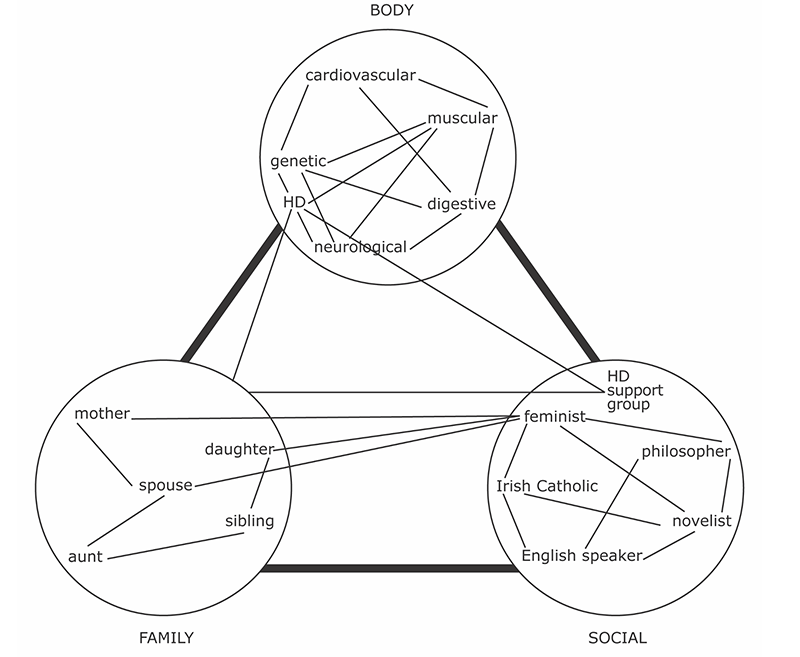
That the self is a network and a process is more plausible than you might think. Paradigmatic substances, such as the body, are systems of networks that are in constant process even when we don’t see that at a macro level: cells are replaced, hair and nails grow, food is digested, cellular and molecular processes are ongoing as long as the body is alive. Consciousness or the stream of awareness itself is in constant flux. Psychological dispositions or attitudes might be subject to variation in expression and occurrence. They’re not fixed and invariable, even when they’re somewhat settled aspects of a self. Social traits evolve. As Kathleen Wallace, author of the Networked Self puts it:
One of the most important contributors to our sense of wellbeing is the sense of being in control of our own lives, of being self-directing. You might worry that the multiplicity of the network self means that it’s determined by other factors and can’t be self-determining. The thought might be that freedom and self-determination start with a clean slate, with a self that has no characteristics, social relations, preferences or capabilities that would predetermine it.
But such a self would lack resources for giving itself direction. Such a being would be buffeted by external forces rather than realising its own potentialities and making its own choices. That would be randomness, not self-determination. In contrast, rather than limiting the self, the network view sees the multiple identities as resources for a self that’s actively setting its own direction and making choices for itself.
Lindsey might prioritise career over parenthood for a period of time, she might commit to finishing her novel, setting philosophical work aside. Nothing prevents a network self from freely choosing a direction or forging new ones. Self-determination expresses the self. It’s rooted in self-understanding.
So, we find meaning, find “ourselves”, our identity, even our purpose, in a networked story of who we are. As Dr Dan Siegel explains:
“Integration is not the same as blending. Integration requires that we maintain elements of our differentiated selves while also promoting our linkage. Becoming a part of a “we: does not mean losing a “me.” Integration as a focus of intervention among a range of domains of integration becomes the fundamental basis for how we apply interpersonal neurobiology principles to the nurturing of healthy relationships.” ― Daniel J. Siegel, Pocket Guide to Interpersonal Neurobiology: An Integrative Handbook of the Mind
The networked, information-based model appears to give us a better explanation of how the mind works, and what can be done to promote the growth of vibrant lives and healthy minds. As Neuroscientist Dr Daniel Siegel points out:
“[Mind is] an embodied and relational process that regulates the flow of energy and information, consciousness included. Mind is shared between people. It isn’t something you own; we are profoundly interconnected. We need to make maps of We because We is what me is!”
As Dr Deepak Chopra points out, by taking this definition of mind one word at a time, we can explain the mind and consciousness in a single paragraph:
“The mind makes itself known through an organ of the body, the brain (“Embodied”). Our minds reflect the environment around us. We are constantly being shaped by the people around us, responding to their habits, speech, gestures and facial expressions (“Relational”). Mind is an activity. It isn’t static but dynamic (“Process”).
The jumble of data the universe produces would be chaotic unless something organised it into a coherent reality. To keep reality intact, each part must be regulated with every other part. (“Regulate”). There is an uninterrupted stream of consciousness to parallel the uninterrupted stream of external events. (“Flow”).
To keep the flow going takes energy, at all levels from the immensity of the Big Bang to the micro level of ions passing through the cell membrane of a neuron. (“Energy”). Every piece of data can be seen as information, containing a bit of meaning. (“Information”).”
The development of healthier, more creative minds and hearts, and more effective treatments for psychological illnesses, are both high potential applications of the information-based model. The fully integrated human being capable of thriving and contributing to the flourishing of those they interact with is increasingly a reality for millions of people who are benefitting from such insights into our mind and consciousness.
Through consciousness, subjective experience, and information processing, we are able to uncover our mind’s self-organizational properties that emerge from both our bodies and the relationships we have with one another, and with the world around us. Yet even more profoundly than what we are consciously aware of, we find our deepest values are unconsciously held, like the 80% of the iceberg beneath the water line, while our conscious minds may be aware of 20% or less of what is actually motivating us and directing what and who we pay attention to, and why.
To close this article, I’ll simply say that most synchronistic moments and events can only be recognised in hindsight, until one becomes adept at paying attention to one’s own thinking process, becoming concept aware and able to helicopter dispassionately above our own thoughts, intentions and desires before diving into actions and decisions.
Only in hindsight was I able to recognise the synchronicity of the way I met several of my business partners in my startups; how I found and fell in love with the woman of my dreams; realised my vision for an Oasis where I could create a small corner of paradise for social innovators in the south of France; and of course, got the ideas that became my eight books and hundreds of articles. Synchronicity is real, and beautiful, if only we can pay enough attention to what is emerging inside us in the flow of everyday life.
Pay close attention to those quiet insistent voices in your head we often call our conscience or higher self; notice the images and sounds wandering through your mind that seem to stand out as particularly important; open your mind and heart to the infinite possibilities that are actually all around you at every moment which you may barely notice while you are caught up in the midst of life’s dramas and crises. It could change your life, forever. It certainly changed mine.