avatarBrett Berry

Free AI web copilot to create summaries, insights and extended knowledge, download it at here

2081

Abstract

the truth values in column B. If you’re using a pencil, you can erase column B and simply replace it with ~B.</p><p id="1ae6"><b>Step 3: </b>Next we need to compute (A ∧ ~B) and (C ∨ D). We’ll add two more columns onto our table for these computations.</p><p id="1e52">For logical conjunction, i.e. the AND operator, we need both A and ~B to be True to result in True. For OR, we only need one of either C or D to be True to result in True. Use this knowledge to fill in the last two columns.</p><figure id="9c65"><img src="https://cdn-images-1.readmedium.com/v2/resize:fit:800/1*sXyssDQkgccLTkcnVqC0Ag.png"><figcaption>Step 3</figcaption></figure><p id="5ea5"><b>Step 4: </b>This is the last step! Add one more column to the end for our final computation: (A ∧ ~B) → (C ∨ D).</p><p id="3c7f">We know that there is only one case in which implication (→) is false, and that’s when T → F. So check the (A ∧ ~B) and (C ∨ D) columns for this case. There is only one row where this happens in our table. Mark that result as F, and the rest as T.</p><figure id="627f"><img src="https://cdn-images-1.readmedium.com/v2/resize:fit:800/1*s6rdopqZ6GfnzDM2PCxJDA.png"><figcaption>Solution: Truth Table for (A ∧ ~B) → (C ∨ D)</figcaption></figure><p id="572a">As messy as this may seem at a glance, it is just a simple application of the definitions presented in the last post. Just remember to always take it one little piece at a time.</p><p id="71ee"><b><i>→ For more math tutorials, <a href="https://www.youtube.com/c/mathhacks?sub_confirmation=1">check out Math Hacks on YouTube!</a></i></b></p><div id="2055" class="link-block"> <a href="https://www.youtube.com/c/mathhacks"> <div> <div> <h2>Math Hacks</h2> <div><h3>Welcome to Season Two of Math Hacks! This season we'll be covering topics from Algebra and Trigonometry as well as…</h3></div> <div><p>www.youtube.com</p></div> </div> <div> <div style="background-image: url(https://miro.readmedium.com/v2/re

Options

size:fit:320/0*LecSrxiM_BHqpHqE)"></div> </div> </div> </a> </div><div id="611d" class="link-block"> <a href="https://readmedium.com/intro-to-truth-tables-boolean-algebra-73b331dd9b94"> <div> <div> <h2>Intro to Truth Tables & Boolean Algebra</h2> <div><h3>A truth table is a handy little logical device that shows up not only in mathematics, but also in Computer Science and…</h3></div> <div><p>medium.com</p></div> </div> <div> <div style="background-image: url(https://miro.readmedium.com/v2/resize:fit:320/1*8E9UI2hsBWhIz5_SRvR5uQ.png)"></div> </div> </div> </a> </div><div id="3435" class="link-block"> <a href="https://readmedium.com/top-10-secrets-of-pascals-triangle-6012ba9c5e23"> <div> <div> <h2>Top 10 Secrets of Pascal’s Triangle</h2> <div><h3>Binomial Theorem, Fibonacci Sequence, Sierpinski Triangle & More</h3></div> <div><p>medium.com</p></div> </div> <div> <div style="background-image: url(https://miro.readmedium.com/v2/resize:fit:320/1*BswW10Q9p_FaVhubzwsrTA.png)"></div> </div> </div> </a> </div><div id="58ba" class="link-block"> <a href="https://readmedium.com/combinations-permutations-fa7ac680f0ac"> <div> <div> <h2>Combinations vs Permutations</h2> <div><h3>We throw around the term “combination” loosely, and usually in the wrong way. We say things like, “Hey, what’s your…</h3></div> <div><p>medium.com</p></div> </div> <div> <div style="background-image: url(https://miro.readmedium.com/v2/resize:fit:320/1*BAkJ645c6yt4-IJZifGC_A.png)"></div> </div> </div> </a> </div></article></body>

An Example of

Symbolic Logic With Truth Tables

We covered the basics of symbolic logic in the last post. Now let’s put those skills to use by solving a symbolic logic statement.

Last Post

Generating a Truth Table for (A ∧ ~B) → (C ∨ D)

The key to solving this problem is to break it down into it’s simplest components and take it one piece at a time.
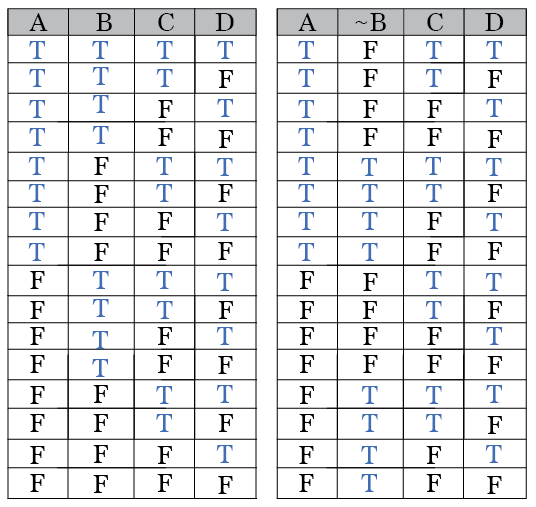
Steps 1 and 2

Step 1: We have 4 variables, so we need 4 columns. We’ll also need 16 rows since their are two options for each.

The easiest way to lay out the table is to use an alternating T/F pattern.

In the first column fill in the first half with T and second half with F. Then alternate T/F every 8÷2, or 4, in the second column. Keep the pattern going by alternating T/F every 2 in the third column and every other space in the final column. This covers all possible permutations.

Step 2: We need ~B instead of B, so flip all the truth values in column B. If you’re using a pencil, you can erase column B and simply replace it with ~B.

Step 3: Next we need to compute (A ∧ ~B) and (C ∨ D). We’ll add two more columns onto our table for these computations.

For logical conjunction, i.e. the AND operator, we need both A and ~B to be True to result in True. For OR, we only need one of either C or D to be True to result in True. Use this knowledge to fill in the last two columns.
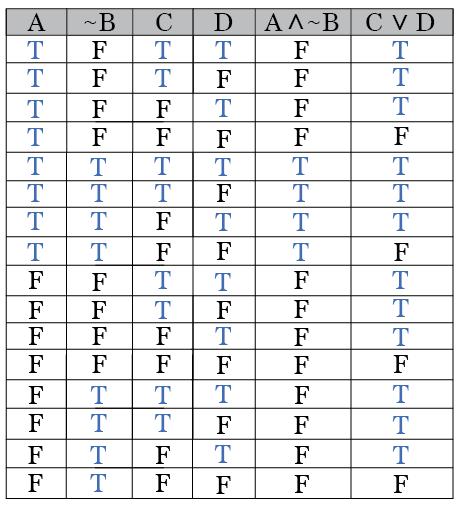
Step 3

Step 4: This is the last step! Add one more column to the end for our final computation: (A ∧ ~B) → (C ∨ D).

We know that there is only one case in which implication (→) is false, and that’s when T → F. So check the (A ∧ ~B) and (C ∨ D) columns for this case. There is only one row where this happens in our table. Mark that result as F, and the rest as T.
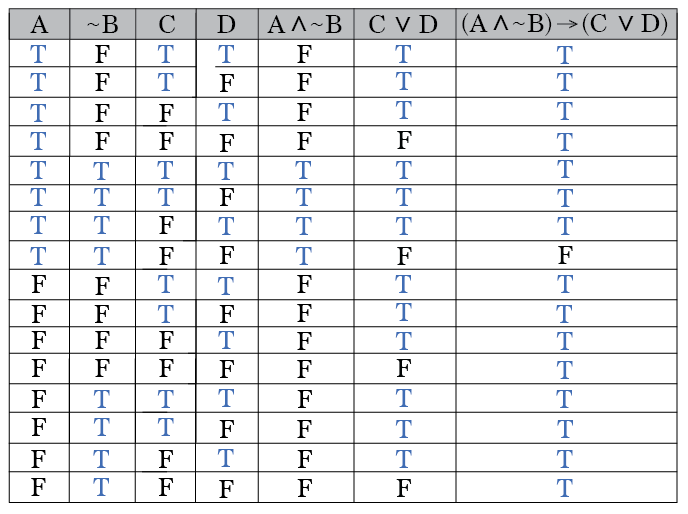
Solution: Truth Table for (A ∧ ~B) → (C ∨ D)

As messy as this may seem at a glance, it is just a simple application of the definitions presented in the last post. Just remember to always take it one little piece at a time.

→ For more math tutorials, check out Math Hacks on YouTube!

Programming
Logic
Math
Mathematics
Learning To Code
Recommended from ReadMedium