SWOT Analysis Template
Resources for the go-getters, head-breakers, and goal-chasers!
Get it!
As part of the Extend Node for Entrepreneur’s vision to provide value to you, the reader.
I present the SWOT analysis template for your use and free distribution.
What is SWOT Analysis?
A SWOT analysis is a planning tool used to understand the Strengths, Weaknesses, Opportunities, and Threats involved in a project or a business. It involves specifying the objective of the company or project and identifying the internal and external factors that are supportive or unfavourable to achieving that goal.
Albert Humphrey developed the SWOT Analysis durring a research project at Standford University during the 1960s & ’70s. The focus of the research was to identify why top companies failed to perform. Humphrey was a business and management consultant who specialized in organizational management and cultural change.
How does it work?
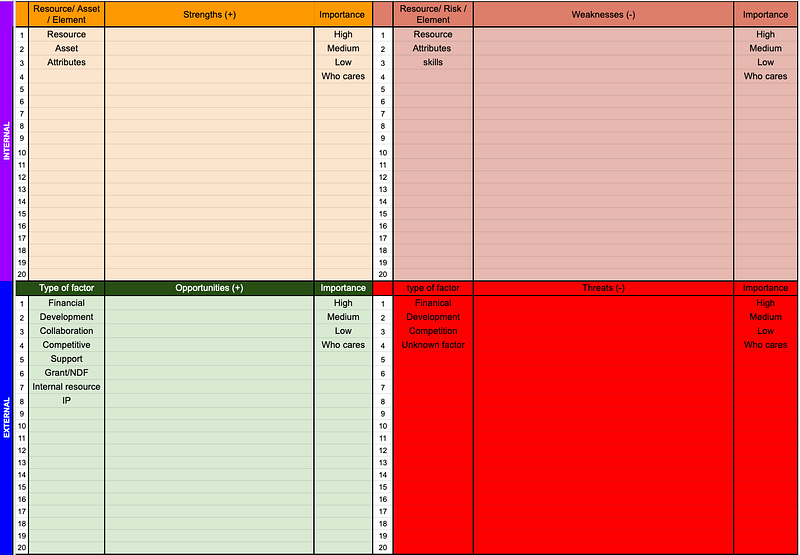
The template provided above serves to help you centralize all of the data captured about a specific analysis. The analysis itself occurs as the process takes place. Our team specifically conducted this over a series of mini-brain-storming sessions in a one-day workshop. This provided adequate opportunities to look at different perspectives and ensure we thoroughly analyzed the data we had available.
What specifically are we analyzing?
Strengths
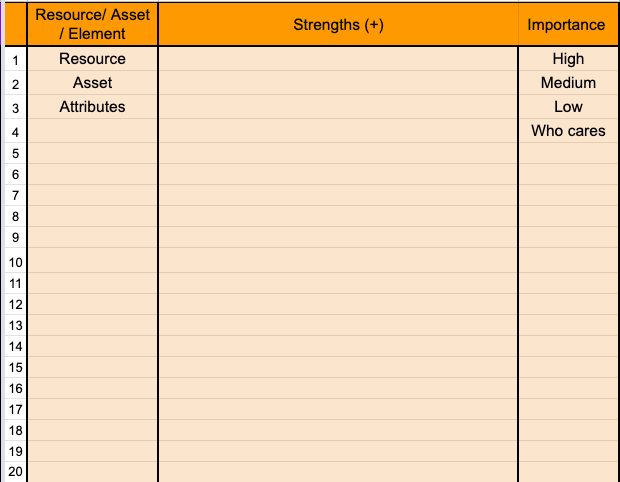
- Resources you have available to your team or company that strengthen your position.
- Assets your team or company may have or can acquire before beginning the project.
- Positive tangible and intangible attributes, your team’s “why” and team member’s specific skillsets.
- These strengths are within your team’s control.
- They can be tangible and intangible.
Weakness
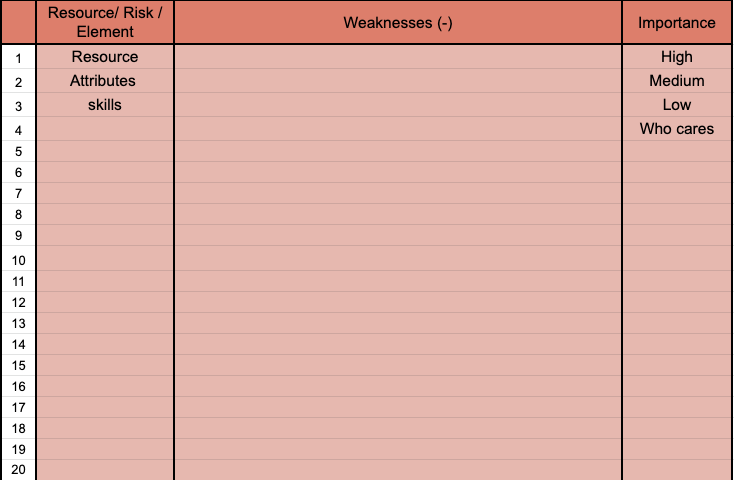
- Resources that your team or company may not be able to obtain or utilize.
- Factors that are within your team’s control that detract from its ability to attain the desired goal.
- Areas that you’ve identified an internal weakness or space to improve?
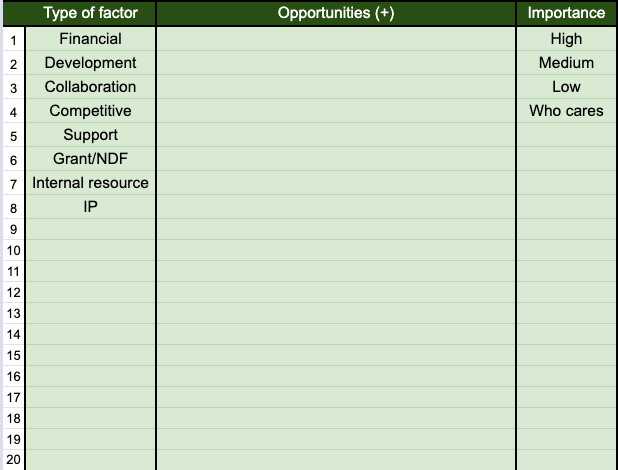
Opportunities
- Attractive external factors that represent the reason for you to develop your product or service. These should be concrete and validated through stringent testing and analysis.
- What opportunities exist in the environment, which will propel the product or service? Identify them by their “time frames” and quantify these opportunities. Quantifying your prospect does not translate into a single slide with a Total Addressable Market, Serviceable Addressable Market, and Serviceable Obtainable Market (TAM, SAM, SOM.) Take the time and do your homework, really figure out your SAM and SOM, because your success depends on it.
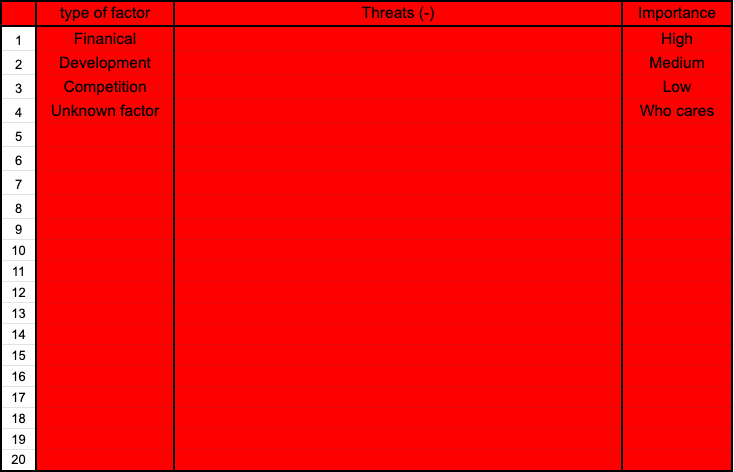
Threats
- External factors, beyond your team’s control, which could place the company’s mission or project at risk.
- Your company will benefit by having contingency plans to address them if they should occur.
- Financial threats are genuine in the start-up hustle. How much money do you need for a full year of development run-way? How do you plan to raise capital? What milestones do you need to achieve before you can start raising that capital?
- Though competition is rarely the death of start-ups (No product-solution fit, and running out of capital are the big killers.) It is critical you watch what’s happening in the market and stays informed about your competitors. Our team took the time to conduct a SWOT analysis for all of our major competitors, and it yielded great results.
What’s next
Classify every element in every category by their “seriousness” and “probability of occurrence.” Ensure that your entire team is in agreement about this document, and discuss regularly. We revisited our SWOT analysis on a semi-annual basis to ensure we stayed current and aligned with the internal and external opportunities and threats.