
Switching career to Data Science in your 30s.
Don’t dwell on questions that already have answers. Here are three things I wish I knew before starting my career transition to Data Science.

You have reached a point in your career that it does not make sense to continue doing the same thing. Maybe you are bored, don’t earn as much as you deserve or, like me, simply never liked your job. Amidst a career turmoil, you came across data science and noticed there is a massive opportunity by switching careers. Also, you have found several coding tutorials on YouTube by Data Scientists.
However, despite many experts online, maybe a few of them have been in a career transition to data science. Probably even fewer did such a change from a completely unrelated field in their late 30s. This suggests that what you have been watching/reading may not apply to your reality. That said, you should watch those videos with a pinch of salt. After all, you do not want to waste your valuable time. So, here are three things I wish someone in a similar career and life stage would have told me before making a career change to data science:
1- Choose Python and move on.
If you have done your homework, then you know there are basically two programming languages optimal for a career in data science: R and Python. Although R is used among statisticians and researchers, and it can be used for Data Science, Python is by far your best choice.
For those with little or no background in programming, Python is the most accessible programming language. It is incredibly easy to learn due to its simplified syntax, which makes coding faster compared to other programming languages, such as Java. This is an advantage as Python allows those who are amateur programmers to read your code and collaborate with you. Therefore, Python can increase productivity and accelerate your career transition.
Python allows you to take data directly from the web, which is perfect for those who want to work with data analysis and generate insights or predict certain human behaviours. Data collection will be painless, which means you can build your own portfolio on GitHub at your own pace. More importantly, most of the data processing using machine learning and research around artificial intelligence is developed with Python language. This is because Python offers hundreds of libraries such as TensorFlow for neural networks and NumPy for working with arrays, matrices and high-level mathematical functions.
Don’t dwell on which programming language you need to learn. This decision can save you valuable time, especially if you are in your 30s. So, choose Python and move on.
2- Don’t fall for quick tutorials, prioritise a structured course.
Because Data Science is a hot topic, multiple YouTubers are offering quick alternatives for beginners: ‘Pandas in 10 min.’ However, researchers say that the learning process is relatively slow, requires repetition and is most effective when distributed across spacing intervals [1][2]. Therefore, a well-structured curriculum is vital to building a solid foundation in a new skill, such as programming. Also, don’t forget that programming requires both cognitive (new syntax) and motor skills (typing). This means it is practically impossible for beginners to learn Python in a few hours, let alone in ten minutes from watching a video on their mobile phone.
What is the solution? It depends on how much you want to invest at this stage. Below are three options:
- Free without a certificate: simply go to Coursera and search for ‘Programming for Everybody (getting started with Python)’ from the University of Michigan.
- One-time payment and low cost: go to Udemy and search for ‘Complete Python Bootcamp From Zero to Hero in Python’ from Jose Portilla.
- Monthly membership but more depth: in this category, you can choose platforms, such as Codecademy. These platforms offer a Data Science with Python track and now more specific courses in Deep Learning, like this one below:
- Learn SQL asap. This is an underestimated skill in most bootcamps but a key skill in any data job. My suggestion is SQL Habit.
My recommendation is to try DataQuest. Not only for the well-structure curriculum but also for something that might surprise you and is what brings me to the third and last thing I wish someone told me before.
3- Learn by doing, not by watching — literally.
Watching a video tutorial seems the preferred learning method of the 21st century. It is easy to find a video online; you only have to click on play and could even multitask. However, when learning data science and programming, watching videos is NOT the optimal learning format.
I am sure you have watched a video on how to write a function or a code. But, have you watched it whilst trying to understand the logic behind a code and typing on your keyboard? As Python and functions get more complicated, learning from videos, do not work. As a consequence, you will often have to watch over and over the same explanation, which is less effective and time-consuming. Basically, you will spend a lot of time pausing the video and trying to find the precise minute/second you want to start watching again. This is annoying.
That said, I strongly recommend DataQuest because their lectures are not videos but texts. You have to read and then start typing what you read. It seems a bit old school, but it works really well for beginners, who require more time to process what they are learning. They provide you with the instructions and a script area to test your code on the same screen. Their format is simply perfect for those who are seeking to optimise their study time.
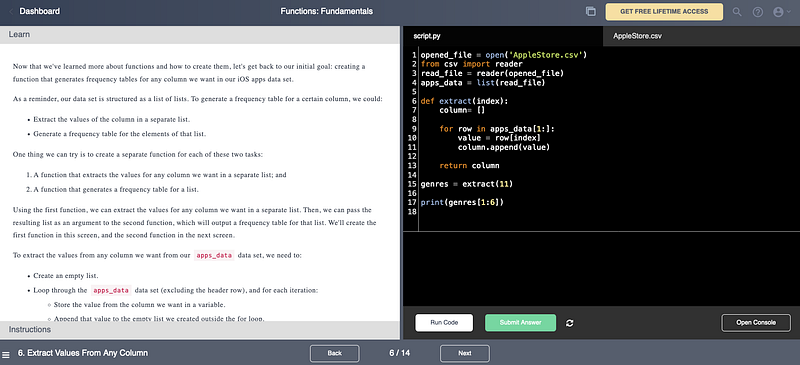
Last but not least, the DataQuest curriculum is created based on real-life data, such as Android & iOS apps, MoMa artworks, S&P500. This is important because you will learn by doing. Their approach will make a significant improvement to your learning curve. Again, this will save you valuable time and make you more motivated to switch careers as you see what it is like to work as a Data Scientist. I will write a more in-depth review on DataQuest, so watch this space.
Conclusion
In conclusion, if you are in a career transition to Data Science, probably in your 30s, then you don’t want to waste time on questions that already have a clear answer. For this reason, I have outlined what I wish someone told me before starting my career change:
(1) focus on Python and SQL.
(2) choose a well-structured course to get a solid foundation as you progress to more complex topics such as machine learning.
(3) learn by doing real projects, not by watching simple videos on YouTube.
I hope this post has helped you in some way. If you want to give DataQuest a try, then just check their website and start their free trial. As a disclaimer, I don’t receive any compensation from DataQuest or any other platform mentioned in this post in exchange for my recommendation. So, let’s get to work.
Want to get full access to Medium articles and support my work? Subscribe using the link below:
References:
[1] J. D. Karpicke and A. Bauernschmidt. Spaced retrieval: absolute spacing enhances learning regardless of relative spacing (2011). J. Exp. Psychol. 37 (5) 1250–1257.
[2] N. J. Cepeda, et al. Spacing effects in learning. A temporal ridgeline of optimal retention (2008). Sage Journals Psychological Science 19 (11): 1095–1102
Disclaimer:
This post includes affiliate promotions. Nevertheless, all courses suggested in this post, I have tested and used it.