
Swimming on the Cote D’Azur
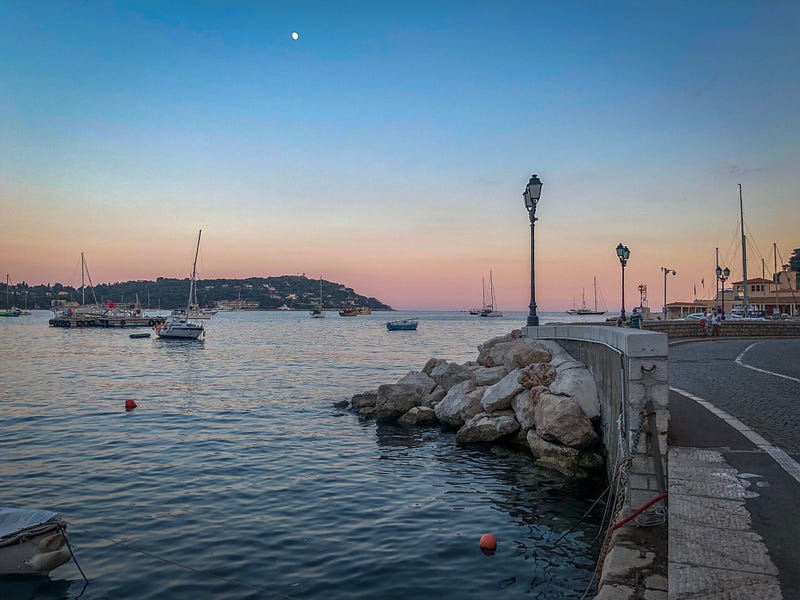
I’m swimming, in October.
This isn’t the warm bath of the Caribbean, soaking up endless sun in between annual explosions of stormy wrath. Nor is it the ink-black, heart-stopping icewater of Vancouver. Beyond the narrow band of smooth rocks that guard the entrance to the sea, hiding just below the surf, your breath will catch as you plunge into the blue. But you will adjust. When the stolen heat of the Mediterranean sun is washed away and your core temperature more closely reflects the water’s, you’ll be quite comfortable.
The water is shallow for a while, the drop into the deep gradual. And if you stand up, tiny silver fish dart into the cloud of sand your feet kick up, filtering dirt and water through their mouths while you lumber past in slow motion. I’ve always loved the sea and cursed the fates that had me born in the English town furthest from any coast. But it’s an attraction laced with fear. There are things out there against which a lone human has no defense, and even the water itself can kill. In Hawaii, they say you should never turn your back on the sea. Beautiful and deadly, a femme fatale with tight dress and drawn gun.
This isn’t Hawaii either. There’s no crackling coral; with ears below the water, all I hear is shifting sand. And music. I’m still hearing the melodies from last night’s concert, Offenbach’s Orpheus bouncing back from the white walls of the Roman amphitheater shattered by time, and the blue wavelets lift their skirts and flash bright limbs under the Riviera sun. We’re lucky to be here, and don’t think for a second that I don’t know it. People our age are raising children, reaching for the first few rungs of the property ladder, testing at the tensile strength of their first marriages. But instead of doing that, we’re pissing around on the Med.
In Canada, everything is awesome. You got a day off from work? Awesome. Your barista got your name right? Awesome. You want aioli dip with your yam fries? Awesome! When I first moved to Vancouver, it struck me as risible. Then it was comical. Then I stopped hearing it, shortly before I began to say it myself. But the thing is, some things actually are awesome, and the sea must surely be one of those things. I love it and I fear it, and far from being at odds, the two feelings feed each other. There’s more to awe than love and fear, just as you need more than vermouth and gin to make a martini. But that’s where it starts.
The locals here have tans that go down to the bone. That’s how you can tell them from the tourists. And even in October, an hour or two on the beach will expose you to Italian, German, English, Norwegian. Without the crowds of summer, Juan les Pins still gets plenty of visitors. You only have to look at the herds of luxury yachts clustered in every harbour from here to Monte Carlo to see how blessed this peninsula is.
If you survive the threat of sharks — there are Great Whites in the Mediterranean, no matter what the tourist office says — and the much more likely sting of the beautiful and beautifully named meduse jellyfish, you’ll find that the water in the showers dotted along the beach is warm from the autumn sun, at least for a little while. You could be a different person here, you start to think. You could swim every day until muscles began to show through skin tanned the colour of brandy. Your hair would bleach to the warm yellow of the sand, and your eyes would take on the bright clarity of the ocean, right there, when it rises and glitters green before bubbling over the pebbles. You’d speak mellifluous French and playfully race pretty women from one buoy to another, letting them win so that you have to buy them dinner. In the evenings, you would read Sartre and Camus and pronounce everything absurd, and you’d always be up in the morning to buy a fresh baguette from the boulangerie.
It’s an idle and pleasant fantasy, something to savour while the beads of water roll off your salty skin. And you lie back on a towel, and feel the hot sand vibrate as a train rattles towards Nice, and while you rinse the seawater from your mouth with cheap red wine and dream about being a person you are not, the awesome mystery rolls along the same steel tracks, and disappears.

This story is published in Writers on the Run. If you’re interested in submitting your travel stories please visit our submission guidelines.


