
Swimming Alongside Grief
How I understood it was not a battle to be won.
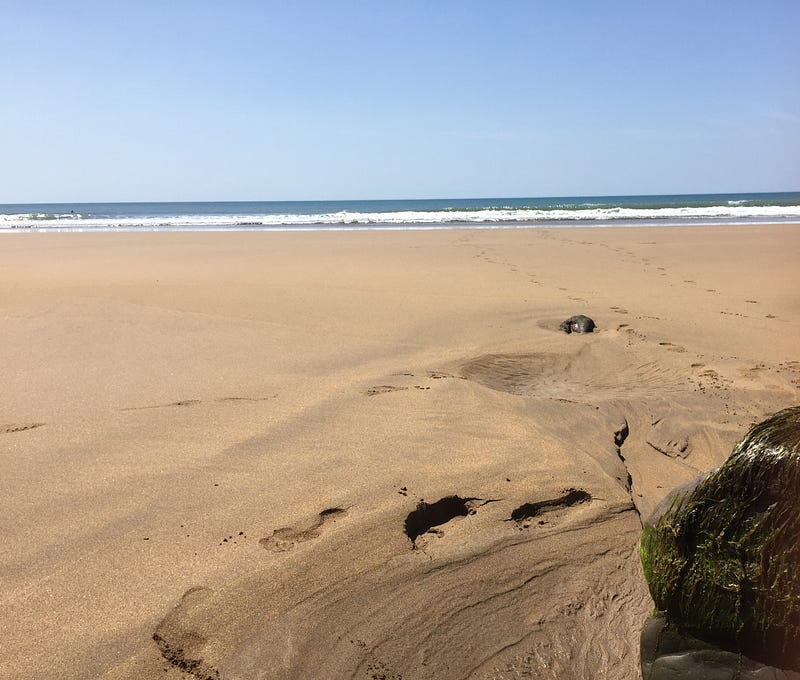
The only footprints are mine, but grief is with me as I dive into the waves. Together we delight in the heat of the sunshine and the cool of the water. Grief is there not as an unwelcome visitor but as an invited companion. It has taken me two years and several weeks of forced isolation to reach out and hold her hand.
In the last few days, I have involved myself in all sorts of creative endeavours that I have neglected for years. I have begun writing music just for the love of it. I remember the flow of that process from over 30 years ago. I have been making storytelling videos, harking back to a career as a performing storyteller last practised professionally 20 years ago.
Now I must write. Not to achieve anything, just because I must write.
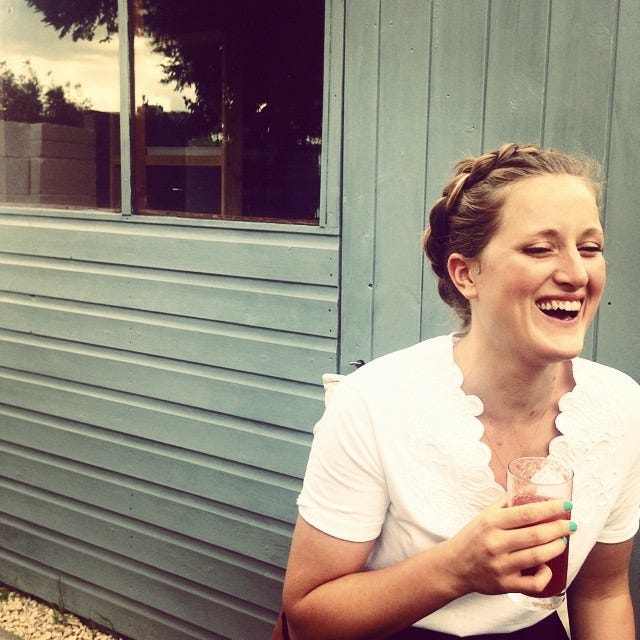
Holly took her own life almost two years ago. At 28 she had just completed a Masters Degree in Behavioural Psychology and was working in her dream job supervising the tutors of autistic children. She had married her childhood sweetheart, sang in a choir and had many friends she could call on.
It was a complete shock.
My grief process has mainly involved me pulling myself together and getting on with things. My first reaction was to find ways to be there for others. I assumed this was my duty as Holly’s father. We spent ten days in London walking down to the hospital where her body was held. In a park by the river, we met her friends, colleagues and family members. We exchanged hugs and ate food together and shook our heads in disbelief.
Far from home, I could only think of one personal friend in London. I called him up, and he came to join us and took me to a Sushi bar. I treasure that as a moment where I was doing something for myself. He was the perfect friend to share grief with.
That one meeting amongst so many serves to illustrate the imbalance of my grief process. At the funeral, I left my wife to bawl her eyes out by the graveside while I walked around the burial field, greeting each of the 300 or so family and friends.
I am not judging myself here, just noticing that my process was focused on what I have felt to be the needs of others.
Similarly, my first significant action within days of her death was to sign up for a Counselling Training course. The questions driving me were — How can I help others avoid having to live through such trauma? Or maybe — How can I help other young people going through similar mental distress?
Now 23 months down the line I am beginning to notice how I am grieving for myself. The loss of Holly is such a massive trauma that my body, emotions and spirit have taken over the grieving process. I have given my mind space to step aside. I am feeling the grief in my body. I am allowing the emotions to bubble up and not trying to fix them.
I have a clear sense of purpose and direction which is not driven by the needs of others. This is new to me. It is as if I had a concept in my mind that to create meaning and purpose in my life, I had to focus on the needs of others. Now I am finding purpose and meaning by focusing on my own needs, and this has allowed my creative processes to open up in new ways.
The music of grief.
Lockdown has enabled me to create a music studio for myself in the spare bedroom. Till now it has always been temporary. Dismantled for visitors or to pack up instruments for gigs. Now with none of that possible, it is stable.
One morning last week, I moved from my second breakfast into the studio, and I started playing a melody on my little melodica. I became engrossed. The theme grew, an accompaniment flowered in the background. I made a rough recording layering up the parts as if I was writing music for a yet to be created film.
There were several things unusual about this. For 30 years, I have only written music for a specific purpose. I worked as a Storyteller in schools and wrote music to accompany a particular story. Or I had a gig coming up that needed padding out. Always specific and with a clear brief and goal in mind.
Today I wrote music for no reason just as I had in my youth.
It flowed easily. There were times when I had tears in my eyes. There were times when I felt like I was observing myself composing music. As if the observer and the composer were two separate entities.
Eventually, I pulled out of the process and left the music playing on a loop now on monitor speakers. I made coffee and sat with my wife.
“That sounds like your grief,” she said.
I realised at that moment that at last, I was allowing my grief to flow. Not judging it or trying to turn it to some purpose or managing it.
I could sense it in my body. As I lifted the coffee cup, there was sadness there. But it was not stopping me from drinking my coffee or being a creative person. It was is if it was driving my creative process, and I was allowing it to do that. I was no longer in a battle with or struggling with grief. I had achieved some sort of partnership with it.
The story of grief.
In the next few days, the song took hold.
For my grandson and two nephews, I have been making youtube videos under my old performing name of Dragonfly Stories. I have not performed professionally as a storyteller for 20 years. I would however always be asked to resurrect a few for family birthdays and other occasions when we gathered together.
The creating of the music now took on a new life in creating a story performance to go with it. I found myself researching myths, legends and folk tales related to grief.
Many I could not relate to at all. Western culture and religions particularly seem to have a peculiar perception of the grief process. I found more resonance with Asian religions but finally managed to settle on using a common African folktale around which to hang my song and story.
I have called it Aaliyah — The girl with the golden hair.
A young woman suffering the grief of losing her entire extended family travels through a dark forest and finds a village of people very unlike her. She settles in and is accepted even though she is clearly different to them. Each morning she walks around the village singing a song to awaken everyone to enjoy the day.
The villagers have never sung or even heard singing before. They are entranced and ask Aaliyah to teach them to sing. She brings much joy and happiness to the village.
However, the medicine man is jealous and thinks she has enchanted them with magic that he does not possess. He begins to implant doubt and fearful thoughts into the mind of Aaliyah.
“They don’t really love you. They pretend they do because they are afraid.” “They are plotting to kill you” “They will cut off your golden hair in the night.”
Finally, she is so afraid that she leaves the village never to return.
Now the villagers express their grief in a song. Every evening they gather by the forest and sing to Aaliyah.
Aaliyah, We miss you when the morning comes.
Where are you, when will you return?
We miss you when the evening comes.
Will you return to us? Please return to us?
Although she never returns. The gift of singing and the joy she brought to the village remains and has become part of their lives.
The flow of grief.
The most used metaphor for traumatic grief is that of a black hole. You never get rid of it, but you grow a new life around it. I have never related to this metaphor. It suggests the grief is a singular item with a permanent place in your life which will never change.
The metaphor that I have with me now is that of a flowing stream. The grief is not one of the rocks or a deep pool which life flows around. The grief is part of the flow. The grief is there flowing in shallow waters over pebbly ground catching the sunlight. It is part of the flow through dark underground caves. It is part of the joyous splashing of a waterfall over rocks. It is part of the wide river on its determined journey to the ocean. It is part of the ocean.
Grief will always be with me, but not as an obstacle or a distraction. Grief will now inspire me to write, compose or perform. This is quite different from using my creative skills as an outlet for my grief. I can now allow grief to be part of the driving force of my life. Not as an unwelcome visitor but as a companion.


