avatarYannis Georgiadis

Free AI web copilot to create summaries, insights and extended knowledge, download it at here

8410

Abstract

         </div>
        </div>
      </a>
    </div><p id="5534">Ιn any case, this shows that Sweden’s strategy, relying on individual responsibility rather than an obligatory nationwide quarantine, has been to a very significant extend effective, especially if you compare with the hardest affected European countries. The logical conclusion is that harsher measures would probably not make such a big difference when it comes to the spread of the coronavirus, while taking a big toll on society and the economy, plus significantly limiting the protective immunity of low-risk groups.</p><h2 id="8a6b">Highest number of deaths among Scandinavian countries</h2><p id="07ca">Many have instead focused on the other Scandinavian countries to show that Sweden has by comparison been by far the worst in handling this pandemic. Sure, Finland, Denmark, Norway and even countries like Greece have had an impressively low number of coronavirus cases and deaths, some of them even <a href="https://www.worldometers.info/coronavirus/#countries">10 times less</a> than Sweden. All these countries implemented early strict restrictions and quarantines, effectively keeping the coronavirus at bay before it could really spread, in stark contrast with has happened in Sweden. How then can the Swedish coronavirus strategy be considered a success?</p><p id="6737">What critics do not seem to understand here, is that this comparison is at the very least very premature. Those countries who have aggressively and quite successfully contained the coronavirus so far, have their greatest challenge ahead of them. Officials have been for a while now trying to figure out how to slowly open-up their tightly closed countries, without causing a destructive second wave of coronavirus infections and deaths. The need to do that is very pressing, exactly because a strict quarantine approach is impossible to maintain for months. And the problems in that aspect have already started to show.</p><p id="a6fc">We have all seen what has been happening with <a href="https://www.huffingtonpost.co.uk/entry/trump-defends-right-wing-protesters_uk_5e9d4474c5b63c5b58713179">protestors in many US states</a>, demanding faster lifting of quarantine measures. In Greece, we saw last week the first signs of <a href="https://balkaninsight.com/2020/05/14/in-pandemic-era-greece-fighting-for-control-of-the-square/">social unrest</a> as more and more people want to freely gather and meet, despite the government wanting to gradually loosen its tight restrictions. Something similar has been also unfolding in the UK, with massive <a href="https://www.express.co.uk/news/uk/1283129/london-news-lockdown-hyde-park-protest-met-police-coronavirus-covid-19-latest-uk-news">London anti-lockdown protests</a> unfolding this weekend. And did you hear the latest news? <a href="https://www.theguardian.com/world/2020/may/19/china-puts-city-of-shulan-under-wuhan-style-lockdown-after-fresh-covid-19-cases">Chinese cities on lockdown</a> once again. If anyone thought that the coronavirus would disappear from any single country that easily, let China demonstrate first how naive and shortsighted that notion is.</p><p id="ba1c">Where strict measures have swiftly been implemented, without much concern about the public’s long term understanding of the problem, laws and emergency orders can keep people isolated only for so long. People will soon want to return to life as usual, giving the coronavirus new chances to spread in the population. Sweden on the other hand, has a level and quality of restrictions that can more or less stay in place even throughout the summer, without any such major problems. Letting people take personal responsibility in protecting themselves and others — if that is possible and effective in the first place — is simply more sustainable than just forcing them to stay inside.</p><div id="1b2d" class="link-block">
      <a href="https://www.dw.com/en/psychiatrist-simon-wessely-mass-quarantine-is-not-sustainable-over-a-long-period-of-time/a-52937404">
        <div>
          <div>
            <h2>Psychiatrist Simon Wessely: 'Mass quarantine is not sustainable over a long period of time' | DW |…</h2>
            <div><h3>Deutsche Welle: Hundreds of millions of people are locked in their homes right now. What should we expect to happen to…</h3></div>
            <div><p>www.dw.com</p></div>
          </div>
          <div>
            <div style="background-image: url(https://miro.readmedium.com/v2/resize:fit:320/0*ogb-HD4kQwSgi_o0)"></div>
          </div>
        </div>
      </a>
    </div><p id="5350">And let’s not forget <b>the other downside</b> of early harsh quarantine measures: The fact that the population has barely been exposed to the coronavirus, not even young people who in the great majority of cases would only experience a hefty cold and wouldn’t even require primary healthcare.</p><p id="b7af">In Sweden, not everything has shut down and some level of activity has continued this past couple of months — still <a href="https://www.thelocal.se/20200424/interview-isabella-lovin-coronavirus-the-biggest-myth-about-sweden-is-that-life-is-going-on-as-normal">far from normal</a> though. This means that the coronavirus has had the chance to spread at least among part of the low-risk groups of the population. These people who have now gone through a light (possibly even asymptomatic) infection are expected to have number some level of immunity (impossible to say exactly how much or for how long right now) providing some degree of protection for the more vulnerable groups of the population in the next stages of the pandemic, since they should not be able to be infected again or infect others for a while.</p><p id="a129">Not having such protection at all, due to an early total quarantine, means that a <b>second wave</b> could much more easily get out of control. That is exactly what authorities in Germany for example are worried about, as they slowly try to reopen the country.</p><div id="a0a9" class="link-block">
      <a href="https://www.theguardian.com/world/2020/may/10/fears-rise-in-germany-over-second-wave-of-coronavirus-infections">
        <div>
          <div>
            <h2>Fears grow in Germany of second wave of coronavirus infections</h2>
            <div><h3>With the Covid-19 pandemic stretching into its third month in Europe, Germany is discovering that a competent handling…</h3></div>
            <div><p>www.theguardian.com</p></div>
          </div>
          <div>
            <div style="background-image: url(https://miro.readmedium.com/v2/resize:fit:320/0*-cd_cjfk47AwqbOg)"></div>
          </div>
        </div>
      </a>
    </div><p id="7d68">Our Scandinavian neighbors, much like all other countries that have implemented early nation-wide quarantines, have thus a very thin balance to keep now. Even if they also manage to avoid the worst-case scenario I described above, their number of deaths could easily reach a few thousand, or more. In other words, it is simply <b>too early </b>to say whether their strategy was more effective than Sweden’s. We might be able to tell with a reasonable degree of certainty, only after the summer.</p><h2 id="b5ff">Sacrificing the elders to save the economy?</h2><p id="5596">Those who have followed the developments in Sweden know that there has been much discussion about the <a href="https://www.theguardian.com/world/2020/apr/19/anger-in-sweden-as-elderly-pay-price-for-coronavirus-strategy">coronavirus getting in many elder care homes</a>, with the country’s Health and Social Affairs Minister recently stating:</p><blockquote id="efb1"><p>“We failed to protect our elderly. That’s really serious, and a failure for society as a whole. We have to learn from this, we’re not done with this pandemic yet”</p></blockquote><p id="7889">A great majority of the deaths in Sweden have been among residents of elder care homes, with only about 10% of the total death toll being people under 70 years of age. Many see this as an undeniable failure of the Swedish coronavirus strategy, some even believing that the country’s officials have chosen to sacrifice thousands of elderly lives in order to keep the economy alive. In any case, how can a strategy with such loss of life be considere

Options

d effective?</p><p id="adc1">Well, besides the fact that Sweden has avoided a much more deadly and tragic scenario as I explained, <a href="https://www.thelocal.se/20200506/coronavirus-what-went-wrong-in-swedens-care-homes">the coronavirus entering elder care homes</a> doesn’t seem to be a direct effect of the country being more open than others. Visits from relatives were forbidden quite early and the isolation of elders was strongly recommended from day one. What was expected was not only that older people would strictly stay at home, literally isolated from relatives, but also that elder care homes could and would effectively shield their residents.</p><p id="e780">Unfortunately, it seems that second part was seriously lacking in many cases. A combination of shortage of protective equipment, permanent staff and adequate relevant skills has apparently allowed for the coronavirus to get in, via the very people taking care of Sweden’s elders. These factors are not directly controlled by the government (but by the individual regions and cities) and are thus largely independent of the overarching national coronavirus strategy, but officials are now <a href="https://www.forbes.com/sites/davidnikel/2020/05/05/sweden-health-agency-investigates-high-coronavirus-death-toll-in-elderly-care-homes/">trying to pin-point exactly what went wrong</a> and fix it quickly, since the coronavirus pandemic is far from over, as Sweden’s Health Minister emphasized in her statement. No one is taking this lightly.</p><div id="b2a0" class="link-block"> <a href="https://www.cnbc.com/2020/05/12/sweden-boosts-elderly-care-spending-as-coronavirus-death-toll-rises.html"> <div> <div> <h2>Sweden boosts elderly care spending as coronavirus death toll rises</h2> <div><h3>The Swedish government has pledged to spend an additional 2.2 billion Swedish krona ($226 million) on care for the…</h3></div> <div><p>www.cnbc.com</p></div> </div> <div> <div style="background-image: url(https://miro.readmedium.com/v2/resize:fit:320/0*chMYmlllhjodyRPq)"></div> </div> </div> </a> </div><p id="960d">Better funding, more trained staff and the right use of protective equipment appear to be the keys to stopping the further spread of the coronavirus in elder care homes, regardless of the restrictions on the rest of the country. This has certainly been a failure for Sweden on many levels, but it has not been a consequence of the overall strategy, which has otherwise proven effective.</p><h2 id="0e40">The Swedish strategy still makes sense</h2><p id="cf5f">We are still in the initial phase of an unprecedented pandemic, the road ahead is full of question marks and unforeseen challenges. No country can claim victory over the powerful threat that is the coronavirus. Not yet. It is impossible to reliably compare countries and the overall effectiveness of their strategies at this early stage. Relatively few interventions, medical or epidemiological, can be backed by concrete scientific evidence, as there is still very little of it available, and the scientific community is working feverishly to change that.</p><p id="caf3">With the data we have so far, each city and country should try to recognize its failures around the coronavirus pandemic and fix them as soon as possible, if we want this crisis to end sooner than later and with as few lives lost as possible. Sweden’s overall strategy seems to have worked so far, averting the worst scenario and reaching an initial plateau much faster and smoother than other European countries and with a lower cost for its society. Yet for other reasons, the country has failed to adequately protect its senior citizens.</p><p id="c678">Officials see therefore no reason to change the overarching measures of the Swedish strategy, but are already working on ways to reinforce the much needed isolation of high-risk groups in the population.</p><p id="87b4">If you want to hear all this from official lips as well, Sweden’s National Epidemiologist addresses many of these points in his recent interview with Trevor Noah.</p> <figure id="da77"> <div> <div> <img class="ratio" src="http://placehold.it/16x9"> <iframe class="" src="https://cdn.embedly.com/widgets/media.html?src=https%3A%2F%2Fwww.youtube.com%2Fembed%2FypwoyVl5Dxk%3Ffeature%3Doembed&amp;display_name=YouTube&amp;url=https%3A%2F%2Fwww.youtube.com%2Fwatch%3Fv%3DypwoyVl5Dxk&amp;image=https%3A%2F%2Fi.ytimg.com%2Fvi%2FypwoyVl5Dxk%2Fhqdefault.jpg&amp;key=a19fcc184b9711e1b4764040d3dc5c07&amp;type=text%2Fhtml&amp;schema=youtube" allowfullscreen="" frameborder="0" height="480" width="854"> </div> </div> </figure></iframe></div></div></figure><h2 id="d7dd">Pointing fingers and widespread mistrust — we can do better</h2><p id="0f34">No matter how certain some people are that Sweden has totally failed and/or sacrificed its most vulnerable citizens for the good of the economy, it is simply <b>not true</b>. At the very least, it’s an oversimplification of a very complex and still unclear situation. Sweden has not totally failed but not done everything right either. As you can see, Swedish officials have openly admitted this and show determination to do better. And to maintain the existing level of public awareness and social distancing, as we are still in the early stages of this pandemic.</p><p id="2b38">Prematurely screaming (literally or figuratively) at each other or panicking on social media is not going to help anyone. Damning pieces on that or the other policy of any country or oversimplifying narratives based on isolated early studies are only counterproductive. More <a href="https://www.theguardian.com/commentisfree/2020/may/15/europe-emerges-lockdown-question-hangs-was-sweden-right?CMP=fb_gu&amp;utm_medium=Social&amp;utm_source=Facebook#Echobox=1589539074">nuanced approaches</a> instead are meaningful and give us a better grasp of the situation. Open dialogue and an effort to reach a deeper understanding around the inherent national and international complexities of the coronavirus pandemic in order to forge a robust international strategy, is the only reasonable way forward. I think the world has a lot to learn from Sweden’s strategy, if only as a “future model”, as the WHO recently stated.</p><div id="64b1" class="link-block"> <a href="https://sverigesradio.se/sida/artikel.aspx?artikel=7463561"> <div> <div> <h2>WHO says Sweden's Corona strategy could be "a future model" post lockdowns - Radio Sweden</h2> <div><h3>Dr Mike Ryan, the WHO's top emergencies expert, asked about Sweden's strategy of shunning lockdowns and allowing most…</h3></div> <div><p>sverigesradio.se</p></div> </div> <div> <div style="background-image: url(https://miro.readmedium.com/v2/resize:fit:320/0*K4LNSPUvrrxMLfj6)"></div> </div> </div> </a> </div><p id="03b1">Of course, Sweden has also a lot to learn from the successes and mistakes of other countries. Cooperation and trust between nations is extremely important in this global crisis. In the words of the historian, philosopher, and bestselling author <a href="https://www.ynharari.com/about/">Yuval Noah Harari</a>, from his recent thought-provoking <a href="https://time.com/5803225/yuval-noah-harari-coronavirus-humanity-leadership/">Time article</a>:</p><blockquote id="6b4e"><p>“In this moment of crisis, the crucial struggle takes place within humanity itself. If this epidemic results in greater disunity and mistrust among humans, it will be the virus’s greatest victory. When humans squabble — viruses double. In contrast, if the epidemic results in closer global cooperation, it will be a victory not only against the coronavirus, but against all future pathogens.”</p></blockquote><p id="7447">As I have written <a href="https://readmedium.com/how-swedens-coronavirus-strategy-makes-sense-2f07f69df2f2">before</a>, we are in this together. And our best bet to come through this pandemic without mortal wounds is <b>together</b>.</p><p id="b4e7">Do not forget that.</p></article></body>

Sweden’s Coronavirus Strategy: Is It Working?

The answer is not simple.
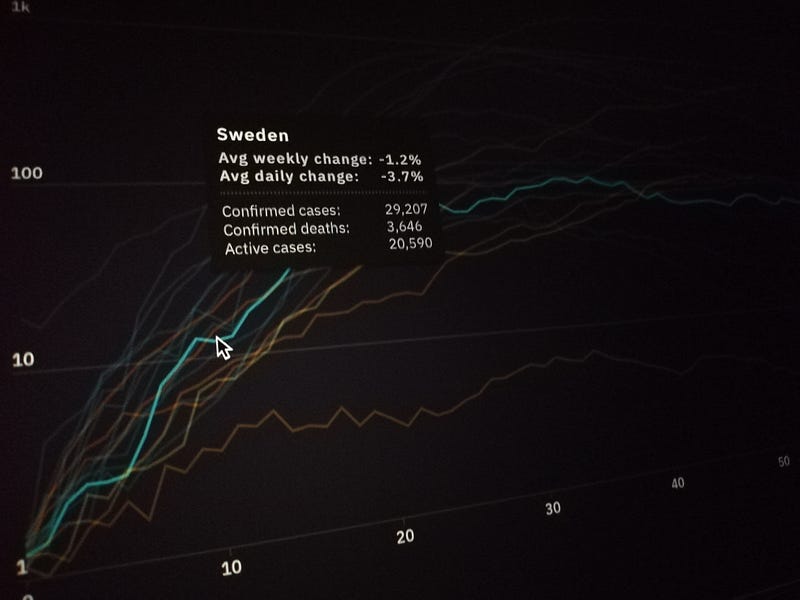
Graphic from informationisbeautiful.

This is May 16th. It’s been more than a month since I published the article How Sweden’s Coronavirus Strategy Makes Sense where, as a doctor in Sweden, I explained the logic behind the country’s seemingly too lax measures against CoViD-19, as well as the particular characteristics that make these measures reasonable for the country, but possibly not for many others.

My most important point in that article was that no one during this unprecedented modern pandemic can be sure of what the right answers are, regarding the various problematic questions and challenges this global crisis poses. Certainly not in the still very early stages of the pandemic.

Even though the situation has developed a lot since then, and despite the fact that we have accumulated a lot of data about this coronavirus, my point still holds true. Way too much is still uncertain and we are far from the end of the tunnel, even if some very optimistically already start seeing the light at the end of it.

In the midst of all this uncertainty, while some seem to consider Sweden’s strategy as an international example for the future, many others have instead taken Sweden’s Health and Social Affairs Minister’s recent statement that “We failed to protect our elderly” together with the high number of deaths Sweden has had compared to its Scandinavian neighbors, as definitive proof that the whole strategy was indeed reckless and ultimately a failure. Yet the country’s officials have been repeatedly stating that the particular measures taken and the Swedish coronavirus strategy as a whole have so far proven effective, acknowledging at the same time the significant failure in shielding elder care homes from the deadly virus.

How can that be? What do they mean “effective”? See, once more, the situation is more complicated that it seems.

Let me try to explain.

A great tragedy averted, at a lower cost

The first and most important aspect in the assessment of the Swedish coronavirus strategy is whether the country has avoided the worst-case scenario. The one that has tragically played out in countries like Italy and Spain, where the enormous number of deaths is only part of the terrifying story.

The scenario every country has worked hard to avoid, is one where the healthcare system overflows with CoViD-19 patients in need of intensive care and respirator support. That would lead to many other patients being left without the critical help they need. Not only coronavirus patients, but also every other kind of patient needing intensive care, as the available hospital beds and respirators would run out. This would mean a huge amount of completely avoidable deaths and preventable suffering. Avoiding this hellish scenario is what flattening the curve has been all about from the start.

So, what has been happening in Sweden, in comparison to Italy, Spain and even the UK? These countries enforced harsh quarantine measures but have experienced a much more dramatic situation than Sweden. It is obviously a little misleading to compare Sweden’s 3,700 death toll with numbers soaring around 30,000 in much bigger countries, but even when comparing the death count per capita (or per 1 million population, to be exact) these countries have significantly higher numbers than Sweden’s.

The country’s healthcare system has been able to handle the extra influx of patients, without ever reaching its maximum capacity. Of course, among other big changes in Swedish hospitals, the ICU beds had to be significantly increased — more than doubled in Stockholm, where the coronavirus was expected to hit the hardest. As a result, even though the ICUs around the country have been straining to keep up with the new cases coming in, they never run out of ICU beds. No one has been denied the treatment he/she needs, whether that is respirator support or any other level of care.

The fear that the number of deaths would increase exponentially, quickly skyrocketing to horribly uncontrollable Italy-like levels, has also proven unfounded, as Sweden has already for a few weeks now been seeing a plateau in the number of coronavirus cases, intensive care patients and deaths. There has even been some optimism about immunity levels in the population, but we still have no real data on that, only speculations.

Ιn any case, this shows that Sweden’s strategy, relying on individual responsibility rather than an obligatory nationwide quarantine, has been to a very significant extend effective, especially if you compare with the hardest affected European countries. The logical conclusion is that harsher measures would probably not make such a big difference when it comes to the spread of the coronavirus, while taking a big toll on society and the economy, plus significantly limiting the protective immunity of low-risk groups.

Highest number of deaths among Scandinavian countries

Many have instead focused on the other Scandinavian countries to show that Sweden has by comparison been by far the worst in handling this pandemic. Sure, Finland, Denmark, Norway and even countries like Greece have had an impressively low number of coronavirus cases and deaths, some of them even 10 times less than Sweden. All these countries implemented early strict restrictions and quarantines, effectively keeping the coronavirus at bay before it could really spread, in stark contrast with has happened in Sweden. How then can the Swedish coronavirus strategy be considered a success?

What critics do not seem to understand here, is that this comparison is at the very least very premature. Those countries who have aggressively and quite successfully contained the coronavirus so far, have their greatest challenge ahead of them. Officials have been for a while now trying to figure out how to slowly open-up their tightly closed countries, without causing a destructive second wave of coronavirus infections and deaths. The need to do that is very pressing, exactly because a strict quarantine approach is impossible to maintain for months. And the problems in that aspect have already started to show.

We have all seen what has been happening with protestors in many US states, demanding faster lifting of quarantine measures. In Greece, we saw last week the first signs of social unrest as more and more people want to freely gather and meet, despite the government wanting to gradually loosen its tight restrictions. Something similar has been also unfolding in the UK, with massive London anti-lockdown protests unfolding this weekend. And did you hear the latest news? Chinese cities on lockdown once again. If anyone thought that the coronavirus would disappear from any single country that easily, let China demonstrate first how naive and shortsighted that notion is.

Where strict measures have swiftly been implemented, without much concern about the public’s long term understanding of the problem, laws and emergency orders can keep people isolated only for so long. People will soon want to return to life as usual, giving the coronavirus new chances to spread in the population. Sweden on the other hand, has a level and quality of restrictions that can more or less stay in place even throughout the summer, without any such major problems. Letting people take personal responsibility in protecting themselves and others — if that is possible and effective in the first place — is simply more sustainable than just forcing them to stay inside.

And let’s not forget the other downside of early harsh quarantine measures: The fact that the population has barely been exposed to the coronavirus, not even young people who in the great majority of cases would only experience a hefty cold and wouldn’t even require primary healthcare.

In Sweden, not everything has shut down and some level of activity has continued this past couple of months — still far from normal though. This means that the coronavirus has had the chance to spread at least among part of the low-risk groups of the population. These people who have now gone through a light (possibly even asymptomatic) infection are expected to have number some level of immunity (impossible to say exactly how much or for how long right now) providing some degree of protection for the more vulnerable groups of the population in the next stages of the pandemic, since they should not be able to be infected again or infect others for a while.

Not having such protection at all, due to an early total quarantine, means that a second wave could much more easily get out of control. That is exactly what authorities in Germany for example are worried about, as they slowly try to reopen the country.

Our Scandinavian neighbors, much like all other countries that have implemented early nation-wide quarantines, have thus a very thin balance to keep now. Even if they also manage to avoid the worst-case scenario I described above, their number of deaths could easily reach a few thousand, or more. In other words, it is simply too early to say whether their strategy was more effective than Sweden’s. We might be able to tell with a reasonable degree of certainty, only after the summer.

Sacrificing the elders to save the economy?

Those who have followed the developments in Sweden know that there has been much discussion about the coronavirus getting in many elder care homes, with the country’s Health and Social Affairs Minister recently stating:

“We failed to protect our elderly. That’s really serious, and a failure for society as a whole. We have to learn from this, we’re not done with this pandemic yet”

A great majority of the deaths in Sweden have been among residents of elder care homes, with only about 10% of the total death toll being people under 70 years of age. Many see this as an undeniable failure of the Swedish coronavirus strategy, some even believing that the country’s officials have chosen to sacrifice thousands of elderly lives in order to keep the economy alive. In any case, how can a strategy with such loss of life be considered effective?

Well, besides the fact that Sweden has avoided a much more deadly and tragic scenario as I explained, the coronavirus entering elder care homes doesn’t seem to be a direct effect of the country being more open than others. Visits from relatives were forbidden quite early and the isolation of elders was strongly recommended from day one. What was expected was not only that older people would strictly stay at home, literally isolated from relatives, but also that elder care homes could and would effectively shield their residents.

Unfortunately, it seems that second part was seriously lacking in many cases. A combination of shortage of protective equipment, permanent staff and adequate relevant skills has apparently allowed for the coronavirus to get in, via the very people taking care of Sweden’s elders. These factors are not directly controlled by the government (but by the individual regions and cities) and are thus largely independent of the overarching national coronavirus strategy, but officials are now trying to pin-point exactly what went wrong and fix it quickly, since the coronavirus pandemic is far from over, as Sweden’s Health Minister emphasized in her statement. No one is taking this lightly.

Better funding, more trained staff and the right use of protective equipment appear to be the keys to stopping the further spread of the coronavirus in elder care homes, regardless of the restrictions on the rest of the country. This has certainly been a failure for Sweden on many levels, but it has not been a consequence of the overall strategy, which has otherwise proven effective.

The Swedish strategy still makes sense

We are still in the initial phase of an unprecedented pandemic, the road ahead is full of question marks and unforeseen challenges. No country can claim victory over the powerful threat that is the coronavirus. Not yet. It is impossible to reliably compare countries and the overall effectiveness of their strategies at this early stage. Relatively few interventions, medical or epidemiological, can be backed by concrete scientific evidence, as there is still very little of it available, and the scientific community is working feverishly to change that.

With the data we have so far, each city and country should try to recognize its failures around the coronavirus pandemic and fix them as soon as possible, if we want this crisis to end sooner than later and with as few lives lost as possible. Sweden’s overall strategy seems to have worked so far, averting the worst scenario and reaching an initial plateau much faster and smoother than other European countries and with a lower cost for its society. Yet for other reasons, the country has failed to adequately protect its senior citizens.

Officials see therefore no reason to change the overarching measures of the Swedish strategy, but are already working on ways to reinforce the much needed isolation of high-risk groups in the population.

If you want to hear all this from official lips as well, Sweden’s National Epidemiologist addresses many of these points in his recent interview with Trevor Noah.

Pointing fingers and widespread mistrust — we can do better

No matter how certain some people are that Sweden has totally failed and/or sacrificed its most vulnerable citizens for the good of the economy, it is simply not true. At the very least, it’s an oversimplification of a very complex and still unclear situation. Sweden has not totally failed but not done everything right either. As you can see, Swedish officials have openly admitted this and show determination to do better. And to maintain the existing level of public awareness and social distancing, as we are still in the early stages of this pandemic.

Prematurely screaming (literally or figuratively) at each other or panicking on social media is not going to help anyone. Damning pieces on that or the other policy of any country or oversimplifying narratives based on isolated early studies are only counterproductive. More nuanced approaches instead are meaningful and give us a better grasp of the situation. Open dialogue and an effort to reach a deeper understanding around the inherent national and international complexities of the coronavirus pandemic in order to forge a robust international strategy, is the only reasonable way forward. I think the world has a lot to learn from Sweden’s strategy, if only as a “future model”, as the WHO recently stated.

Of course, Sweden has also a lot to learn from the successes and mistakes of other countries. Cooperation and trust between nations is extremely important in this global crisis. In the words of the historian, philosopher, and bestselling author Yuval Noah Harari, from his recent thought-provoking Time article:

“In this moment of crisis, the crucial struggle takes place within humanity itself. If this epidemic results in greater disunity and mistrust among humans, it will be the virus’s greatest victory. When humans squabble — viruses double. In contrast, if the epidemic results in closer global cooperation, it will be a victory not only against the coronavirus, but against all future pathogens.”

As I have written before, we are in this together. And our best bet to come through this pandemic without mortal wounds is together.

Do not forget that.

Coronavirus
Sweden
World
Health
Quarantine
Recommended from ReadMedium