
Sweden Joins NATO; Europe Considers ‘Boots On The Ground’
Ends 200 years of neutrality
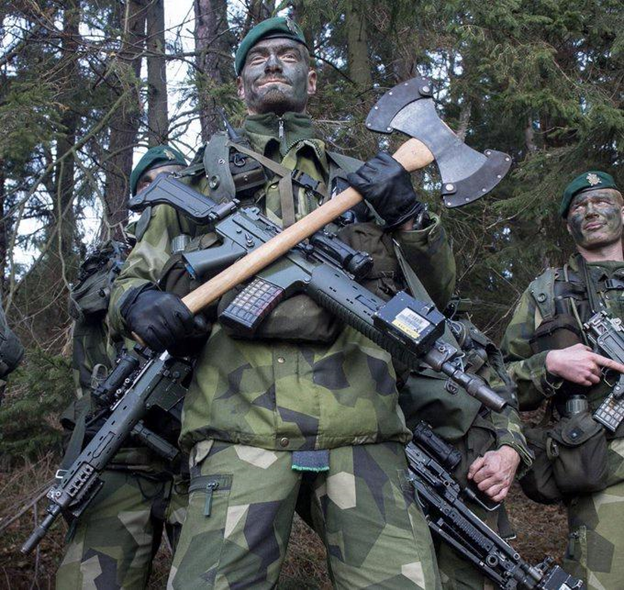
The Vikings have joined the game!
Russia is running out of border that isn’t NATO.
When Sweden joins NATO, seven of the eight Arctic states — all except for Russia — will be part of the same Alliance.
Hungary’s parliament voted Monday to ratify Sweden’s bid to join NATO, ending more than 18 months of delays. All of NATO’s 31 members are required to give their approval to admit new countries, and Hungary was the final hold-out.
This is the second expansion of NATO’s ranks in a year after both Sweden and Finland applied to join the alliance in May 2022. They applied almost immediately after Putin launched his attack on Ukraine…in order to prevent the expansion of NATO.
This is a momentous historic occasion, as Sweden’s Prime Minister Ulf Kristersson noted: “We are now leaving 200 years of neutrality and nonalignment behind us.” He expanded that it was also “a very natural step that we are taking. NATO membership means that we’ve found a new home within a large number of democracies which work together for peace and freedom.”
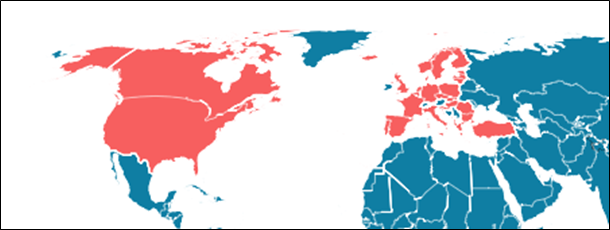
NATO Secretary-General Jens Stoltenberg told The Associated Press that the vote “makes NATO stronger, Sweden safer and all of us more secure.”
He added that Sweden brings with it capable armed forces and a first-class defense industry, and it is spending at least 2% of national gross domestic product on defense, which is NATO’s target level.
Hungarian Prime Minister Viktor Orbán gave his nod to the arrangement after a visit last weekend from a bipartisan group of U.S. senators. They visited Hungary and announced they would submit a joint resolution to Congress condemning Hungary’s democratic backsliding. The EU had also frozen billions in funding to Hungary over alleged breaches of rule-of-law and democracy standards. The senators urged Orbán’s government to allow Sweden into NATO. It seems they were very persuasive. The US gives billions in aid to Eastern European countries…except Serbia and Hungary. They are judged to be too close to Russia to merit attention. This latest stance by Hungary may move those yardsticks.
Kristersson also met with Orbán at the same time, and apparently the two countries moved closer to an agreement allowing Hungary to acquire Swedish-built military equipment. Swedish-built Gripen fighter jets were especially high on the wish-list. Hungary already leases 14 jets from Sweden and is planning to add four more.
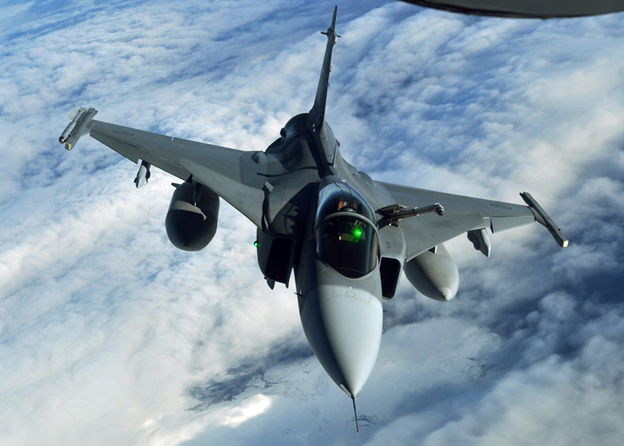
Previously, the other hold-out from NATO approval was Turkey, which made its support for Stockholm’s membership contingent on the approval of the sale of F-16 fighter jets from the US. Hours after Turkey’s ratification, Washington announced the $23-billion sale.
The most recent time that a Swedish unit had experienced war-like conditions with NATO allies was in late 1993. A reinforced Swedish-Danish-Norwegian mechanized battalion (Nordbat 2) deployed to Bosnia as part of an ongoing UN peacekeeping mission. The Swedes had one thing the others didn’t: a culture of mission command that had grown and developed for decades. To the surprise of many, even in Sweden, Nordbat 2 quickly established a reputation as one of the most trigger-happy UN units in Bosnia. It comes from their training as independent combat units.
Sweden’s preparation for a war against Russia dates back to 1943, when senior Swedish army officers were taking note of the tactical superiority of German troops fighting Soviets on the Eastern Front. Sweden, being a small nation with several large and frequently hostile neighbors, had to prepare to fight an enemy which possessed overwhelming numerical superiority.
Soviet strike aircraft headed for Norway or the Greenland-Iceland-United Kingdom (GIUK) gap needed to pass directly over Swedish airspace to reach their targets. Additionally, in the event of a conflict, the Soviets feared that NATO would use Swedish air bases to launch attacks against the Soviet mainland. Consequently, neutralizing Sweden’s military capacity and securing at least parts of its territory was an obvious strategic objective for the Soviet Union
The Swedish Armed Forces were consequently trained to respond to a massive Soviet invasion force, which was expected to attack overland via Finland. The Swedish Army estimated that a breakdown of command and control was a likely scenario as communications and command centers would be destroyed. In order to cope with this contingency, all units were trained to engage in what was known as “the free war” — autonomous operations against local targets, without centralized command. The free war was intended as a last resort, which would only end when the invader had finally retreated. The official doctrine stated that all Swedish citizens were to, without exception, consider any order to surrender to be false, regardless of its origin. This was even printed in all phone books, which also contained instructions for the civilian population in case of war.
The officers and non-commissioned officers, all the way down to the lowest-ranking enlisted men, were taught that the only truly mortal sin was to hesitate. There was no priority higher than that of achieving the mission objectives at hand.
This is the enemy that Putin has added to Russia’s list of opponents. Nice work. You know you’ve messed up when your actions single-handedly awoke Sweden out of a 200+ year neutrality stance.
Here is what Sweden brings:
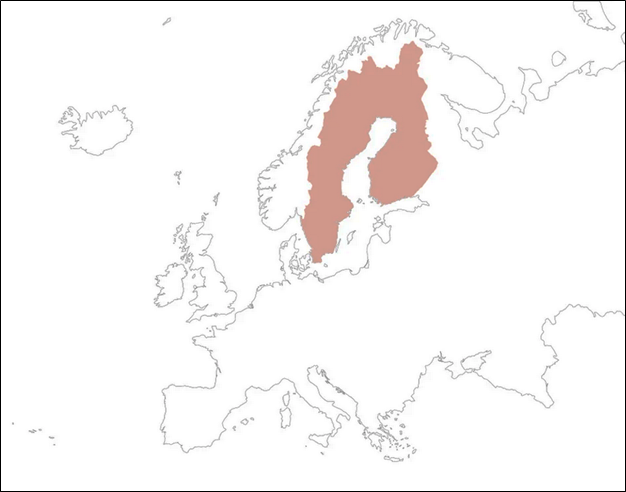
First, Sweden’s geostrategic location in the heart of the Nordic countries. This is the first time all of the Nordic countries have been in the same alliance since 1523. With Sweden as a member, the Alliance will gain strategic depth in the Baltic Sea region. Most countries around the Baltic Sea will now be part of the same military alliance, which has led some people to dub the Baltic Sea a ‘NATO lake’. Sweden’s entry into the Alliance will add three new strategic locations to the Alliance: 1) the strait of Øresund, the main strait connecting the North Sea to the Baltic Sea; 2) Gotland, the largest island in the Baltic Sea, often called an ‘unsinkable aircraft carrier’ due to its central location in the Baltics; and 3) shoreline along the Åland Sea and Gulf of Bothnia that will make it easier for the Alliance to defend the region between Finland and Sweden at the entry of the Gulf of Bothnia.
Second, Sweden’s defense industry, which will boost the Alliance’s military-industrial capacity. One of the largest in Europe, Sweden’s defense industry amounted to $3 billion in 2022 with exports of defense material totaling over $2 billion. The country’s largest defense companies produce some of the most sophisticated equipment on the market, such as Saab’s Jas 39 Gripen and BAE System AB’s Combat Vehicle 90. Approximately 28,000 people are employed by Sweden’s defense industry, a figure likely to rise as the government has announced a considerable increase in its annual defense budget for 2024; nearly double that of its 2020 defense budget. The high demand for defense production, which has struggled to keep up with weapons demands as countries provide armaments to Ukraine in the wake of Russian aggression, is only going to continue for the coming years.
The third benefit is the high level of technological competence in Sweden’s private sector. Sweden’s extensive public-private partnerships, considerable R&D funding, and highly-ranked education system are some of the factors behind its success in high-tech. The government launched a national ‘Cybercampus’ initiative in 2020 in partnership between the Swedish Defense Forces, public universities, and private companies, and established the Centre for Cyber Defence and Information Security in Stockholm. As NATO expands its ability to counter cyber and hybrid threats, Sweden’s technological know-how will help prepare the Alliance to prepare for tomorrow’s threats.
Fourth, with Sweden in NATO, two of the three manufacturers of 5G equipment — Ericsson and Nokia — will be in the same defensive alliance. The country is home to leading high-tech firms, such as Ericsson, the world’s second largest network company; Hexagon, a major software company; and Northvolt, one of Europe’s largest producers of lithium batteries. Sweden’s success in attracting tech startups and in producing unicorns (startups reaching a billion dollar valuation) has led the country to be informally dubbed the ‘Silicon Valley of Europe’.
Fifth, Sweden also possesses large quantities of critical minerals — such as iron ore and rare earth metals — which are vital for the defense industry, in the green transition, and for the overall economy. After a recent discovery in the Northern Swedish city of Kiruna, the country now possesses the largest-known deposit of rare-earth metals in Europe. Sweden will provide the Alliance with a crucial opportunity to reduce its critical minerals dependency on China and other authoritarian governments.
Sixth, Sweden’s air force. The country’s air force is the largest in the Nordics and one of the largest in Europe, possessing at least 100 fighter jets. With many more slated to be delivered in the upcoming years, Sweden is set to dramatically bolster the Alliance’s number of fighter jets in the Baltic and Arctic regions.
Seventh, Sweden also possesses a world-class submarine fleet — with some of the most advanced submarines in operation — and a wealth of knowledge navigating the shallow Baltic Sea, which it has done since 1904. Sweden’s fleet currently consists of three advanced Gotland-class subs and two new designs to be delivered in 2027 and 2028, giving it five submarines by the end of the decade. Critically, the entirety of US submarine capabilities and a major portion of Russia’s submarine fleet are unable to operate in the shallow Baltic Sea — unlike Sweden’s.
With its robust defense industry, numerous high-tech companies, vital geostrategic location, and a powerful air force that increases force projection into the Baltic Sea and shores up the Northern corridor, Sweden is going to contribute significantly to NATO from day one.
And now comes more bad news for Russia: France has come out with a new position that could change the fundamentals of the Ukrainian war.
President Macron has announced that in considering whether having Europe send ground troops into Ukraine was possible, he said ‘nothing can be excluded.’
‘Nothing can be excluded.’
This is a huge threshold that has been passed. Macron signaled that this is being discussed among Europeans. There is no consensus among them, but still, it is being discussed and not excluded. Meaning it’s a serious enough option now.
It is still very surprising news because at the beginning of the conflict, the West’s top priority was to avoid having the war expand outside of Ukraine.
It might be that the West is now aware that Russia has no capacity to expand the war outside Ukraine. Russia has stripped their entire border with Sweden, Finland, and the Baltic States of troops in late 2022 to feed into Ukraine. Russia has no mobile reserve left. Even if it did a massive call-up, it lacks the weapons to supply them. People forget that when Russia called up millions of men to fight Germany in WW2, their weapons came from America.
It is also possible that European countries are aware that if Russia defeats Ukraine, it will have at its disposal a ready-made army and a weapons industry that is already at full production. Putin has shown that he is not adverse to invading other territories.
If France and other European countries send troops to Ukraine, what can Putin do?
Remember that when the invasion started in 2022, seeing the West send light weapons to Ukraine was considered by Putin a “nuclear-worthy” escalation.
But they accepted the tanks, the airplanes and the drones, so having NATO troops wouldn’t be such a big surprise.
And just to re-cap my argument on why nuclear weapons are not being used and why nuclear threat do not mean squat in the world today: when both antagonists have the same doomsday weapon, it is not used. We can see this from the non-use of poison gas as a mass bombing weapon: even Hitler did not use it, because England also had huge suppliers of it. Poison gas was the WW2 equivalent of nukes.
Russia handed Europe the sword. Those who bring the sword must be prepared to die by the sword.
BTW, Macron also announced the launch of a coalition to provide long range missiles for Ukraine.
Here is what Putin would face if he used the arrival of European troops as a pretext to launch a war against NATO:
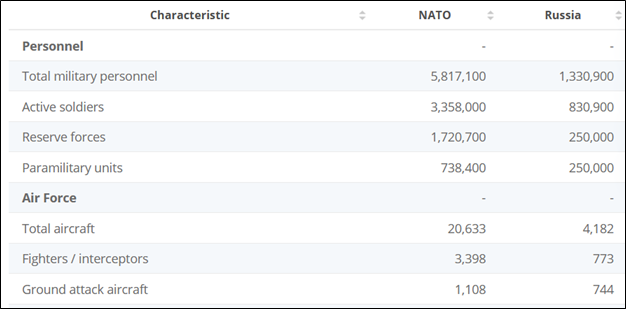
And this chart was made Before Norway and Sweden joined the alliance. NATO outclasses Russia by a factor of 4 or 5 to 1 in almost every field.
Europe is pulling together in other ways. 120 thousand artillery rounds, announced by the German government on February 16 as part of a new military aid package, are going to be provided by Bulgaria. After 35 years of inactivity, the Bulgarian plant in the city of Kostenets is resuming production of 122mm shells. This plant ceased production of 122mm shells in 1988.There is no shortage of money; Germany has allocated about $7.5-billion for Ukrainian weapons for 2024 alone.
Canada has announced another $3-billion in aid. The second anniversary of Russia’s invasion “is a moment for us to both thank Ukraine and demonstrate our solidarity,” said Prime Minister Trudeau.
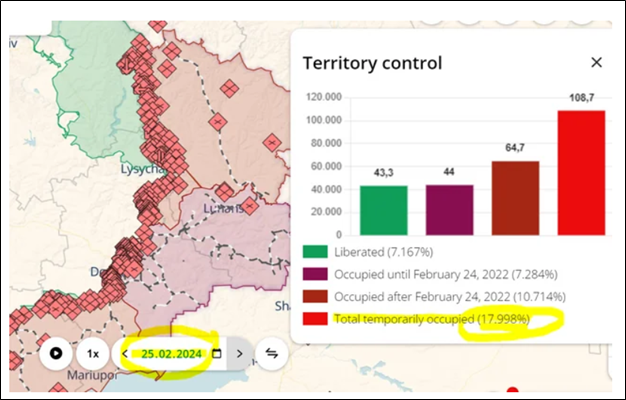
And let us not lose track of the fact that despite Russia’s recent capture of Avdiivka, after five months of fighting, its territorial gain come to nothing.
The other territory it has lost in the fighting means that Russia in total has not gained any territory in the past 12 months (Feb 25th 2023 — Feb 25th 2024). And it has spent 400,000 Russian lives going nowhere.
Hal Brands, Distinguished Professor of Global Affairs at the Johns Hopkins School of Advanced International Studies, says that “A properly supplied and supported Ukraine could weather Russian attacks this year, while striking deeper into Crimea and Russia, clearing the Black Sea of Moscow’s Navy, and building the forces necessary for another offensive. In this scenario, a difficult 2024 could lay the groundwork for a 2025 in which the advantage shifts back to Kyiv.”
The other player which Putin’s genius is flushing down the sewer is China. Unfortunately for Xi, Putin’s wars cannot make up for the huge strategic costs his war has already imposed on China. China’s net geopolitical position will almost certainly be worse than before Feb. 24, 2022. The number of companies that have left China are contributing to an economic implosion.
Speaking of which, Russia has lost $400 billion because of sanctions, and the Russian rouble lost 45% of its value, according to the Advisor to the Head of the Office of the President of Ukraine Vladyslav Vlasiuk.
And as soon as the shooting stops in Ukraine, Ukraine will certainly join NATO. So might Armenia and Georgia.
How Swede it is!


