
Sustainability May Not Be Possible
Our current system will never produce sustainable products
The other day, I went into a local supermarket here in Denmark. As I walked through the aisles, I noticed a classic greenwashing scam.
One of the shelves featured a “sustainable single-use lunch box”. Yes, that is exactly what the label read. Let’s read it again. Sustainable. Single. Use. Lunchbox. Made of recycled cardboard.
This is one of the many obvious and less obvious ways of greenwashing. Exactly like single-use paper straws are.
If you ever fell for greenwashing, I do not blame you. The corporations will do anything to sell us the idea that we can be sustainable. All the while we continue to advocate for infinite growth.
But currently, no product that we consume could ever be sustainable. Let me explain why.
Every Product Leaves a Mark on The Environment
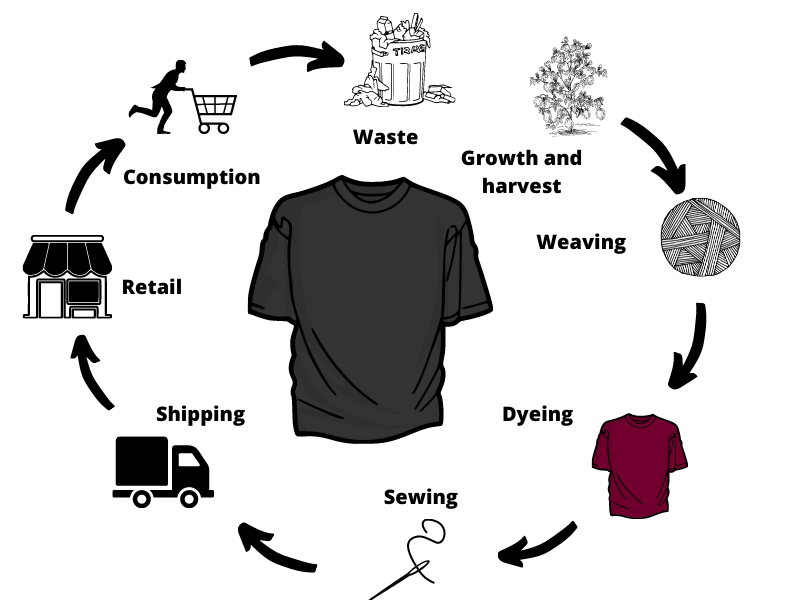
The graphic above illustrates the production cycle of a t-shirt. Every good that we produce follows a similar cycle. The more components a product needs, the more steps there are in the cycle.
But we cannot run away from one simple fact. Every step in the cycle will make an environmental impact.
We release carbon dioxide, destroy nature, or pollute the land.
What is worse is, that for the vast majority of goods, the cycle ends with the consumer. After that, it is garbage.
Natural ecosystems do not have a thing called garbage. In Earth’s natural systems, the cycle closes and will start anew.
We will always make a negative impact on the environment by producing. It does not matter, whether we produce our straws with bamboo or our clothes with hemp.
This is the case with recycled products and raw materials as well.
We can offset some of the impacts, but we cannot avoid them altogether.
Thus, the “sustainable single-use lunchbox” is an oxymoron.
For Something To Be Truly Sustainable, There Is Only One Way
There is just one way out of this dilemma, as I see it.
We need to emulate natural cycles as close as possible. By producing in closed cycles. And by eliminating our impacts where we can. Waste can not exist.
We also need to drastically cut down on our consumption.
For me, this is not a question of either-or. We need to do both. At the same time. The first problem we can perhaps solve by technical means and clever design. Think cradle-to-cradle, for example.
The second part of the problem, we cannot solve. At least not within the constraints of our current economic system.
Mainstream economic teaching makes bizarre assumptions.
For instance, nature is an externality we can ignore. Or that we can have infinite growth. Both of these assumptions contradict the laws of physics. That is one reason why Economics is not a field of science.
Do you know what else tries to grow infinitely? Cancer cells and viruses.
True sustainability means that single-use products cannot exist. Regardless of which materials we use for them.
But we can do something on our end. We may need to go against the bizarre logic of the system any way we can. Keep your car driving for as long as you can. Think hard, about what you need, before buying. Share assets whenever you can with your local community. Wear your clothes for as long as possible. And try to recycle, reuse or upcycle whatever you can.
This is the hardest collective challenge humanity has ever faced. We may never be able to make it happen. But we need to at least make the effort.
If you like my writings, why not buy me a coffee?
Also, check out my other blog.