
“Surviving” Isn’t Always Living
These 3 Harmful Personas Block Resilience
It’s a wet, chilly night in Mendocino, California. The tiny, enchanted town, perched with quiet confidence atop the rocky Pacific shoreline has all but shut down for the eve. A few local “misfits and mavericks,” as they are affectionately called, dim the lights in their shops, turn the “Open” sign to “Closed,” and step out into the meandering fog. In the distance, stands a large, cream-colored building, like a prettied-up version of one used on the set of Little House and the Prairie. The canopied lawn beside it, decked with delicate lights and people in their finest, raising a glass to one in flowing white and another in fitted black, suggests a couple has just said “I do.”
They all look so happy, I say to myself with silent venom.
I’m sitting in a rental car that smells like an ashtray doused with putrid “Evergreen” car freshener, which is way more lethal than fresh. A knock on the window makes me jump, but the figure behind it is blurry from the fog. I lower the window, slightly.
“Checking into the inn?” says the figure in a dark coat.
“No,” I reply without further explanation, and then raise the window.
He nods and walks away.
I wish I was staying in the inn, I mutter, this time with a heaping helping of self-pity. But, oh no! I insisted on “being strong” and proving to myself and to others that I could “go it alone.” Who needs four walls, a roof and floor, bathroom, heater, deadbolt, reliable phone and internet, and front desk attendant who could call 911 if, per chance, I was rendered unable to breathe — because I had another heart attack, like the one only three weeks before?
“Come in, defeat, come in and make yourself at home.” ― Iris Murdoch, The Sacred and Profane Love Machine
“Do you really think this is a good idea?” my boyfriend had asked me that morning, as he hesitantly handed me the thin, nylon bag that held a one-person tent.
I didn’t respond. I just took it and threw it down next to my bag.
“I need the cooler too,” I said, pointing to the top storage shelf, next to the other outdoor gear. Of the many things my cardiologists restricted me doing, at least for a while, was reaching over my head and carrying things that weighed more than a gallon of milk. My boyfriend climbed the ladder, stretched to reach the large, red container, and hauled the thing down and set it on the floor in front of me.
How exactly I was going to transport a food-filled, 48-quart Coleman to a camp site I still had yet to find, I also hadn’t yet worked out. All I knew was that I was saturated with sullenness, bitterness, anger, and despair at having nearly lost my life for a third time in a decade. I needed to do something that made me feel like I had a driblet of control.
Ten years, almost to the day, before my ill-fated Mendocino camping expedition I woke up struggling to breathe; my upper back felt like someone slammed me with a pipe; and I was ashen. Never suspecting a heart attack, because I was young, fit, and absent of risk factors, I went about life, as best as I could, for the next three days, until finally, I realized it was either the ER or the grave. After two hospital visits, one ambulance ride akin to a spin at Daytona, a slew of medical and genetic tests, and a trip to the operating room, the doctors determined I was having a serious heart attack caused by a rare condition called a Spontaneous Coronary Arterial Dissection, aka SCAD. (Turns out SCAD is the leading cause of heart attacks in women under 50.) Five days later, after getting me stabilized and having little more to offer than a hope and a prayer, my doctors released me from the Cardiac Care Unit (CCU). I arrived home like a chicken without its head; I still had no definitive explanation for why this happened or if it would happen again.
Three days later, it happened again, and this one was worse — the kind that sends doctors to the “family room” to break the news to loved ones that they are “doing everything possible, but it’s not looking good.” So much for hope and prayers.
I survived, despite the odds, and spent the next decade adjusting to the dreaded, horribly clichéd “new normal” — managing emotions I never knew I had and thoughts I never could have possibly conceived. At times reality became as distorted as mirrors in a funhouse. I was also trying like hell to figure out what behavior might cause yet another heart attack — and then, avoiding said behavior. Competitive weightlifting was definitely out, as was becoming a professional mover. Shoveling snow was also a big no-no. But everything else, from painting a room to riding a bike up a hill, was up in the air. For a while, I spent my days fluttering around in that air, like a pixie with tears in her wings. Over time, and not without a bunch of effort, I learned how to overcome the urge to become what I have since affectionately named the 3 Harmful Personas* that prevent us from being resilient.
Persona One: The Survivor — “Sullen Skin”
Many people like to talk about “surviving” after trauma or loss. Given the alternative, it makes good sense. But as I’ve experienced it — both personally, as a “survivor” myself, and professionally, as a therapist, clinical ethicist, and trauma researcher — surviving isn’t enough, because survivors aren’t necessarily resilient. To survive means only that you continue to exist after all is said and done. But it is important to remember that there are many ways to exist — and not all of them are healthy or serve us well.
When you think of the survivor persona imagine a zombie or the walking dead. Think of a tarnished penny or a flower that has turned to seed. Think of how food tastes when you have a nasty cold or what things sound like when you have water in your ears. You have survived, but at what cost? Are you really living?
Persona Two: The Victim — “Caged Lion”

The victim persona is characterized by a sense of iniquity and blame. When we experience loss, crises, trauma, or forced transition we often feel that we have been wronged, whether it is by someone or something specific, or simply by life itself. It’s natural to want to know why “this” happened, and especially why “this” happened to us? But in our attempt to demand answers, particularly when they don’t come as quickly as we’d like, we can become overly sensitive, easily offended, and sometimes rash.
When we adopt the victim persona, we make ourselves smaller, which only intensifies our suffering. We develop an entitlement mentality and assume a defensive posture. We become consumed by our own feelings and wants at the expense of others. We tend to take more for ourselves and share less with those around us. We struggle to feel empathy and to show compassion. And we become empowered by anger, which leads nowhere good.
When you think of the victim persona imagine a captured lion pacing within the small confines of a cage or an aggravated insect slamming against a window, trying to find the freedom of fresh air. Imagine getting stuck in an elevator if you are claustrophobic or being ignored or belittled when you have something important to say. Think of a time when you were bullied or made fun of or abandoned by friends and left helpless to fend for yourself. These are terrible feelings indeed.
When we live as a victim, we allow ourselves to become so identified with our grievance or loss, that we stay trapped in a past that only leads to a life of torment. We think that by raging against adversity, we can defeat the problem or make the pain submit. But again, this is not to be. In truth, we only continue to suffer and make our spirit sick.
Persona Three: The Martyr — “Scratchy Record”
The martyr complex is well known: the person who seeks sympathy and attention by suffering for the sake of some value or belief; and though many agree it’s an unappealing quality, too easily and too often we let the experience of adversity turn us into just this — a martyr.
The martyr persona exploits and contorts our feelings of anguish to such an extent that we willingly commend our life to sacrifice and our spirit to indefinite suffering. As martyrs, no one’s pain is ever quite like ours, and no one’s response to it ever noble enough. We demand recognition for what we see as our worthy behavior, and, if it’s not forthcoming, or if it is challenged in any way, we often dismiss or break off the relationship with the person who challenged us. Our mistake is that we see virtue in indulging our pain and abstaining from things that could bring us joy. As a result, we forgo the possibility of future happiness by relinquishing both our good sense and perspective.
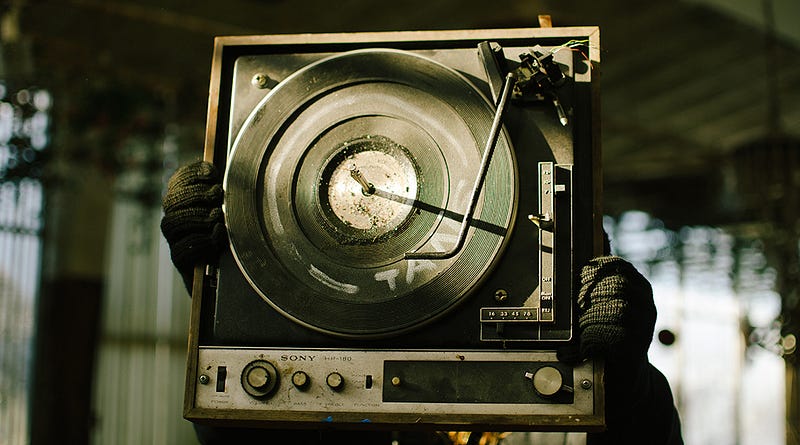
When you think of the martyr persona, imagine an old vinyl record that has reached its end but is now in an eternal loop of static noise, projecting fuzzy, screeching sounds, instead of beautiful music. Think of a tattered blanket or pants that are worn through and beyond repair whose owner refuses, on principle, to stop wearing them.
The martyr thinks that by wallowing in adversity, they can turn their pain into a crutch to support them and carry them onward. But as with the other two personas, this also gets us nowhere.
“It was the worst of times, [and] the worst of times.” Truly.
“It was the worst of times, [and] the worst of times.” Truly. It being June 30, 2008 — the date of heart attack number one — and June 30, 2018 — the day when some combination of the 3 Harmful Personas conspired to convince me that going camping alone in the mountains of Northern California, without any real plan about where to stop for the night or reliable cell service, not even a month after being released from the CCU, having just had a heart attack and an invasive procedure in my heart, unable to pick up even my Main Coon cat, let alone a cooler with food, in the fog and the rain, at night (sigh) was somehow a good thing to be doing.
I left Mendocino around 8pm and miraculously found some little “spot” of land that looked as if it might hold a tent. It technically wasn’t a legit, State-of-California-approved campsite — but hey, if they hauled me off to jail, at least 911 could easily be called if “it” happened again.
I left the cooler in the backseat of the putrid rental; and while I considered sleeping in there with it, I finally pulled out the tent, turned on the headlights to light the land, and got to work assembling the nylon and steel. Miraculously, that effort also went okay. After a quick check-in with my heart to make sure it wasn’t threatening #4, I shut off the engine, pulled out a sleeping bag and pillow, ducked into the tent, and put together that night’s sleeping arrangements. Then I laid down and waited to die.
But, thankfully, die I didn’t. I’ll be honest, that night was the pinnacle of suckitude. I was sad, scared, angry, lonely, and despairing, clinging to each of the personas as a child does a teddy bear. Every rustle or twitch outside my four fabric walls sent a ripple through my chest that made it seize. Whether I feared a hungry bear or the widow maker more I wasn’t sure. Twice I nearly called 911 convinced that it was happening again, only to remember that I had no cell service.
Stupid, a thousand times stupid.
When meaningful change, challenge, or crisis strikes, our heart speaks very differently than it usually does.
The Hopi Indians have a saying, “To watch us dance is to hear our hearts speak.” But when meaningful change, challenge, or crisis strikes, our hearts speak very differently than they usually do. For some it might be a deafening cry of rage. For others it’s like the eternal drum beat to the gallows. For many, the heart simply loses its voice or freezes with fear, uncertain how to sing again.
I woke up the next morning to the “sun in the sky and the breeze driftn’ by” and the dawn chorus. Staring through the mesh overhead at the now brilliant blue beyond, I thought with smirk, well, “I’m not yet dead!” The iconic image of Monty Python and the Holy Grail’s Eric Idle and John Cleese arguing over whether or not some peasant had reached his demise, one saying, “He says he’s not dead”; the other saying “well, he will be soon. He’s very ill…” brought an actual smile to my face. Then that smile broke out into laughter as I recalled the rest of the skit (worth watching here) as the not-dead peasant pleads that he is getting better and can walk, while the others say, “You’re not fooln’ anyone … You’ll be stone dead in a moment.” It ends with the peasant screaming for his life, “I feel happy! I feel happy!”
I realized in that moment that the 3 Harmful Personas were the equivalent of Idle and Cleese’s characters trying to force the living into the grave before they were good and ready to go. And the fact is I wasn’t ready to go — either physically or mentally. If nothing else, all the anger, fear, and other emotions coursing beneath my skin were a clear indicator of that.
I had to acknowledge I was becoming a shell of my former self. These Personas were holding me back, making me smaller, and keeping me an existential fog as thick as the day before. As I had learned a decade earlier, donning any of the Personas was technically living, but it was truly no life at all.
Perhaps my own heart needed some laughter in order to make it sing again.
Perhaps my own heart needed some laughter in order to make it sing again.
I pushed out of the sleeping bag and stepped out into the crisp morning air. Everything still looked as it had the night before: the soaring centuries-old cedars surrounding the cove; the boulder that had nearly taken out the rental car’s transmission as I angrily Duke’s-and-Hazzarded over it on the way in; even the putrid Evergreen smell (nothing’s perfect). But somehow it all looked a bit different — “not [quite] so dead.”
I disassembled the tent and packed the car. When I was ready to leave another “voice” spoke to my heart. This time it was Nina Simone:
Sleep in peace when day is done, that’s what I mean // And this old world is a new world //And a bold world, for me.
It’s a new dawn // It’s a new day // It’s a new life for me //
And I’m feelin’ good.
*Excerpt from Michele DeMarco’s upcoming book Holding Onto Air: The Art and Science of Building a Resilient Spirit.