
Survey Shows U.S. Schools Becoming More Hostile for LGBTQ Students
If you believe being LGBTQ in U.S. schools is fun or trendy, GLSEN’s 2021 National School Climate Survey will shatter your illusions
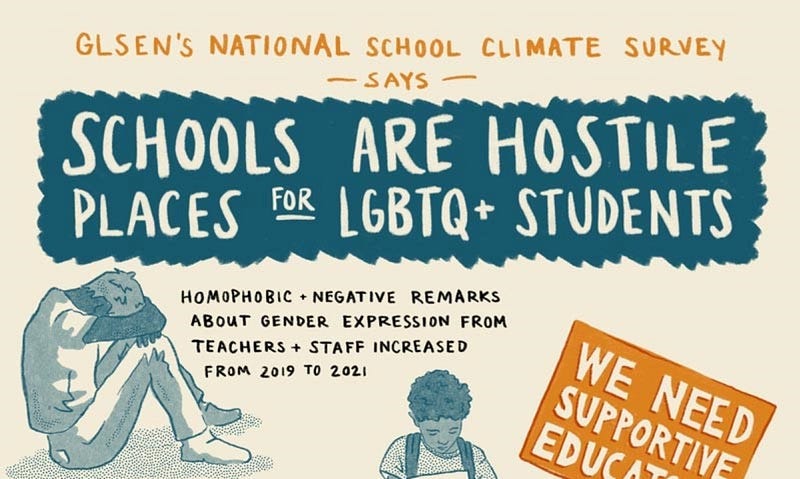
I was supposed to publish this column two days ago, timed for the official release of GLSEN’s latest National School Climate Survey, which shows that LGBTQ youth in U.S. schools face pervasive levels of bullying and abuse from peers and school staff. I even spent an hour on the phone with GLSEN’s research director, Dr. Joseph G. Kosciw, who was kind enough to help me get a handle on the numbers before the release date.
Ironically or not, I missed my deadline because I was busy chasing down a story about school children in Talihina, Oklahoma being abused with anti-LGBTQ and racist slurs. I didn’t have time to write about GLSEN data that shows those experiences are ordinary.
Let’s remedy that right now.
Schools are hostile places for LGBTQ+ students
Long and short: GLSEN surveyed 22,298 self-identified LGBTQ students in U.S. schools, in a carefully representative sample, and learned that school climates are toxic and harmful to the students’ mental health — at high rates likely to surprise many Americans.
If you believe being LGBTQ in U.S. schools is fun or trendy, this survey will shatter your illusions. Here’s the key takeaway:
The vast majority of LGBTQ+ students who attended school in-person at some point during the 2021–2022 academic year (83.1%) experienced in-person harassment or assault based on personal characteristics, including sexual orientation, gender expression, gender, religion, actual or perceived race and ethnicity, and actual or perceived disability.
Think I’m talking about students bullying other students? Well, yes, but teachers and other staff are participating at shocking levels. Look at these numbers from the survey, which show the “vast majority” of LGBTQ students faced verbal/physical harassment and/or physical assault:
Verbal harassment/bullying by teachers and staff is pervasive
- 72.0% of students reported hearing negative remarks about gender expression from teachers or other school staff.
- 58.0% of students reported hearing homophobic remarks from their teachers or other school staff.
- Only one-tenth of LGBTQ+ students (10.9%) reported that school staff intervened most of the time or always when overhearing homophobic remarks at school.
- Less than one-tenth of LGBTQ+ students (8.8%) reported that school staff intervened most of the time or always when overhearing negative remarks about gender expression.
Physical harassment/assault by other students is pervasive
- 31.2% of LGBTQ+ students were physically harassed (e.g., pushed or shoved) in the past year based on their sexual orientation or gender expression.
- 12.5% were physically assaulted (e.g., punched, kicked, injured with a weapon) in the past year based on their sexual orientation or gender expression.
- In a further breakdown, 22.4% of LGBTQ+ students were physically harassed at school based on their sexual orientation. 8.8% were physically assaulted based on their sexual orientation. 8.2% were physically assaulted based on gender expression
LGBTQ students report little access to inclusive education, report negative lessons being taught about them
- A majority (71.6%) of LGBTQ+ students reported that their classes did not include any LGBTQ+ topics in class.
- Under a fifth of LGBTQ+ students reported that LGBTQ+-related topics were included in textbooks or other assigned readings, with only 0.4% of students reporting that these topics were included in many of their textbooks and readings.
- Only 16.3% of LGBTQ+ students were taught positive representations about LGBTQ+ people, history, or events in their schools.
- 14.4% had been taught negative content about LGBTQ+ topics.
GSA clubs becoming less prevalent in schools despite evidence they decrease bullying and improve school climates across the board
The percentage of LGBTQ+ students who had a GSA available at their school dropped from more than 50% in recent years to less than 40% in 2021. GSAs, also known as Gay/Straight Alliances or Gender/Sexuality Alliances, are student-led clubs that encourage kids to meet in mixed groups that foster acceptance and support.
Schools with active GSAs report substantially less bullying and harassment of LGBTQ students and other students. A decrease in GSAs in schools tracks with increases in harassment and assault, though the GLSEN survey cannot by design demonstrate a causal effect.
School climates for LGBTQ kids are getting worse. Mental health outcomes are too.
GLSEN has conducted its school climate survey every two years for the last twenty years, and trends over the last several years are grim. In 2017, the survey found victimization based on gender expression increasing. In 2019, verbal and physical harassment and assault were pervasive.
2021 is harder to compare because of increased on-line learning due to the the COVID pandemic, but LGBTQ children doing in-person learning reported pervasively negative experiences.
More LGBTQ kids are skipping school, fewer are making plans for higher education, and negative mental health outcomes like depression and suicidal thoughts are high.
Intersectional considerations are highly significant. Black students and other students of color who identify as LGBTQ report significantly more bullying and abuse. Gender-nonconforming students report especially high levels of bullying and abuse. Poor mental health outcomes track closely with rates of bullying and abuse, so students with more than one marginalized identity report especially poor outcomes.
Being LGBTQ in school is not fun or fashionable. It’s dangerous, and we need to act together as a nation to support our children.
GLSEN’s survey is not designed to look at causes for toxic school climates, but I’ve been writing about such climates and interviewing students and parents for years. I think I can make some pretty reasonable guesses about what’s going on.
Ash Tough in Carroll County, Maryland is an important illustration.
When Ash was in 8th grade last year, they began to identify as nonbinary, coming out to family, then to friends and teachers. The response they got at first in school was pretty good, even though their mom tells me she worried quite a bit for Ash.
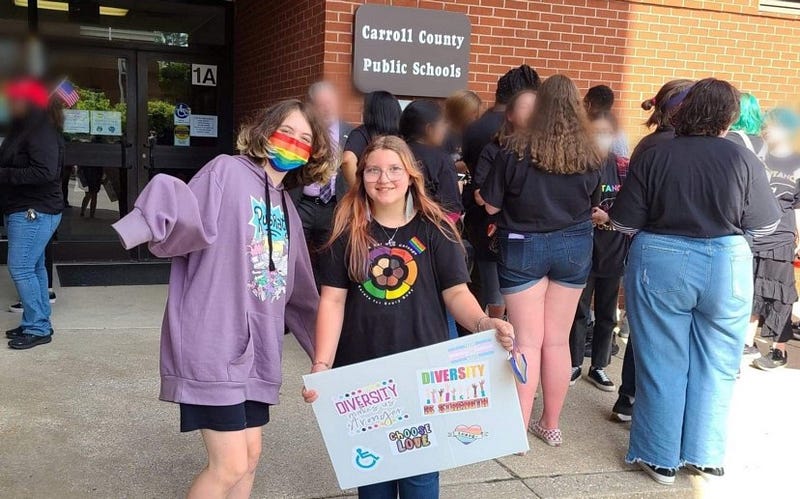
I interviewed Ash and their mom because they eventually became the center of an intense county hate storm after Ash brought a small rainbow flag to school one day on a whim. More than 20 students called Ash ugly homophobic slurs, and about 10 students publicly urged them to commit suicide.
Staff were mostly (though not entirely) supportive, but Ash was so shocked they attended the next school board meeting and asked board members to please help. A different student spoke up to suggest supportive teachers could put little rainbow flags on their desks to indicate safe spaces, and the board greenlighted the idea.
Then all hell broke loose in Carroll County.
It took awhile for opposition to build, but Ash eventually became the target of hate speech, insults, and death wishes from adults in their community. Ash told me they have no particular political views, saying, “I don’t even care about politics,” but groups like Moms for Liberty and other partisan Republican groups put the 13-year-old in their crosshairs. Norms of civilized behavior collapsed as adult community leaders called a child nasty names on public forums.
Students emboldened by their conservative parents directed even more slurs and hate speech at Ash. Their school climate grew worse.
Then the school board, responding to the hatred directed against Ash, voted to ban rainbow flags at school. Students felt more emboldened and validated, and Ash’s school climate grew much MORE toxic.
Today, LGBTQ students in the Carroll County school system live with inevitable, pervasive, toxic slurs and hate speech — not just tolerated by adults, but abetted by parents and community leaders who engage in the same behavior. That’s how it happens.
Ash is only one example, and GLSEN’s latest survey shows they are far from alone
Talihina, Oklahoma is poor and isolated, with an average family income of only $18,000.00. Carroll County is relatively wealthy, families bringing in just shy of $100,000.00 a year. What the communities share in common is tolerating and even encouraging slurs and hate speech against LGBTQ children in school.
The toxic mood on the right today is unhealthy and irrational.
School board members in a town near me in western Michigan reported feeling physically unsafe a couple days ago when parents started screaming anti-LGBTQ slurs and threatening violence, demanding members vote to remove Gender Queer, a memoir about about the nonbinary experience, from school libraries. The board, which had previously defended the book, voted to approve such stringent restrictions that no student is likely to read it.
I hate to even think about the school climate in that community, but isn’t it time we start to do better as a nation? Isn’t it time that community and political leaders stop demonizing LGBTQ people? Isn’t it time parents stop setting terrible examples for their children?
Schools should not be hostile places for LGBTQ kids, but they are. To learn more, read GLSEN’s National School Climate Survey. Arm yourself with the truth.
My writing is always free to readers who click my social media links, but if you’d like to browse more, click here to join Medium. Your nominal membership fee will help support my work:
To get an email whenever I publish a new story, Click Here:


