avatarCharles Browne

Free AI web copilot to create summaries, insights and extended knowledge, download it at here

7230

Abstract

one day after Leshchenko’s NED presentation, <a href="https://www.youtube.com/watch?v=WV9J6sxCs5k">an intercepted recording</a> of a telephone call between Nuland–now Under Secretary of State for Political Affairs–and U.S. Ambassador to Ukraine Geoffrey Pyatt was leaked, in which the pair discussed how Washington was “midwifing” Yanukovych’s ouster, and named several handpicked individuals to head the post-coup government.</i></p><p id="2ed2">Or possibly this, taken from a Cato.org site originally posted at the American Conservative website?</p><p id="80ef"><i>For years, the Kremlin made it emphatically clear that inviting Ukraine to join NATO would <a href="https://www.reuters.com/world/kremlin-says-nato-expansion-ukraine-crosses-red-line-putin-2021-09-27/">cross a red line</a> that threatened Russia’s vital security interests. However, it was never merely an issue of Kiev’s formal accession to the alliance. Comments from Russian President Vladimir Putin and other officials signaled that the truly intolerable development was Ukraine becoming a NATO military asset and an arena for the <a href="https://www.foxnews.com/world/putin-warning-nato-urkraine">deployment of U.S. and NATO forces</a>. That danger could — and ultimately did — arise, even though France and Germany continued to block a formal membership invitation.</i></p><p id="f2dc"><i>The magnitude of the aggressive moves taken by the Pentagon and CIA are just now becoming apparent.</i></p><p id="51ff"><i>Evidence grew in recent years that the United States had begun to treat Ukraine as a NATO ally <a href="https://www.cato.org/commentary/making-ukraine-nato-member-all-name">in all but name</a>. Steps included pouring nearly $3 billion in “security assistance” (primarily weaponry) into the country since 2014. Such armaments included the deadly Javelin anti‐​tank missiles. Military collaboration also included joint military exercises between U.S. and Ukrainian troops — and between NATO and Ukrainian forces. A segment on National Public Radio <a href="https://www.npr.org/2019/12/18/788874844/how-u-s-military-aid-has-helped-ukraine-since-2014">in 2019</a> featured U.S. officials preening about how such measures had strengthened Ukraine’s deterrence capabilities.</i></p><p id="13b4"><i>In his article, Dorfman documented the extent of other provocative military measures Washington pursued with respect to Ukraine. The CIA “made a series of covert moves that have helped prepare the Ukrainian security services for the current crisis. Shortly after Russia annexed Crimea in 2014, the agency initiated <a href="https://news.yahoo.com/exclusive-secret-cia-training-program-in-ukraine-helped-kyiv-prepare-for-russian-invasion-090052743.html">secret paramilitary training programs</a> for <a href="https://news.yahoo.com/cia-trained-ukrainian-paramilitaries-may-take-central-role-if-russia-invades-185258008.html">Ukrainian special operations personnel</a> in the U.S. and on Ukraine’s former eastern front.” (The eastern front was the Donbas region where Ukrainian forces were attempting to suppress Russian‐​backed separatist fighters.) Current and former intelligence officials clearly thought that those programs were especially clever initiatives, insisting that they “helped teach forces loyal to Kyiv the skills that have enabled it to mount an unexpectedly fierce resistance to the Russian onslaught.”</i></p><p id="b18c">By now it should be clear that this is a classic American CIA backed operation. Remember that we “liked” Putin at first, and then began thwarting him at every turn. Soon after becoming president he asked to join NATO, nope. He later asked to join the European Union. Nope, to big a country he was told (say what?). Remember that our policy since WWII was to maintain complete global hegemony and never allow any others to grow to a point of true “independence” from our global influence. Any of this beginning to make sense? Let us look at the definition of a proxy war, and then comments from our leadership.</p><p id="93c8">From Wikipedia:</p><p id="8ec2"><i>A <b>proxy war</b> is an armed conflict between two states or <a href="https://en.wikipedia.org/wiki/Non-state_actor">non-state actors</a>, one or both of which act at the instigation or on behalf of other parties that are not directly involved in the hostilities.<a href="https://en.wikipedia.org/wiki/Proxy_war#cite_note-UN1-1">[1]</a> In order for a conflict to be considered a proxy war, there must be a direct, long-term relationship between external actors and the <a href="https://en.wikipedia.org/wiki/Belligerent">belligerents</a> involved.<a href="https://en.wikipedia.org/wiki/Proxy_war#cite_note-Hughes-2">[2]</a> The aforementioned relationship usually takes the form of funding, military training, arms, or other forms of material assistance which assist a belligerent party in sustaining its war effort.<a href="https://en.wikipedia.org/wiki/Proxy_war#cite_note-Hughes-2">[2]</a></i></p><p id="ba4f">The comments (denials included). Let’s start with a bit of PR bullshit noted by Axios.com written by Jacob Knutson:</p><p id="967b"><i>What they’re saying: “I would like this whole group today to leave with a common and transparent understanding of Ukraine’s near-term security requirements because we are going to keep moving heaven and earth so that we can meet them,” Austin said during his opening remarks for the meeting.</i></p><ul><li><i>“We’re all here because of Ukraine’s courage, because of the innocent civilians who have been killed and because of the suffering that your people still endure,” he said to Oleksiy Reznikov, Ukraine’s minister of defense.</i></li><li><i>“Your country has been ravaged, your hospitals have been bombed, your citizens have been executed, your children have been traumatized. But Ukraine has done a magnificent job at defending its sovereignty against Russia’s unprovoked invasion.”</i></li><li><i>“Ukraine’s valor and skill will go down in military history.”</i></li></ul><p id="0aca">Taken from samf.substack.com by Lawrence Freedman</p><p id="907d"><i>One difficulty now is that the idea that proxy wars are good things for the US, precisely because somebody else does the fighting, is now so ingrained, that the term has been embraced by some former US officials, although not <a href="https://www.youtube.com/watch?v=2MTAryuTRMw">by President Biden</a>. Thus former Supreme Allied Commander of NATO, <a href="https://www.nytimes.com/2022/04/06/opinion/why-russian-sanctions-wont-stop-putin.html?showTranscript=">General Philip Breedlove</a> stated in an interview last April that ‘I think we are in a proxy war with Russia. We are using the Ukrainians as our proxy forces.’ Former CIA director Leon Panetta declared, when arguing that as much military aid as possible should be given to Ukraine, ‘We are engaged in a conflict here. It’s a proxy war with Russia, whether we say so or not.’ All of these statements have been seized upon by <a href="https://noahcarl.substack.com/p/is-ukraine-a-proxy-war">critics of the war</a> in the West, as letting the cat out of the bag, revealing the true intentions of the West.</i></p><p id="75ca">Or, from the Cato Institute again, by Ted Galen Carp

Options

enter</p><p id="d429"><i>It is hard to determine how much Western political leaders and their media mouthpieces actually believe their own moralistic propaganda. Some likely have drunk the Kool Aid, but others clearly have more practical (and less savory) reasons for wanting Washington to wage a proxy war against Russia. First and foremost, the financial benefits to the military‐​industrial complex are enormous. The United States has already provided more than <a href="https://www.19fortyfive.com/2022/12/100-billion-for-ukraine-congress-needs-to-explain-why/">$100 billion</a> in aid to Kyiv, and a major portion of those funds are going to pay for Ukraine’s purchases (now or in the near future) of weapons systems from Raytheon, Lockheed Martin, or other manufacturers. Those firms also will benefit from the destruction of weapons already provided to Kyiv, since US stockpiles supposedly must be replenished. The usual collection of hawks already are sounding alarms that the arsenals of the United States and its NATO allies have become <a href="https://www.nytimes.com/2022/11/26/world/europe/nato-weapons-shortage-ukraine.html">significantly depleted</a>.</i></p><p id="fd4e"><i>However, Secretary of Defense Lloyd Austin may have inadvertently disclosed a broader, ignoble motive for the proxy war. An April 2022 statement that he issued in Poland at the end of his stealth visit to Kyiv emphasized that Washington’s goal was not merely to help Ukraine repel Russia’s invasion, but to “<a href="https://www.nytimes.com/2022/04/25/us/politics/ukraine-russia-us-dynamic.html">weaken Russia</a>” to the point that it could no longer pose a threat to any other country. Achieving such an objective would indisputably require a prolonged war in Ukraine — regardless of the consequences to the Ukrainian people.</i></p><p id="3a9c">I could go on here but I believe I have made my point. I will include the links to the articles I drew from and a few more for added “flavor”. Is it just me, or are we moving forward on our decades long plan to be able to carry out two major wars on two separate fronts or am I just being “paranoid”? Obviously, draw yourown conclusions.</p><div id="08dd" class="link-block"> <a href="https://scheerpost.com/2023/02/03/caitlin-johnstone-us-surrounds-china-with-war-machinery-while-freaking-out-about-balloons/"> <div> <div> <h2>Caitlin Johnstone: US Surrounds China With War Machinery While Freaking Out About Balloons …</h2> <div><h3>The U.S. empire has been surrounding China with military bases and war machinery for many years, in ways Washington…</h3></div> <div><p>scheerpost.com</p></div> </div> <div> <div style="background-image: url(https://miro.readmedium.com/v2/resize:fit:320/0*9tFg3-trj1_y0Se-)"></div> </div> </div> </a> </div><p id="7405"><a href="https://nsarchive.gwu.edu/briefing-book/russia-programs/2017-12-12/nato-expansion-what-gorbachev-heard-western-leaders-early">https://nsarchive.gwu.edu/briefing-book/russia-programs/2017-12-12/nato-expansion-what-gorbachev-heard-western-leaders-early</a></p><div id="f5bd" class="link-block"> <a href="https://theconversation.com/ukraine-war-follows-decades-of-warnings-that-nato-expansion-into-eastern-europe-could-provoke-russia-177999?utm_medium=email&amp;utm_campaign=Daily%20Newsletter%20for%20March%201%202022%20-%202219322020&amp;utm_content=Daily%20Newsletter%20for%20March%201%202022%20-%202219322020+CID_620269200e51e7851bd6f3297831f147&amp;utm_source=campaign_monitor_us&amp;utm_term=Ukraine%20war%20follows%20decades%20of%20warnings%20that%20NATO%20expansion%20into%20Eastern%20Europe%20could%20provoke%20Russia"> <div> <div> <h2>Ukraine war follows decades of warnings that NATO expansion into Eastern Europe could provoke…</h2> <div><h3>As fighting rages across Ukraine, two versions of reality that underlie the conflict stare across a deep divide…</h3></div> <div><p>theconversation.com</p></div> </div> <div> <div style="background-image: url(https://miro.readmedium.com/v2/resize:fit:320/0*Ky5Eb68bEHjYXhrr)"></div> </div> </div> </a> </div><div id="f6bc" class="link-block"> <a href="https://scheerpost.com/2022/03/11/ray-mcgovern-what-role-has-the-u-s-played-in-the-ukraine-crisis/"> <div> <div> <h2>Ray McGovern: What Role Has the U.S. Played in the Ukraine Crisis? - scheerpost.com</h2> <div><h3>As Russia's attack on Ukraine wages on, and Ukrainian civilians die daily, the fog of war has seemingly been clouding…</h3></div> <div><p>scheerpost.com</p></div> </div> <div> <div style="background-image: url(https://miro.readmedium.com/v2/resize:fit:320/0*4TMDvUDDnuweidzK)"></div> </div> </div> </a> </div><div id="24c0" class="link-block"> <a href="https://mronline.org/2022/07/06/anatomy-of-a-coup/"> <div> <div> <h2>Anatomy of a Coup: How CIA front laid foundations for Ukraine war | MR Online</h2> <div><h3>Obvious examples of Central Intelligence Agency covert action abroad are difficult to identify today, save for…</h3></div> <div><p>mronline.org</p></div> </div> <div> <div style="background-image: url(https://miro.readmedium.com/v2/resize:fit:320/0*_m4MXIByE1cOzyt-)"></div> </div> </div> </a> </div><div id="1314" class="link-block"> <a href="https://www.cato.org/commentary/washington-helped-trigger-ukraine-war"> <div> <div> <h2>Washington Helped Trigger the Ukraine War</h2> <div><h3>Evidence grew in recent years that the United States had begun to treat Ukraine as a NATO ally in all but name. Steps…</h3></div> <div><p>www.cato.org</p></div> </div> <div> <div style="background-image: url(https://miro.readmedium.com/v2/resize:fit:320/0*Qql3G7ohwIcC3-0w)"></div> </div> </div> </a> </div><div id="7856" class="link-block"> <a href="https://www.cato.org/commentary/using-ukraine-bloodied-pawn"> <div> <div> <h2>Using Ukraine as a Bloodied Pawn</h2> <div><h3>That cynical strategy replicates the one the United States used in Afghanistan between 1979 and 1989 to aid mujahidin…</h3></div> <div><p>www.cato.org</p></div> </div> <div> <div style="background-image: url(https://miro.readmedium.com/v2/resize:fit:320/0*Zz5eDLzpgQEtgrMT)"></div> </div> </div> </a> </div><p id="c647">Enjoy the knowledge addition, weep for all involved. Peace.</p></article></body>

Surveillance Balloons versus Military Bases -which would you prefer?
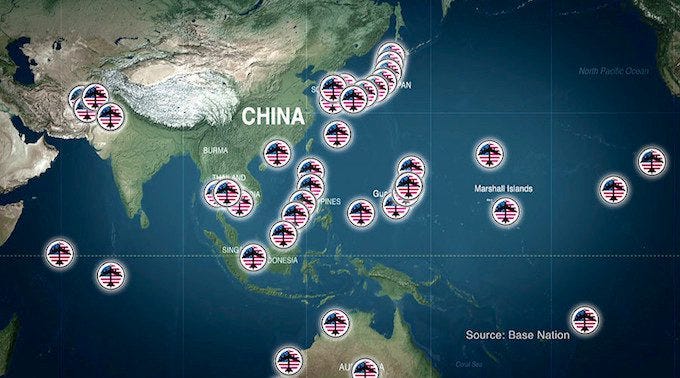
U.S. military bases surrounding China. (John Pilger — The Coming War With China.)

As the old saying goes “a picture is worth a thousand words”.

Europe in 1990
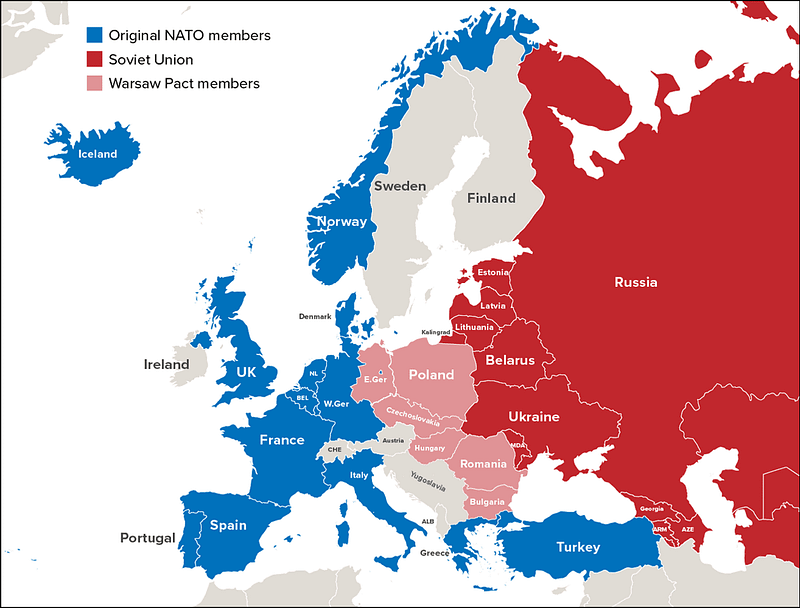
In 1990, the year after the Berlin Wall fell, Russia dominated the Soviet Union and six allied Warsaw Pact countries.

Bryn Bache | CNBC

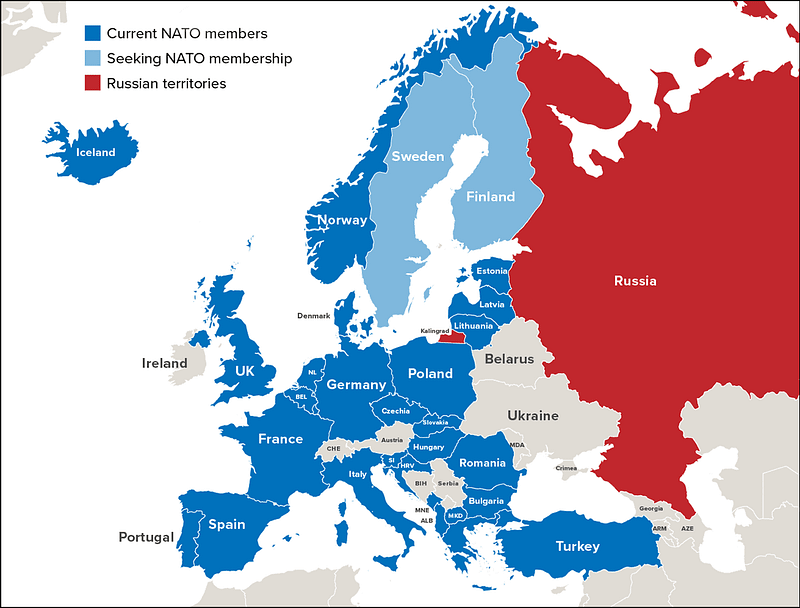
Europe in 2022

As of 2022, NATO has expanded to let in three former Soviet states and all of the former Warsaw Pact countries.

Bryn Bache | CNBC

Declassified documents show security assurances against NATO expansion to Soviet leaders from Baker, Bush, Genscher, Kohl, Gates, Mitterrand, Thatcher, Hurd, Major, and Woerner

Slavic Studies Panel Addresses “Who Promised What to Whom on NATO Expansion?”
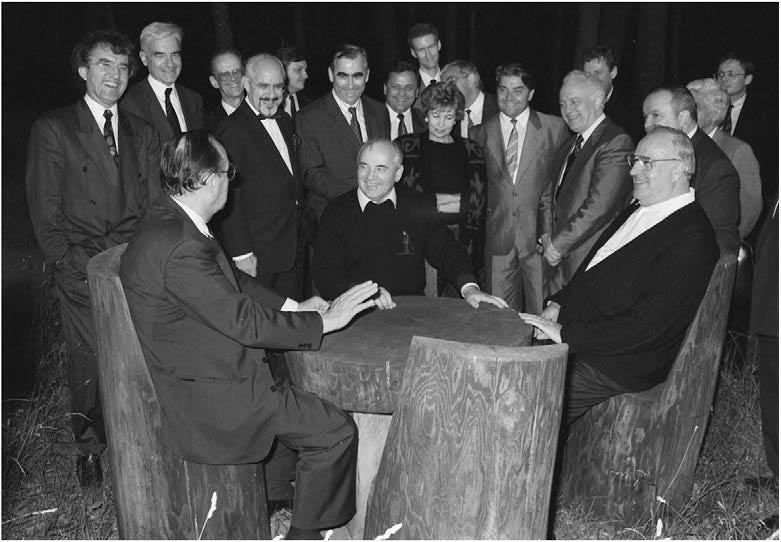
Michail Gorbachev discussing German unification with Hans-Dietrich Genscher and Helmut Kohl in Russia, July 15, 1990. Photo: Bundesbildstelle / Presseund Informationsamt der Bundesregierung.

Washington D.C., December 12, 2017 — U.S. Secretary of State James Baker’s famous “not one inch eastward” assurance about NATO expansion in his meeting with Soviet leader Mikhail Gorbachev on February 9, 1990, was part of a cascade of assurances about Soviet security given by Western leaders to Gorbachev and other Soviet officials throughout the process of German unification in 1990 and on into 1991, according to declassified U.S., Soviet, German, British and French documents posted today by the National Security Archive at George Washington University.

Here is a quote from an experienced ex CIA analyst taken from an article in the Sheerpost. A link will be left at the end of this article:

As Russia’s attack on Ukraine wages on, and Ukrainian civilians die daily, the fog of war has seemingly been clouding more nuanced analysis in the United States, argues “Scheer Intelligence” host Robert Scheer. To get more perspective on the historical context of the current conflict, Scheer invites former CIA analyst Ray McGovern to discuss the role the U.S. and NATO have played in Ukraine. McGovern has long been an outspoken critic of what he’s coined as the American Military-Industrial-Congressional-Intelligence-Media-Academia-Think-Tank (MICIMATT) for leading the world ever closer to a nuclear war.

McGovern spent 27 years as a CIA analyst, during which time he led the Soviet Foreign Policy Branch and prepared The President’s Daily Brief for three U.S. presidents. Months before the Iraq War, the former intelligence analyst joined a group of his peers to ward against the “insanity” of war, creating the group Veteran Intelligence Professionals for Sanity (VIPS). Now, as news of the war in Ukraine fills American media, McGovern has attempted to call for sanity once more.

The CIA veteran sees the conflict, which he argues is as a direct result of what he calls a Western-orchestrated coup against Vladimir Putin’s ally, former Ukrainian President Viktor Yanukovych, as global brinkmanship at its most dangerous given the nuclear arsenal that both Russia and the U.S. possess. Scheer pushes back on McGovern’s use of the term “coup” as well as his assessment of Russian attacks on Ukraine, which the “Scheer Intelligence” host — who covered the Soviet Union and later Russia, as well as Ukraine, as a foreign correspondent — has condemned as a war crime.

And why would we have “couped” the former President Viktor Yanukovych, and did we? How about this from MRonline.com taken from a Kit’s newsletter article:

Writing in NED’s quarterly academic publication Journal of Democracy in July that year, Leshchenko discussed in detail the media’s role in the Maidan coup’s success, drawing particular attention to the fundamental role of “online journalist” Mustafa Nayyem.

He kickstarted the protests the previous November, rallying hundreds of his Facebook followers to protest in Kiev’s Independence–now Maidan–Square, after Yanukovych scrapped the Ukrainian-European Association Agreement in favor of a more agreeable deal with Moscow.

Nayyem was no ordinary “online journalist”. In October 2012, he was one of six Ukrainians whisked to Washington DC by Meridian International, a State Department-connected organization that identifies and grooms future overseas leaders, to “observe and experience” that year’s Presidential election.

Funded by the U.S. embassy in Kiev, over 10 days they “[gained] a deeper understanding of the American electoral process,” meeting candidates and election officials, and touring voting facilities. They were also invited to discuss “Ukraine’s progress towards a more fair and transparent election process” with “equally curious” representatives of U.S. government agencies.

With whom the sextet met is unstated, although promotional pictures show Nayyem filming a personal summit with John McCain on his smartphone. The video was posted to his personal YouTube channel–in it, Nayyem asks the noted warhawk for his thoughts on Ukraine, to which he responds, “I’m concerned with the influence of Russia.”

This is striking, for McCain flew to Kiev in December 2013 to give an address to Maidan protesters, flanked by known Neo-Nazi Oleh Tyahnybok. Then-State Department official Victoria Nuland, now Under Secretary of State for Political Affairs, was also present, notoriously handing out motivational cookies to attendees.

On February 4th 2014, one day after Leshchenko’s NED presentation, an intercepted recording of a telephone call between Nuland–now Under Secretary of State for Political Affairs–and U.S. Ambassador to Ukraine Geoffrey Pyatt was leaked, in which the pair discussed how Washington was “midwifing” Yanukovych’s ouster, and named several handpicked individuals to head the post-coup government.

Or possibly this, taken from a Cato.org site originally posted at the American Conservative website?

For years, the Kremlin made it emphatically clear that inviting Ukraine to join NATO would cross a red line that threatened Russia’s vital security interests. However, it was never merely an issue of Kiev’s formal accession to the alliance. Comments from Russian President Vladimir Putin and other officials signaled that the truly intolerable development was Ukraine becoming a NATO military asset and an arena for the deployment of U.S. and NATO forces. That danger could — and ultimately did — arise, even though France and Germany continued to block a formal membership invitation.

The magnitude of the aggressive moves taken by the Pentagon and CIA are just now becoming apparent.

Evidence grew in recent years that the United States had begun to treat Ukraine as a NATO ally in all but name. Steps included pouring nearly $3 billion in “security assistance” (primarily weaponry) into the country since 2014. Such armaments included the deadly Javelin anti‐​tank missiles. Military collaboration also included joint military exercises between U.S. and Ukrainian troops — and between NATO and Ukrainian forces. A segment on National Public Radio in 2019 featured U.S. officials preening about how such measures had strengthened Ukraine’s deterrence capabilities.

In his article, Dorfman documented the extent of other provocative military measures Washington pursued with respect to Ukraine. The CIA “made a series of covert moves that have helped prepare the Ukrainian security services for the current crisis. Shortly after Russia annexed Crimea in 2014, the agency initiated secret paramilitary training programs for Ukrainian special operations personnel in the U.S. and on Ukraine’s former eastern front.” (The eastern front was the Donbas region where Ukrainian forces were attempting to suppress Russian‐​backed separatist fighters.) Current and former intelligence officials clearly thought that those programs were especially clever initiatives, insisting that they “helped teach forces loyal to Kyiv the skills that have enabled it to mount an unexpectedly fierce resistance to the Russian onslaught.”

By now it should be clear that this is a classic American CIA backed operation. Remember that we “liked” Putin at first, and then began thwarting him at every turn. Soon after becoming president he asked to join NATO, nope. He later asked to join the European Union. Nope, to big a country he was told (say what?). Remember that our policy since WWII was to maintain complete global hegemony and never allow any others to grow to a point of true “independence” from our global influence. Any of this beginning to make sense? Let us look at the definition of a proxy war, and then comments from our leadership.

From Wikipedia:

A proxy war is an armed conflict between two states or non-state actors, one or both of which act at the instigation or on behalf of other parties that are not directly involved in the hostilities.[1] In order for a conflict to be considered a proxy war, there must be a direct, long-term relationship between external actors and the belligerents involved.[2] The aforementioned relationship usually takes the form of funding, military training, arms, or other forms of material assistance which assist a belligerent party in sustaining its war effort.[2]

The comments (denials included). Let’s start with a bit of PR bullshit noted by Axios.com written by Jacob Knutson:

What they’re saying: “I would like this whole group today to leave with a common and transparent understanding of Ukraine’s near-term security requirements because we are going to keep moving heaven and earth so that we can meet them,” Austin said during his opening remarks for the meeting.

  • “We’re all here because of Ukraine’s courage, because of the innocent civilians who have been killed and because of the suffering that your people still endure,” he said to Oleksiy Reznikov, Ukraine’s minister of defense.
  • “Your country has been ravaged, your hospitals have been bombed, your citizens have been executed, your children have been traumatized. But Ukraine has done a magnificent job at defending its sovereignty against Russia’s unprovoked invasion.”
  • “Ukraine’s valor and skill will go down in military history.”

Taken from samf.substack.com by Lawrence Freedman

One difficulty now is that the idea that proxy wars are good things for the US, precisely because somebody else does the fighting, is now so ingrained, that the term has been embraced by some former US officials, although not by President Biden. Thus former Supreme Allied Commander of NATO, General Philip Breedlove stated in an interview last April that ‘I think we are in a proxy war with Russia. We are using the Ukrainians as our proxy forces.’ Former CIA director Leon Panetta declared, when arguing that as much military aid as possible should be given to Ukraine, ‘We are engaged in a conflict here. It’s a proxy war with Russia, whether we say so or not.’ All of these statements have been seized upon by critics of the war in the West, as letting the cat out of the bag, revealing the true intentions of the West.

Or, from the Cato Institute again, by Ted Galen Carpenter

It is hard to determine how much Western political leaders and their media mouthpieces actually believe their own moralistic propaganda. Some likely have drunk the Kool Aid, but others clearly have more practical (and less savory) reasons for wanting Washington to wage a proxy war against Russia. First and foremost, the financial benefits to the military‐​industrial complex are enormous. The United States has already provided more than $100 billion in aid to Kyiv, and a major portion of those funds are going to pay for Ukraine’s purchases (now or in the near future) of weapons systems from Raytheon, Lockheed Martin, or other manufacturers. Those firms also will benefit from the destruction of weapons already provided to Kyiv, since US stockpiles supposedly must be replenished. The usual collection of hawks already are sounding alarms that the arsenals of the United States and its NATO allies have become significantly depleted.

However, Secretary of Defense Lloyd Austin may have inadvertently disclosed a broader, ignoble motive for the proxy war. An April 2022 statement that he issued in Poland at the end of his stealth visit to Kyiv emphasized that Washington’s goal was not merely to help Ukraine repel Russia’s invasion, but to “weaken Russia” to the point that it could no longer pose a threat to any other country. Achieving such an objective would indisputably require a prolonged war in Ukraine — regardless of the consequences to the Ukrainian people.

I could go on here but I believe I have made my point. I will include the links to the articles I drew from and a few more for added “flavor”. Is it just me, or are we moving forward on our decades long plan to be able to carry out two major wars on two separate fronts or am I just being “paranoid”? Obviously, draw yourown conclusions.

https://nsarchive.gwu.edu/briefing-book/russia-programs/2017-12-12/nato-expansion-what-gorbachev-heard-western-leaders-early

Enjoy the knowledge addition, weep for all involved. Peace.

Recommended from ReadMedium