
Surprising Life Lessons I Learned from Army Reserve Officer Training
A love of nature and respect for silence were two of them.

A long time ago, I did infantry training in the Australian Army Reserve. I got to fire a semi-automatic rifle, let rip with a machine gun, throw a grenade, and blast a stationary tank with orange paint from a shoulder-holstered missile launcher.
That was a highlight. But some of the things I learned, like bushcraft, were slow burners. They have stuck with me and influenced my lifestyle choices; therefore, I want to share them in this short story.
Without going into the intricate details, I want to summarize potent things I remember under six headings, hoping they might give you some perspectives and insights from my experience.
1 — Sharpen your senses.
When we were patrolling through the bush, we were told to sharpen our senses. If it was dark, we closed our eyes for ten seconds. Then we opened them, and there was light.
Sounds religious. But it is natural, and it works.
You see the dark; then you see the light. That’s the first thing. Close your eyes. Meditative practices also advise this approach. One study showed improved emotional stability in experienced meditators.
2 — Listen deeply.
The Australian bush is a surround-sound ecosystem. From birds to lizards, beetles, and frogs, there’s layer upon layer of civilizations. While guns popped and trip flares crackled, those insects and amphibians had peace and their own social order.
Patrolling was done in silence. We didn’t break a stick.
Like an invisible chain, we were spaced out through the Australian bushland and could only see one or two fellow soldiers. When we needed to communicate, we made field signals.
The less you speak, the more sharply you can observe. The more deeply you can listen.
The authors of one study suggest medical doctors focus on developing their deep listening skills. This would enable them to diagnose and have empathy in chaotic and time-pressured environments.
3 — Keep scanning the horizon.
This is important in business and life.
Where are you? Where do you want to be? How could you get there? What is the landscape? Are there silhouettes of enemy (competitors) on the ridgeline?
Lift your head from the weeds and look up. Every landscape is always changing. It’s the Buddhist Law of Impermanence. Complacency kills.
I once did a marketing strategy for a technology client.
During the Situation Analysis, I discovered their major competitor was stealing market share with a cute new sub-brand.
The client had never heard of it.
It’s easy to get caught in the weeds. Lift your head to the sky sometimes.
We need to scan the surrounding environment or the big picture.
Horizon-scanning systems are now in place across Europe to systematically identify new health technologies before they enter and disrupt the market.
4 — Kindness always works better.
As ancient wisdom advises, we catch more flies with honey than we do with vinegar. Not that you want to catch any more in the Australian bush in summer. But that’s the saying. And it’s right.
You’ll go further when you’re nice to people than when you’re unkind. Some people like to explode. They’re addicted to stress. They’re also setting themselves up for a heart attack.
Be polite and use grace. Think about what you want to happen. Imagine it first. The universe likes to conspire to help you succeed. How could it happen?
If a person is standing in the way, find your common ground. Speak to the person like they’re a friend. Or your baby son or daughter all grown up. Always connect.
Employees in workplaces that include loving-kindness and compassion meditation have been shown to have decreased burnout, lower stress, and increased mental health. These things benefit everyone.
5 — Develop super clear mission statements.
A good mission has a single objective with an active verb. It is clear to everyone. If only companies could get this right. If only nations could get this right.
Mission creep is when the mission is too complicated, blows up, and can’t be delivered. Or it changes. The goalposts keep shifting. I think this is one of the biggest saboteurs or anything in the world.
People suddenly want too much or something else. They delay clarity for speed and then end up completely stuck. Inc. says a simple 12-word pitch got Google its earliest funding.
Companies use contracts that clearly define a scope of work. It shows what success looks like. It clearly defines the mission.
I once worked for a nonprofit that needed a new website. It had spent almost two million dollars and wasn’t mobile-friendly.
Everything they needed could have been done in open-source software like WordPress.
A super clear mission will always keep you on track.
Medical and healthcare students are now taught the importance of a clear mission, vision, and values for ethical leadership.
6 — Express deep gratitude.
At the end of each course, I was ecstatic. I’d made it through. Everything felt like luxury. A bed with fresh sheets. Music. Sleep. No 1am, 3am, and 5am duties. A bathroom sink. An indoor flushing toilet.
When we take all our creature comforts away, life is tough. But when we get a few back, we learn how privileged we are.
In a study of families, when parents wrote a gratitude letter, it predicted greater well-being and family function. It didn’t require any greater effort, energy, or attention on the children but benefitted the entire family.
Conclusions and Takeaways
I did officer training between 1998 and 2001. I don’t miss it. But Being in the Australian bush for weeks at a time always shifted something ineffable.
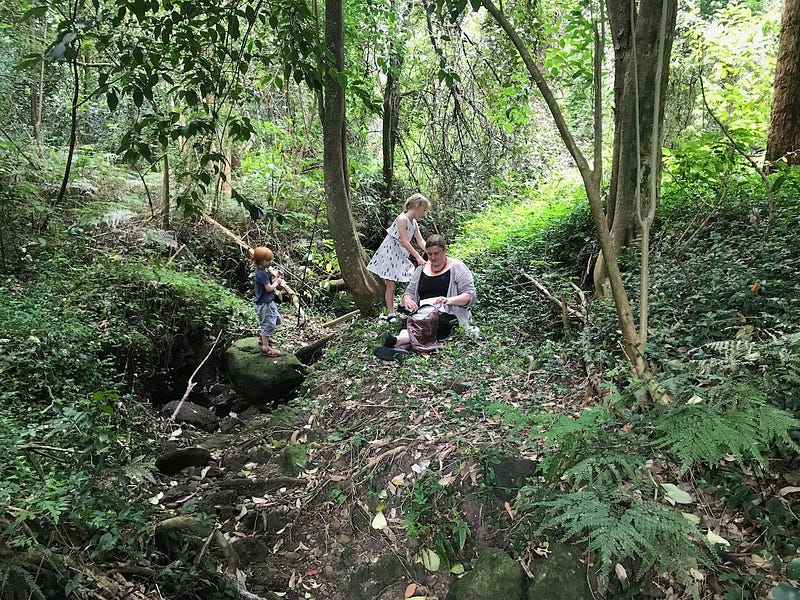
These days, I am happy to go camping. No weapons. No orders. No CRAP food (Combat Army Ration Packs), digital detox, absence of distractions. It’s total immersion and mindfulness. And the results are better than any wellness resort could produce.
So, if you need to recharge, get into nature. Leave your tech behind. Close your eyes. Sharpen your senses. Be clear about what you intend. Be kind. Be grateful for what you have and what you receive in the process.
Be well.


