

Surprising Advice From a Wealthy Man
It just might change your life.
My father was an administrative law judge. Monday through Friday, he’d rise at 5AM and drive to the train station. From there, he’d travel to San Francisco, catch a bus and arrive at his office.
Dad would repeat the journey at the end of each work day. He typically arrived back home around 6PM, except for those times when he fell asleep on the train and missed his stop.
We lived in a three bedroom home in the hills of Los Gatos, California. We had a view of silicon valley. When I was a boy, the dot com era hadn’t begun yet.
Dad made a good living as an administrative law judge, and while we weren’t financially wealthy, we were comfortable. As the years passed, Santa Clara County evolved into the tech hub it is today. More and more “McMansion” homes started popping up around us, as the newfound wealth of Silicon Valley grew.
It wasn’t long before our quiet town of Los Gatos changed. BMW’s, Mercedes Ferrari’s and other expensive cars zipped around town. Michelin rated restaurants emerged to cater to the new glitterati of Silicon Valley.
Meanwhile, Dad continued to drive around town in his old, beat up Ford Ranger truck. “There’s nothing wrong with wealth,” Dad used to tell me, “But for many, they lose themselves in the process. It’s not wealth that defines you…it’s character.”
Of course, as a cocky teenager, my retort was, “Well, I’d rather be a wealthy guy with character than a poor guy with character.” Dad smiled and said, “Sure, but the funny thing is, the most content people I meet are often not wealthy.”
For example, one of my Dad’s favorite people was Corey, the local paver who repaired the neighborhood roadways. Dad used to hire him for odd jobs and invite him over for lunch and iced tea.

They’d talk about history and life. “Corey is more down to earth and authentic than most of the people he works for,” Dad used to say. Dad’s other favorite person was his barber, Pat, who I’ve written about here:
My mother and father sometimes attended parties in our neighborhood, although Dad’s preference was to stay home with a good history book. He went to these soirées mostly for my Mom, who enjoyed socializing.
Dad often observed that many of our wealthy neighbors didn’t seem very happy. Yes, they had huge homes and expensive cars, but some also had marital problems, alcohol issues, stress related health challenges, and more. Others, despite making a lot of money, spent it foolishly. “Half these folks are mortgaged to the hilt,” Dad would say.
My father retired from the bench at the age of 79. He retired later in life because he enjoyed his work and the intellectual engagement it provided. When he retired, he owned his home and cars. He had a good pension, medical benefits, and even invested in excellent, long-term care policies for my mother and himself (policies we’d end up needing later in life).
What I learned from my Dad is that money is helpful, but it doesn’t guarantee happiness.
It’s never enough
There’s a Sufi saying that says:
“You can never get enough of what you don’t really need.”
Maybe that’s what the actor Jim Carrey was referring to when he said:
“I think everybody should get rich and famous and do everything they ever dreamed of so they can see that it’s not the answer.”
The reality is that a focus on materiality, fame and fortunes doesn’t seem to bring lasting happiness. Just look at all the dysfunction associated with Hollywood celebrities. The divorces, drug and alcohol abuse, mental breakdowns and more.
An article in the MessyMinimalist.com had this to say about happiness:
“Let me explain: when every day — every thought — is centered around what you THINK will bring happiness, you’ll quickly find that it’s never enough. This is because after having a happy moment, our brains must come back down to our homeostasis (our natural state of being). If we trick our brains over and over that these temporary ‘happy moments’ (such as eating at a restaurant, getting new furniture or clothes, or vacationing), are how we’re always supposed to feel, then coming back to our homeostasis may begin to feel like a loss… Thus triggering us to pursue MORE feelings of happiness.
The pursuit of happiness is expensive, time-consuming, and exhausting.”
Happiness is fleeting. Sooner or later, the vacation ends. The expensive dinner out is over. We return to the quotidian rhythms of life.
So, if the endless pursuit of money, possessions and fame doesn’t make us happy for long, what should we do?
This is where contentment comes in. Happiness may come and go, but contentment can be more consistently achieved.
Again, from the Messyminimalist.com article:
“If we are content with ourselves and able to accept who we are while in our natural state of being, we will have more time, money, and energy to live and experience life, in both its delightful and inglorious moments. It doesn’t mean we can’t have goals for a better or different lifestyle, but it’s important to find acceptance and contentment no matter your situation. Even if you have nothing, you can enjoy a sunrise. Even if you have no one, you can partake in conversation with a stranger.”
Chasing a mechanical rabbit
Racing dogs run their hearts out around a track chasing a mechanical rabbit. The problem is, they never get to catch the rabbit. In a way, our pursuit of happiness feels like this. What’s worse, even if we catch the “rabbit” of our ambitions, the happiness is fleeting.
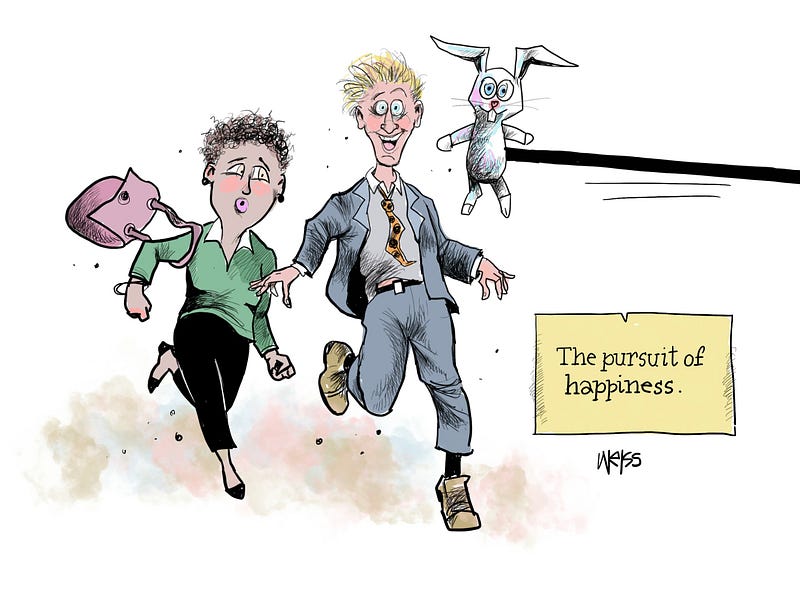
We get the promotion, or achieve that degree. We celebrate. But then, the sun sets, and the next day we have to soldier on to the next thing.
Andrew Weil, M.D. argues that we should pursue contentment rather than happiness. Contentment is an inner feeling of satisfaction. It’s not dependent on external things, like a promotion or winning the lottery. By all means, there’s nothing wrong with ambition and achievement. It’s just that we shouldn’t put all our emotional eggs in that basket.
Here’s Dr. Weil briefly explaining:
Our optimum emotional health should be tied to personal contentment, serenity, comfort and resilience. Well adjusted, content people understand that sadness is, sometimes, part of life. It’s natural and can release some of our deepest feelings. The trick is to not get stuck there.
An odd sense of contentment
In 2006 my father lay in bed, comatose, in the final throes of renal failure. The wonderful hospice nurse kept him as comfortable as possible. I held Dad’s hand and reminisced. Stories of our family, pets, vacations, holidays and the blessings of a good life. I told Dad that if he was tired, it was okay to finally rest. Everyone in the family was fine, thanks to him.
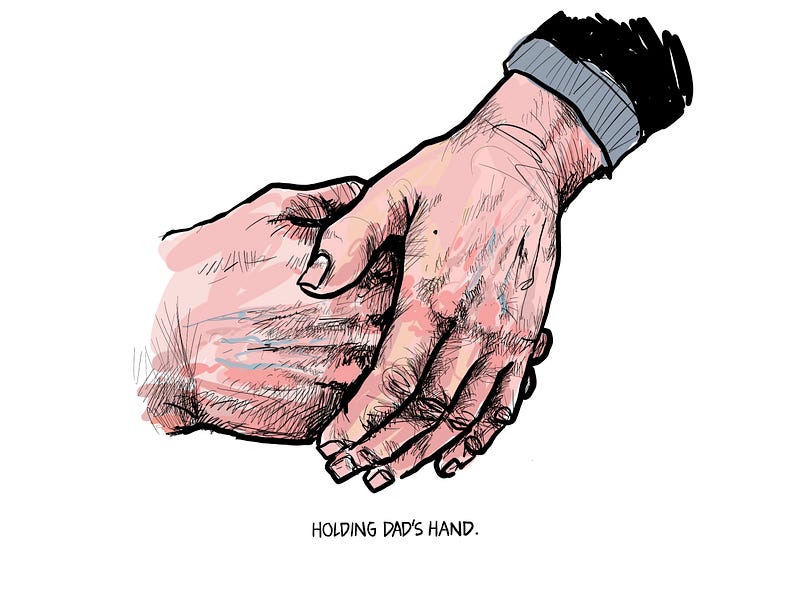
I got the call two hours later that my father had passed away quietly. I was prepared for his death, but the sadness and loss still felt overwhelming. I was far from happy. Yet, I also felt an odd sense of contentment.
I felt good that I had been there for my Dad through his entire illness. I felt good that I made all the necessary arrangements for my mother. I felt proud of the fact that in my father’s hour of need, I was there for him. And I was relieved that he was no longer suffering in any way.
Dad’s passing also forced me to think deeply about my own life. From his wisdom and example, I started to focus on the things that brought me contentment. Like my family, artwork, books, friends and health.
Shadowlands
In the movie Shadowlands, Anthony Hopkins plays the Christian theologian, writer and professor C. S. Lewis. He teaches at Oxford during the 1950s. An American fan, Joy Gresham, travels to meet him for tea in Oxford. Thus begins a love affair that ends sadly with Joy’s diagnosis of cancer.
This true story unfolds in a slow, sincere, elegiac way. There’s one powerful scene where Lewis and Gresham are out in the English countryside on their honeymoon. It’s a beautiful, sunny day, but suddenly rain begins to fall. Soon, it’s a downpour.
They seek shelter under an overhang. Despite the joy of this time they’re sharing, there is sadness. Her illness will soon end their joy. She reminds Lewis that the time they’re sharing won’t last. He tells her not to spoil it, but she says it doesn’t spoil it. It makes it real. Later she says something quite profound:
“The pain then is part of the happiness now.”
I don’t think we want to live in a constant state of happiness. It would deny us the full experience of being human. Of knowing loss, which only amplifies our appreciation for what we had. Our tears of sadness, while difficult, seem to cleanse our souls and release the emotional weight of saying goodbye.
Happiness and sadness will come in and out of our lives. Better to pursue a life of contentment. Focusing on your health, family and passions is a big part of a contented life. However, there is another path to personal contentment. I learned about it from a wealthy man who made a short documentary.
Selflessness is the key
Film maker Erwin Darmali made a documentary about a man named Ramon Tengkano, who had it all (or so it seemed.) It began over a simple challenge with another guy. The challenge was to see who could make a million dollars first. Tengkano won the challenge. In fact, he gloated over the fact that the other guy wasn’t successful at all.
At one point, Tengkano owned several homes, six or seven Harleys, fifteen cars and could pretty much buy whatever he wanted. But deep down he had a big fear, that none of his success would last.
Tengkano tells the story of taking his bouncer to the office of an elderly man that owed him money. The old man bounced three checks, so Tengkano destroyed the old man’s office. The elderly, frail man nervously smoked cigarettes as his office was smashed apart.
Tengkano found out the next day that the old man died of a heart attack. All the money in the world couldn’t change how Tengkano felt about himself. He asked, “What have I become?” He decided at that moment to change. He made a promise, for the rest of his life, to do good things for other people.
I never heard of Ramon Tengkano until a reader was kind enough to send me a link to a moving, documentary film (by Erwin Darmali.) It’s called, “The Simplicity of Happiness,” and it’s worth watching.
Surprising advice
Ramon Tengkano changed his entire life. He sold everything and moved to an underdeveloped village in Indonesia. He helped a homeless boy reunite with his mother. He built a health clinic and improved irrigation for the villagers.
Tengkano tells us that true happiness is when we start to empty ourselves. He adds:
“There’s so much suffering in this world. Because everybody serves themselves. Selflessness is the key.”
Near the end of the short film, Tengkano looks at the camera, and utters the most impactful, surprising piece of advice:
“Live a simpler life.”
How about you? Are you living a simpler life, or a complicated one? In the United States, we are immersed in a consumption, money oriented culture.
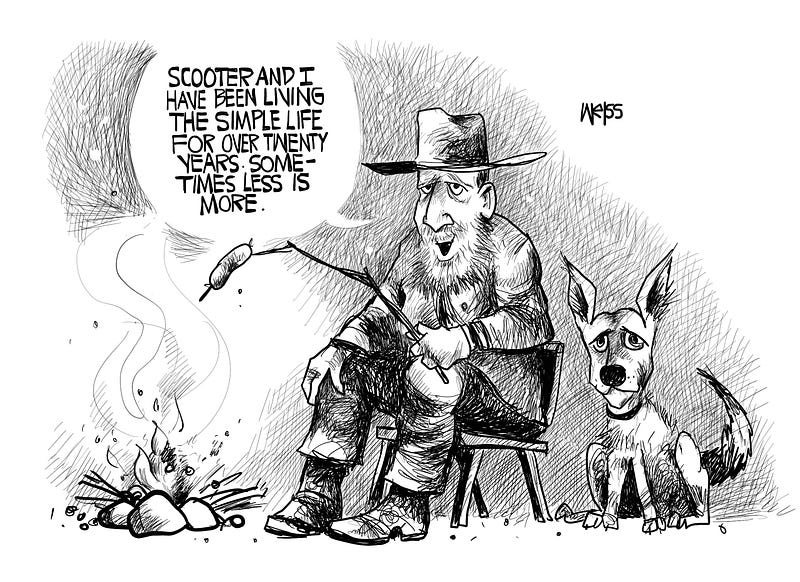
While there’s nothing wrong with ambition and making a good living, we sometimes lose our way. Keeping up with the Joneses, promotions, vacations and the trappings of “success” blind us to the “why” of success. Taking the time to ask “why” you want that BMW, or “why” you want to be rich, can expose some flawed thinking.
For some, it’s all about vanity. For others, it’s about winning at all costs. Still others are insecure, and think financial wealth will bring happiness. They need others to see their homes and endless stuff, so they feel better. Superior, perhaps.
In my law enforcement career, I responded to just as many domestic incidents in the homes of wealthy people as I did the homes of the less fortunate.
Having money didn’t shield people from all the challenges of life. Sure, they didn’t have to worry about making the rent or paying orthodontic bills for their kids. But their relationship issues were still there. Their substance abuse issues were still there. The hole inside them was still there, even when they seemed to have everything.
Live a simpler life
Ramon Tengkano was wealthy. He had all the trappings of success. But his greed made him an ugly person. Luckily, he finally saw this in himself. He changed who he was, and decided to help others. He decided to live a simpler life.
When I was in Ireland a few years ago, we drove past an elderly man herding sheep. It was a glorious, sunny day. There was a pleasant breeze and the landscape was stunning.
The sheepherder, rosy cheeks and all, had a smile on his face. He and his dog ambled down the road with their flock, not a care in the world.
I doubt that sheepherder is worried about his social media analytics, or whether he’s as wealthy as the next sheepherder. I suspect the exercise, outdoors, and a well earned pint of Guinness are all he needs to sustain his spirit.
I decided to adopt a simpler life in 2016, when I retired five years early from my position as Chief of Police. We sold our home in California and moved to Southern Nevada, where the cost of living was more affordable and there was no state income tax. We sold, donated and dumped stuff we didn’t need.
We transitioned to a simpler life, and it has made all the difference. I created more time for my family, health and creative passions.
If it can make all the difference for a wealthy man like Ramon Tengkano, or a stressed out police chief like me, or even a sheepherder in Ireland, then maybe a simpler life can make all the difference for you, too?
You’ll never know unless you give it a try.
Before you go
I’m John P. Weiss. I paint landscapes, draw cartoons and write about life. Thanks for reading.


