
Supervenience Rules- Emergence is the Exception or “Why the World Sucks so Often”- Part One
In these “interesting times”, there appear to be three very different responses to the existential challenges we face (see my recent article “Two Existential Questions for Humanity” for an overview of the multiple interconnected escalating crises we face).
Coping Mechanism One: the world is awful. Humans suck. AI, and other technologies plus climate change, the sixth mass extinction, etc, will probably make things worse. We’re going to run out of the materials needed for renewable energy, and electric vehicles, let alone food and water. World War 3 is coming, and so on.
Discussions about the state of the world too often focus on what is going wrong, rarely mentioning any positive developments, especially given the fear-mongering nature of the world’s media. Think Yuval Harari, Umair Haque, extreme right and left-wingers, and collapsists/end of the worlders/survivalists. There is a large audience for bad news and it is easier and more profitable to scare people than to encourage them to achieve positive change. Having said that, if your house is on fire, calling the fire brigade is a reasonable response.
Coping Mechanism Two: the world is much better. Pushback on the awful world narrative takes it to the other extreme, which is equally damaging. Solely communicating the progress that the world has achieved becomes unhelpful, or even repugnant, when it glosses over the problems that are real today. Think Stephen Pinker, Ray Kurzweil, TED talks, and others who claim we’ve never had it so good. And, of course, in some ways, they have a point.
Coping Mechanism Three: the world can be much better. This requires us to transcend and include both statements one and two, recognizing that there are pockets of collapse all around the world, where life is getting worse for hundreds of millions, while at the same time there are pockets of the future in the present globally, where life is getting better for hundreds of millions. With the rest of humanity somewhere in between.
To see that the world has become a better place does not mean to deny that we are facing very serious problems. On the contrary, if we had achieved the best of all possible worlds I wouldn’t spend my life writing and researching how we got here and what we can do about it. It is because the world is still terrible that it is so important to see how the world became a better place in many ways.
Child Mortality- 4.3% vs 50% . For example, globally, 6 million children die every year before the age of 15- or 4.3% of all children. This is tragic. Historically, however, half of all children died before the age of 15 until the 19th century, which represents a dramatic improvement. In Somalia, the country with the highest child mortality today, about 14% of all children die.
Just a few generations ago the mortality rate was more than three times as high, even in the best-off places. The region where children have the best chance of surviving childhood is the European Union. 99.55% of all children born in the EU survive childhood, but this outcome has taken a century of medical and educational advances powered by enlightened social policies and massive investment in education and healthcare systems.
If we want more people to dedicate their energy and money to make the world a better place then we should make it much more widely known that it is possible to make the world a better place.
Having said all of that, I come to the main theme of this article: “Supervenience Rules- Emergence is the Exception or “Why the World Sucks so Often”.
One of the reasons we humans are so ready to absorb bad news is what is called the “Amygdala Hijack”. Out of the four methods of social control: fear, guilt, shame, and reason, fear is the most immediate and powerful emotion. The basolateral amygdala, a structure involved in rapid threat detection, was more active when research participants avoided a highly provoking opponent. This indicates that provocation increases threat anticipation, thereby leading to cognitive and behavioral disengagement.
We’re told time and again that humanity is in its dangerous “teenager phase” of development as a species, which goes some way to explaining the wild mood swings and crazy behavior of half of the world’s so-called leaders. Some 30% of teens studied worldwide have an anxiety disorder, meaning that one in three teenagers is struggling with anxiety that significantly interferes with their life and is unlikely to fade with treatment.
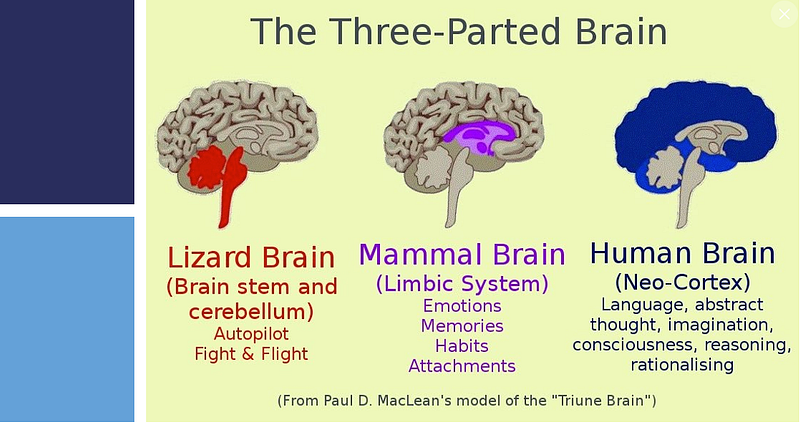
Moreover, when reading emotions, teens rely more on the amygdala than adults, who rely more on the frontal cortex. The frontal and pre-frontal cortices damp down the amygdala hijack through the process of mentalization, which involves making unconscious fear conscious so that the mind and reason can deal with the cause of the fear.
With Coping Mechanisms Two- the world is much better and Three- the world can be much better, we move from the amygdala hijack and the lizard brain responses to mammalian and human brain responses. While all human beings use all three parts of their brains, the proportions are very different between the coping mechanisms.
Even adults are not immune from such fear, even though it is more often conscious rather than unconscious fear. In 2021/22, according to the WEF global risks perception survey, only 10.7% of the world’s leading executives and politicians responded with the answer “Accelerating global recovery”, to the question: “What is your outlook for the world over the next three years”?
41.8% saw the future as consistently volatile with multiple surprises, and 37.4% said they saw the future as a set of fractured trajectories separating relative winners and losers. And 10.7% said they saw a future of progressive tipping points with increasingly catastrophic outcomes.
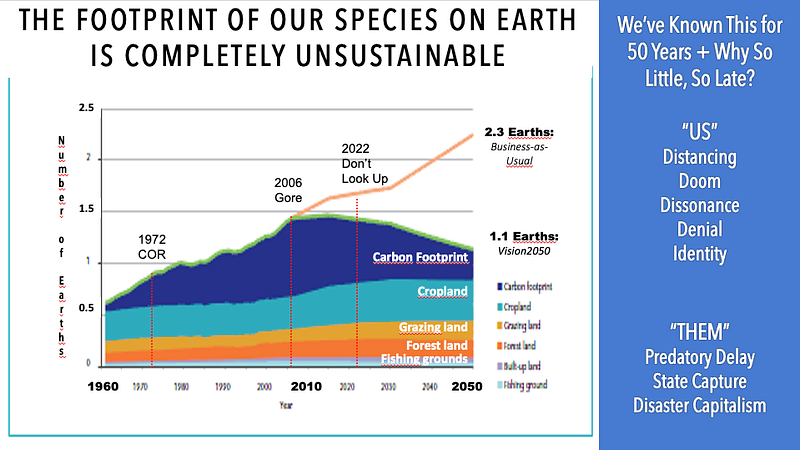
Supervenience, means literally “coming or occurring as something novel, additional, or unexpected”, from “super,” meaning on, above, or additional, and “venire,” meaning to come in Latin. Who amongst us has not had the experience of life as a series of shocks, surprises, and sudden changes of fortune, in one or more areas of our lives? As a 66 years young, semi-retired agent of change and transformation, having worked and lived on four continents in 37 countries, I could tell you dozens of stories of the shocks, surprises, and sudden changes of fortune I’ve endured in my lifetime, to the point where I’ve become “anti-fragile”- harnessing chaos and complexity to survive and thrive.
The world of 2022 and the 21st century, in general, appear to be the most challenging, turbulent, and unpredictable years faced by humanity since we were almost wiped out by the Toba catastrophe, a supervolcano eruption that occurred around 74,000 years ago at the site of present-day Lake Toba in Sumatra, Indonesia, in one of the Earth’s largest known explosive eruptions.
If one were to look for a better example of supervenience, it would be hard to find. The Toba catastrophe theory holds that this event caused a global volcanic winter of six to ten years and possibly a 1,000-year-long cooling episode. According to the genetic bottleneck theory, between 50,000 and 100,000 years ago, human populations sharply decreased to 3,000–10,000 surviving individuals. It is supported by some genetic evidence suggesting that today’s humans are descended from a very small population of between 1,000 and 10,000 breeding pairs that existed about 70,000 years ago.
Emergence, on the other hand, is the process of coming into existence or prominence. For example, “the emergence of life on earth”; “the emergence of the environmental movement”. In philosophy, systems theory, science, and art, emergence occurs when an entity is observed to have properties its parts do not have on their own, properties or behaviors that emerge only when the parts interact as part of a wider whole. Emergence plays a central role in theories of integrative levels and complex systems, as well as psychology, leadership, organizational development and innovation.
For billions of people, the impacts of global overheating and biodiversity collapse will mean that heatwaves, droughts, ferocious storms, wildfires, rising sea levels, economic crashes, and food and water shortages are supervening in their lives, causing death, destruction, and irreversible setbacks. The lovely concepts of emergence, holism, complexity science, and meta-modernism, while useful in helping model ways to avoid such destructive outcomes, are the very last thing on anyone’s mind in such situations. Terror, desperation, depression, anger, hyper-anxiety, and hopelessness reign.
It is therefore completely understandable that Coping Mechanism One- The World is Awful, is prevailing amongst at least half of the world’s population, who reach out to dictatorial leaders and false prophets who promise them a better future while blaming other groups for the situation they are in, thereby absolving them of any guilt or shame for being part of the problem. This is both ridiculously easy, simple, and emotionally satisfying for those whose reasoning powers are limited- for example, 54% of Americans have the reading age of a 12-year-old, which goes a long way to explaining their lack of critical or systemic thinking abilities. Such people are remarkably easy to polarize and brainwash, as we’ve seen in the past few decades.
How to Make Social Emergence and Synergy happen More Often
My life’s work has revolved around helping social and organizational emergence happen more frequently to realize beneficial outcomes- what I’ve called “Game B- Regenerative, Inclusive, Developmental Multicapitalism” in numerous articles and books. Unlike many fluffy-tailed starry-eyed agents of change, however, I’ve also had to learn to survive the shocks, surprises, and sudden changes of fortune inherent in taking on the “Game A- Degenerative, Exclusive, Hierarchical Monocapitalism” system and mindsets that currently rule our world. So far, supervenience is evenly balanced with emergence and synergy in this tale, as Game A and its consequences become almost overwhelming for even the best prepared.
So, for me, the fundamental question is how to make beneficial social and organizational emergence and synergy happen more often than the supervening forces that push us backward.
This is the challenge I will address in Part Two, coming soon to a screen near you :-)