
Summary of Margaret Atwood’s Masterclass on Creative Writing
26 key takeaways from the author of The Handmaid’s Tale
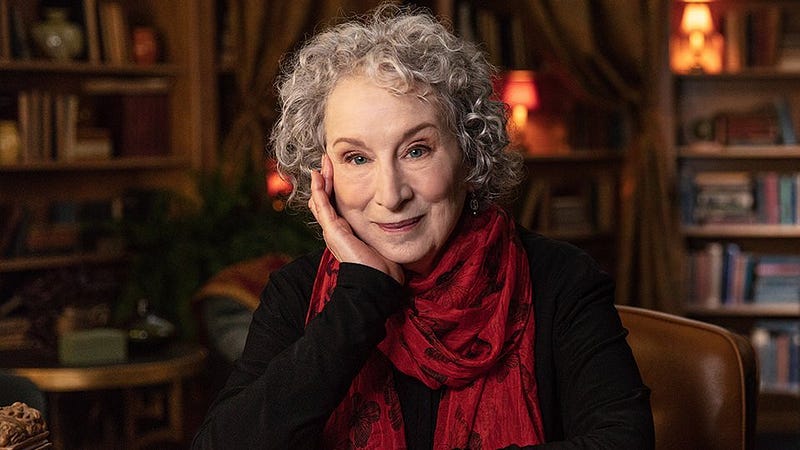
- Don’t just “express yourself”. Because that’s probably just your ego shouting. Instead, aim to conjure up some curiosity, suspense, and interest for the reader.
- To be a writer, read more. When Margaret was a child, her family lived in the woods, where there wasn’t much to do except read, so she read tons. That’s what got her started writing comics, then short stories, then her first poetry book, then her first novel.
- Reading is the most participative of the arts. The words on the page are inert until the reader takes it in and projects it in their imagination, then it becomes alive.
- Write fast, like downhill skiing, then “re-vision”. Get it out as fast as you can onto the page, then you can go through it again and again in revision. Each time you go through it, you’ll see something different, and so you’ll think about it differently.
- Immerse yourself. If you immerse yourself in anything, you’ll get ideas about it. But you must do the immersing first. When you deeply immerse yourself in life, you will find darkness, but interestingly, that’s what propels most writers, because then through their writing, they try to bring light to that darkness. It’s also why the most brilliant writers tend to be older, because you have to have been through enough life and seen enough people to gain some deep enough insights to write well.
- If you’re blocked, identify the fear, look it in the face. For example, if you’re worried about people you know reading your work, write under a pen name, and if you’re afraid to be judged, know that you don’t have to show your writing to anyone until you’re ready.
- Learn the “building block” stories that most stories are put together from. Such as mythologies, folklore, fairy tales, Indigenous tales, Bible stories. Here is an extensive list.
- Alter elements of existing stories to spark new stories. Take a few characters you already know, introduce a new event, and drop them into a “building block” story, and imagine how the situation would change.
- Innovate the story structure. You don’t always have to tell the story chronologically. Start in the middle. Start with a flashback. Pose a detective scene. Use time jumps. Toggle between multiple viewpoints and create the Rashomon effect, leaving the reader wondering which version of the telling was really true. Frame stories within stories like in One Thousand and One Nights. You can even be innovative with narrative point of view, as Agatha Christie did in The Murder of Roger Ackroyd, where we find out in the end it was actually the narrator who did it. But start simple, then work your way up.
- Reveal character through details. Just like real people, your characters should have particular ways of thinking, feeling, and doing things. Reveal them through their histories, obsessions, hobbies, pets, clothes, furniture, and how they interact with them.
- Characters don’t have to be likeable to be compelling. In fact, Margaret wrote the Robber Bride when she saw there were no female con artists in fiction. The heroine in the Handmaid’s Tale is capable of some very dark and violent things. Dare to defy gender norms in your characters. It’s exhausting to be good all the time, and it’s not as interesting in fiction.
- Writing fiction is a form of problem solving. You write towards what you don’t know, and you might find yourself in a corner, then have to write yourself out of it. It’s like venturing into darkness, and trying to bring some light into it.
- Use dialogue to dramatize power struggles. Recognize there is often a gap between what people say and what they’re thinking. They’re speaking to get something or avoid something. Speech can also show the character’s background, social status, etc. The dialogue you write should sound like what such a person would say, but not exactly what they would say in real life, more concise and dramatized.
- Describe sensory perceptions in concrete and significant ways. The initial instinct is to write with labels and abstractions, but it doesn’t work well in fiction. Your job as a fiction writer is to provide the foundation for the reader to imagine their own experiences, to have their own emotional responses. This is why it’s better to describe sensory inputs in detail and let the reader come to their own interpretations, rather than label it exactly as you would imagine, because that constricts the reader’s experience. Leave abstraction and judgement to the essayists.
- Don’t just focus on the visual, incorporate sound, smell, touch, and taste as well. Make sure all sensory details are significant to the storyline and or reveal something significant about the character. An exercise is to take out the people in a scene and try to write it without any visual input. Then when you fold them back in, the sensory description will have become much richer, because you intentionally added to the lesser noticed aspects of it.
- Readers will assume everything you did was deliberate. Sometimes they will attribute meaning where there is none, and find patterns and clues that actually work out even when you didn’t intentionally plan for them to.
- Descriptive detail doesn’t interfere with style. Whether writing in a plainsong or baroque style, you can always focus on descriptive detail. Style mostly comes down to sound, how the words sound next to each other, and as a result, the type of tone it sets.
- Signal to the reader how you’re moving through time. If things come back around to how they were at the beginning, that’s circular time, much like how history works. Most stories, though, tend to follow linear time, from A to B. Use timestamps or give hints through descriptions to show your readers where in time your story is. Use flashbacks sparingly, and make sure the front story is still moving forward noticeably. You can use parallel storylines happening at the same time to generate dramatic irony, because the characters on one side do not know what’s happening to the other, but the reader does. If you are taking many time leaps in your story, make sure there is a reason, otherwise it is better to go the simple straightforward route.
- A story needs an interrupted pattern to get it going. If everything is perfect, and all is going as expected, then there will be no story. Start with the unexpected, move with the unexpected, and end chapters with the unexpected.
- You write your way into the true beginning. Your first chapter should be a good balance of giving information and pulling in with mystery. It should be very inviting. Often, the first chapter you write in your first draft will not end up being the first chapter you choose to have in your book. Because you write your way into a book, and you discover your story’s true beginning as you write it.
- There is no true end. Whether you decide to give closure or leave things open-ended, you will frustrate some readers as everyone has different expectations for how things should end. But just like in real life, there are no perfectly tidy endings.
- Revise from the perspective of the reader. Then, hand it to someone who has no power dynamics in relation to the book to review. Not a spouse, not another writer, not a publishing gatekeeper. Someone on the outside. The best question to ask that person is how fast they read it. If they read it all quickly, that’s good news. It means they couldn’t put it down. Ask what they were most compelled by and confused by. Then do it again with a few more readers. Look for commonalities in their responses. When all the resulting revisions are done, then you are ready to send it to agents and contests.
- Rules of speculative fiction. Margaret calls these “what-if” books. They’re stories about the possibilities latent in society but not yet real. They take an existing idea and extrapolate it beyond its current reality. In doing so, this society will seem to become either a dystopia or a utopia. But see, one person’s dystopia is another’s utopia, and even within dystopias, there will be small pockets of utopias, and vice versa.
- Your story has already happened, research it. If you look closely at history, many things that seem like they’ll never happen have already happened somewhere on a smaller scale. For speculative fiction to be believable, it must be rooted in things that have already happened in the real world. When doing research, seek multiple perspectives to get a holistic view. You’ll discover something new with every perspective.
- The writer’s path is not the same as the writer’s career. You can make a career out of writing cookie cutter books for the masses. That is the economy of art. But the path of art isn’t just about economy, it’s about developing your gift, and offering it to the world. Same concept goes with finding an agent. Look for one that genuinely loves your work, not one that sees you as a commodity.
- Share your gift with the world. Poets & Writers Org keeps one of the most comprehensive and regularly updated lists of literary magazines agents, and contests to submit your work to. Another is Entropy.
These are just the ideas I found most insightful. The full course, which is 3 hr 43 min, can be viewed at masterclass.com