avatarCosmo Zen

Free AI web copilot to create summaries, insights and extended knowledge, download it at here

1392

Abstract

.</p><p id="8472">The second dimension represents <b>features to gestalt</b>. This is the degree to which we are focusing on individual features vs sensing the whole. In order to disambiguate objects, attention must be able to move in both directions (top-down and bottom-up processing). In general, the upper right of this graph corresponds to scaling up, and the lower left to scaling down.</p><p id="fae5">There are two distinct types of mindfulness, which we can classify as <b>meditation</b> and <b>contemplation</b>. The former means to move towards the center, while the latter is derived from Latin meaning to be with the sky. These types may also be referred to as vipassana and metta, and they correspond to scaling down and scaling up, respectively.</p><p id="661b">Both of these types of awareness are essential to generating insight for creative problem solving. Meditation allows us to step out of an inappropriate frame, while contemplation invites us into a new and potentially better frame. Simply breaking up the frame only leads to choking. What is needed is dynamic opponent processing.</p><p id="64d4">There are two kinds of mystical experiences that can occur at either extreme. Continuously scaling down will eventually lead to a <b>pure consciousness</b> event, in which one is blissfully unaware of anything except consciousness itself. Continuously scaling up will e

Options

ventually lead to <b>resonant at-onement</b>, in which everything in the world is encompassed by a unifying gestalt.</p><p id="a872">It is also possible to achieve both, which is the goal of non-duality training, a state known as <b>prajna</b>. One way to practice this is by following the breath, aligning the scale of attention with the movement of the breath. In this state, one can achieve comprehensive insight into reality. When the Buddha achieved enlightenment, he famously referred to himself as “awake”.</p><p id="b919"><b>Altered states of consciousness</b> are pursued by many intelligent species. In some of these states, one might experience the altered world as more real than the everyday world, leading to comprehensive transformation of the agent-arena relationship. According to some estimates, 30–40% of people have experienced this phenomenon. A higher state of consciousness (HSC) is not about what is being sensed, but rather the greater ability to <i>make sense</i>.</p><p id="a781"><a href="https://readmedium.com/summary-of-awakening-from-the-meaning-crisis-by-john-vervaeke-chapter-10-consciousness-55c1f5cc6202">Next Chapter: Consciousness</a></p><p id="cfd7"><a href="https://readmedium.com/summary-of-awakening-from-the-meaning-crisis-by-john-vervaeke-chapter-8-the-buddha-and-3dd3983b7fd0">Previous Chapter: The Buddha and “Mindfulness”</a></p></article></body>

Summary of Awakening from the Meaning Crisis by John Vervaeke, Chapter 9: Insight

Attention can be represented as the two dimensional schema shown below:
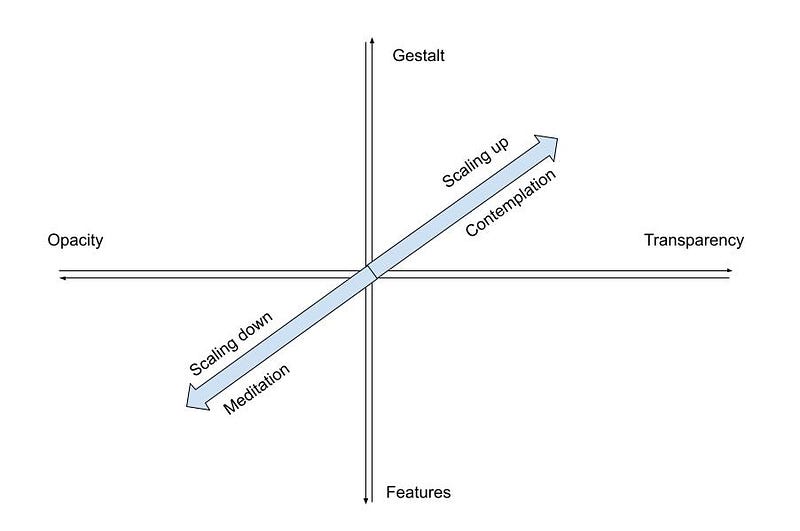
The first dimension represents transparency to opacity. This is the degree to which we are looking through our senses at the world (transparency), vs stepping back to examine our senses (opacity). Attention moves along this spectrum to bring objects into explicit focal awareness while moving everything else into implicit subsidiary awareness.

The second dimension represents features to gestalt. This is the degree to which we are focusing on individual features vs sensing the whole. In order to disambiguate objects, attention must be able to move in both directions (top-down and bottom-up processing). In general, the upper right of this graph corresponds to scaling up, and the lower left to scaling down.

There are two distinct types of mindfulness, which we can classify as meditation and contemplation. The former means to move towards the center, while the latter is derived from Latin meaning to be with the sky. These types may also be referred to as vipassana and metta, and they correspond to scaling down and scaling up, respectively.

Both of these types of awareness are essential to generating insight for creative problem solving. Meditation allows us to step out of an inappropriate frame, while contemplation invites us into a new and potentially better frame. Simply breaking up the frame only leads to choking. What is needed is dynamic opponent processing.

There are two kinds of mystical experiences that can occur at either extreme. Continuously scaling down will eventually lead to a pure consciousness event, in which one is blissfully unaware of anything except consciousness itself. Continuously scaling up will eventually lead to resonant at-onement, in which everything in the world is encompassed by a unifying gestalt.

It is also possible to achieve both, which is the goal of non-duality training, a state known as prajna. One way to practice this is by following the breath, aligning the scale of attention with the movement of the breath. In this state, one can achieve comprehensive insight into reality. When the Buddha achieved enlightenment, he famously referred to himself as “awake”.

Altered states of consciousness are pursued by many intelligent species. In some of these states, one might experience the altered world as more real than the everyday world, leading to comprehensive transformation of the agent-arena relationship. According to some estimates, 30–40% of people have experienced this phenomenon. A higher state of consciousness (HSC) is not about what is being sensed, but rather the greater ability to make sense.

Next Chapter: Consciousness

Previous Chapter: The Buddha and “Mindfulness”

Cognitive Science
Psychology
Meaning Of Life
Consciousness
Spirituality
Recommended from ReadMedium