
Summary of Awakening from the Meaning Crisis by John Vervaeke, Chapter 13: Buddhism and Parasitic Processing
When it comes to Buddhism, we often encounter the dilemma of whether to approach it from an academic (external) or practitioner’s (internal) perspective. The former is more objective but the latter is more transformative (recall the dilemma of truth vs relevance from Socrates).
Instead of becoming fixated on beliefs, let’s instead try to reenact Enlightenment. Transformation of consciousness is not equivalent to having propositional beliefs. In recognizing this, we propose to reframe the Four Noble Truths into the Four Ennobling Provocations.
All is Suffering -> All life is threatened by Suffering
By suffering we are referring to a loss of agency. This can be caused by anger or joy as much as it can be caused by physical pain. In this sense, Enlightenment is not about relief (from pain), but freedom. Specifically, freedom from the type of self-destruction from suffering referred to as Dukkha (which means an off-center axle, i.e. one that’s destroying itself)
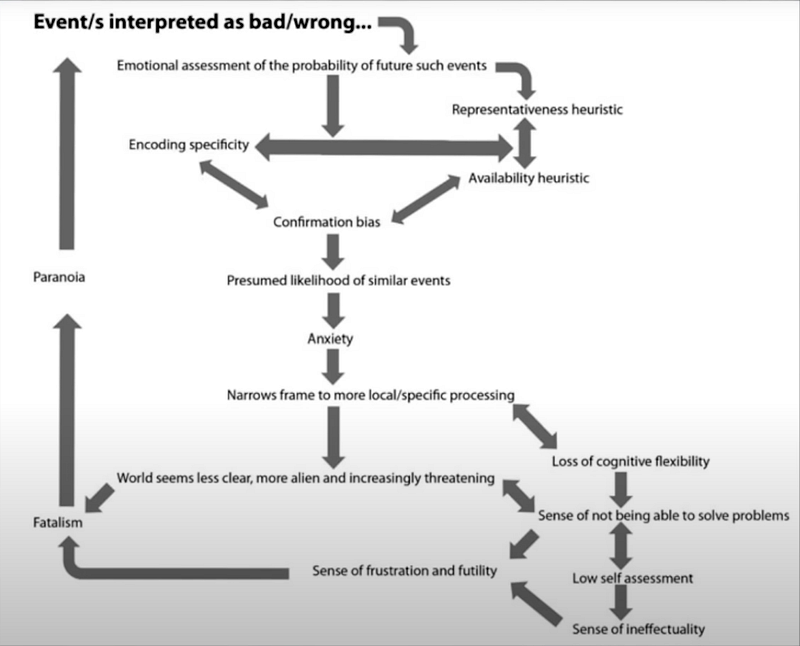
It’s interesting to understand cognitively why “suffering” happens. At the root of suffering is the adaptive tendency to zero in on “relevant” information in the environment. This is necessary for self-organizing cognition, but it also leads to rigidity and parasitic processing. The following diagram from the lecture shows how the different heuristics of the brain can work together as a self-organizing parasitic process, especially in the interpretation and remembrance of negative events.
Suffering is caused by Desire -> Beware of how you get Attached to things
The second truth specifically speaks to addiction and its effect on agency. Properly understood, addiction is not so much a compulsion (for a substance or behavior) as it is a progressive loss of agency due to reciprocal narrowing, which causes one to have fewer options in the world and thereby become stuck. The opposite process is Anagoge, leading to expansion of the world and consciousness.
The cessation of Suffering is attainable + The Noble Eightfold Path
To counter the parasitic process that leads to suffering, it’s not sufficient to intervene at isolated points in the system, because of its self-sustaining ability. Instead, what the Buddha offered with The Noble Eightfold Path is essentially a counteracting dynamic system that intervenes holistically, leading to the eventual cessation of suffering through Enlightenment.
The Noble Eightfold Path can be grouped thematically as follows:
Cognition: Right understanding, Right thinking
Character: Right speech, Right action, Right livelihood, Right effort
Consciousness: Right mindfulness, Right concentration
Remember, the point of reframing these Noble Truths as Provocations is that they should be a call to action, an encouragement to take seriously the threat of suffering and respond by enacting the process of Enlightenment in your own life.


