avatarParoma Sen

Summary

The article "Sum of The Parts" reflects on the Aristotelian concept that the whole is greater than the sum of its parts, illustrating this through various examples and pondering the intangible elements that give meaning to life and art.

Abstract

The author of "Sum of The Parts" delves into the profound implications of the phrase popularized by Aristotle, observing that whether in a human face, a piece of art, or the essence of life, the collective entity always surpasses the mere aggregation of its components. Through a personal anecdote of reassembling a magazine cutout of a face, the author demonstrates how the arrangement and order of parts contribute to the whole's significance. The article contemplates the enigmatic nature of the "life force" that animates a human body, questioning its origin, composition, and fate upon death. It acknowledges the limitations of linear mathematical explanations for the complexities of life, suggesting the presence of an ineffable "secret sauce" that defies simple quantification. The author concludes with a reflection on the human tendency to seek answers to unanswerable questions, contrasting it with a cat's contentment in the simplicity of the present moment, and ultimately advocates for a peaceful acceptance of life's mysteries.

Opinions

  • The author is struck by the profound truth in the statement that the whole is greater than the sum of its parts, seeing its application beyond teamwork to encompass life and art.
  • Through a creative exercise, the author illustrates the importance of order and arrangement in defining the essence of a whole, as seen in the reassembled face from a magazine.
  • The concept of a "life force" is presented as an intangible element that elevates a living being above the physical components, yet its nature remains elusive and beyond mathematical explanation.
  • The author muses on the human propensity to question and explore the mysteries of existence, recognizing that these questions often lead to more questions rather than concrete answers.
  • There is a suggestion that acceptance of the unexplainable might be more fulfilling than the relentless pursuit of answers, as exemplified by the contentment of the author's cat in the face of life's enigmas.

Sum of The Parts

Thoughts of creation
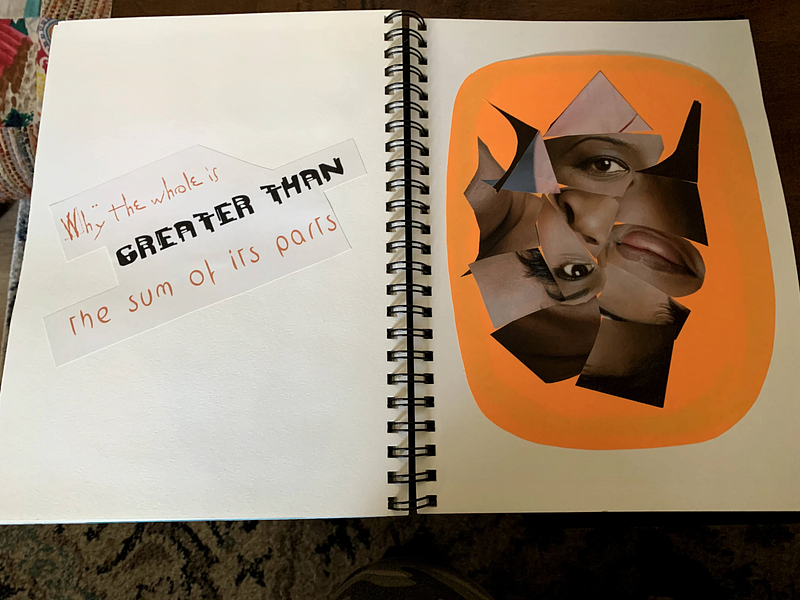
Image by author, concept, design & layout by author

The whole is greater than the sum of its parts.

I’ve always been struck by the depth of this statement. From a human face, to a work of art, to life itself, every single time — the whole is greater than the sum of its parts.

The idea behind the phrase is attributed to Aristotle, who used it in a teamwork analogy. But it applies to so much more.

Back when I was in school, I illustrated the concept through the picture you see above. I cut up a face from a magazine, and pasted it back, but randomly. Nothing is where it should be.

For this picture, the extra is the order in which the parts are placed.

For something else, like a human body, the extra can be the life force itself. Powering the body through its lifetime, it disappears when life leaves the body.

Where does the life force go? Why can’t we include it in the sum of parts? What is it made of, and how does it transform?

As it turns out, many of the things that make life interesting cannot be explained in linear mathematical terms. There’s always something more, defined or undefined, some secret sauce.

There are always more questions than answers. I wonder what it is about the human condition that makes us ponder such unanswerables.

As I glance at my cat, transfixed by the sight of geese outside the window, I know she is not pondering any of life’s unanswerables. And she is quite happy without them.

So perhaps it is best to blow these questions into a balloon, tie a tight knot at the end, and let them escape out the window.

Paroma Sen 2021

Creativity
Nature
Writing
Art
Nonfiction
Recommended from ReadMedium
avatarAnushree Bose
Unbecoming

A Poem

1 min read