
Personal Development
The Necessity of Suffering: How Pain and Struggle Can Help Us Grow
The secret of reaching beyond superficiality

Yellowstone Caldera is a breathtaking work of art, formed over millions of years through the power of a hidden supervolcano. Measuring 55 by 72 km, this natural wonder boasts a range of colorful hot springs, molten rocks, mud-lands, and geysers.
Located in the United States’ first National Park, Yellowstone Caldera is just one example of the stunning beauty that can result from the drama of the natural world.
In this article, we’ll delve deeper into the drama of the human world and explore the outcomes it can produce.
“To care only for well-being seems to me positively ill-bred. Whether it’s good or bad, it is sometimes very pleasant, too, to smash things.” — Fyodor Dostoevsky
It was almost two years ago. I was sitting on my sofa, reading an article from Zat Rana when I came across an equation, describing the attractive personality and the process of reaching:
“There are some people who when they speak, or when they move, or when they listen, or when they make things, or when they look at you, they do so in a way that hints at a deeper confidence and authenticity. They have a secret that reaches beyond superficiality. This secret is the result of work and intention, suffering and reconciliation.”
I was struck by the mention of suffering and set out to understand why it is necessary and why is it not enough, and why we need reconciliation.
I began searching for an answer that made sense, and I believe I have found it now.
Work and intention are important for achieving any goal, but suffering and reconciliation may also play a crucial role in reaching beyond superficiality.
To understand this concept, consider the example of Adam and Rayan, two individuals with the same goal of becoming more charismatic. Both Adam and Rayan read books, watch videos, seek out experts, and make a real effort to improve. However, Adam has a painful past and has suffered in his life, while Rayan has not.
According to the equation mentioned earlier, Adam has a greater chance of achieving much better results than Rayan due to his suffering and the process of reconciliation that he has undergone. To further explore this idea, I set out on a journey where I connected my own memories and experiences with those of others, including Emily Esfahani Smith’s TED presentation “There is more to life than being happy.”
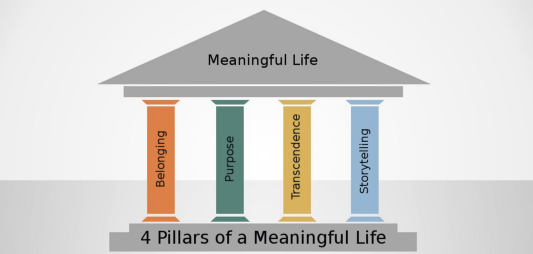
In her book “The Power of Meaning: Finding Fulfillment in a World Obsessed With Happiness,” Emily Esfahani Smith argues that having meaning in life, serving something beyond oneself, and developing one’s best self, is far more fulfilling than seeking personal happiness. According to her research, there are four pillars of a meaningful life: Belonging, Purpose, Transcendence, and Storytelling.
Transcendence is the act of stepping beyond oneself and experiencing a moment of connection to a higher reality. It may come from activities such as nature appreciation, faith and religion, writing, and even suffering. In one study, students who looked up at 200-foot-tall eucalyptus trees for one minute reported feeling less self-centered and even behaved more generously when given the opportunity to help others.
Storytelling is the narrative we tell ourselves about the events in our lives. It brings clarity and helps us understand how we became who we are. A negative example of storytelling might be saying, “My life was good, now it’s bad.” A positive example might be, “Before my injury, my life was purposeless. I was selfish, but my injury made me realize I could be a better person.
Good storytelling can help us make sense of difficult experiences and find meaning in them.
The role of suffering in personal growth
Suffering can be a trigger for personal growth and transformation. People who have experienced hardship often have deeper levels of humility, compassion, and depth as individuals. In fact, Eckhart Tolle argues that suffering “cracks open the shell of ego” and serves a purpose until it is no longer necessary.
“Is suffering really necessary? Yes and no. If you had not suffered as you have, there would be no depth to you as a human being, no humility, no compassion. You would not be reading this now. Suffering cracks open the shell of ego and then comes a point when it has served its purpose. Suffering is necessary until you realize it is unnecessary.” — Eckhart Tolle
Patience, faith, and belonging to something beyond oneself can help in the process of transcending the self and achieving a higher level of awareness.
Unwanted and unexpected events in life can also bring with them new opportunities for learning and growth. These experiences allow us to discover new interests, correct past mistakes, and develop resilience.
In order to reach a deeper level of understanding and fulfillment, it is important to embrace suffering and see it as a means to personal growth and reconciliation with the self.
Work through the pain
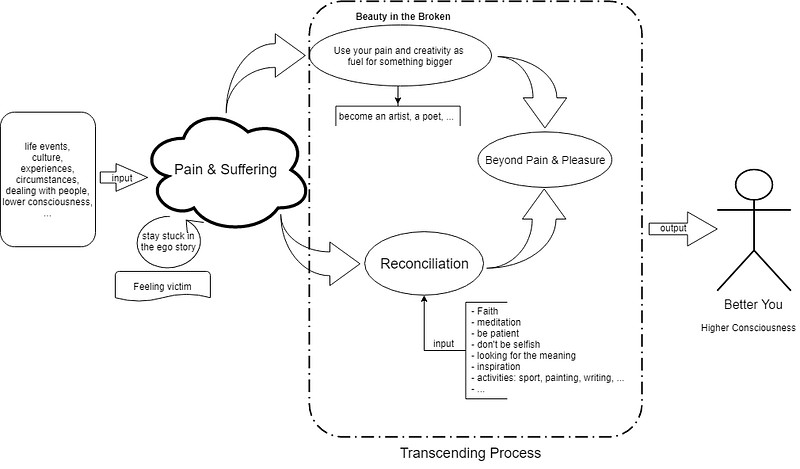
The process of reconciliation involves turning attention away from the thoughts of being a victim and changing your attitudes and behaviors.
“In your own life, perhaps you’re dragged down by the bruisers, offenses, and injustices you’ve endured. They may be caused by circumstances in life or decisions you made, or even by people who should be a source of love and trust rather than hurt and pain.
If you let those things win, then you are a wave in the ocean. But this does not have to be your permanent position. Wanting to change your attitude is the first step. When you work through the pain and channel that energy into building a better future, you can control of your life. You’ll be no more a wave in the ocean. You’re now the ocean.” — Dwell in Possibilities
Throughout history, there have been people who have found happiness and empowerment even in the most difficult circumstances. By reconciling with yourself and with others, you can learn and grow, and you can be better equipped to reach your full potential.
“Suffering and Reconciliation” are integral parts of the four pillars of a meaningful life: “Transcendence, Storytelling, Belonging, and Purpose,” which allow us to feel fulfilled.
I have created the following diagram to illustrate the journey toward reducing suffering and increasing empowerment:
Beauty in the Broken
One of the possible outputs of deep pain is what I’ve called “Beauty in the Broken.” When bleeding emotions meet creativity, they will take a new direction and the story will be different.
In his book “Suffering Art Gladly”, Jerrold Levinson addresses the problem of explaining the appeal of artworks whose appreciation entails negative or difficult emotions on the appreciator’s part, what has traditionally been known as “the paradox of tragedy.”
Just like Van Gogh who painted The Starry Night while in emotional torment and Milton who penned Paradise Lost after losing his wife, his daughter, and his eyesight, there are people who instead of recoiling in passive suffering, choose to let their sorrow and grief give them the insight to turn it into something bigger and so was the main character in “Charisma vs. Power: The Difference and the Side Effects”: the tree.
The original tree story was written by the German author Heinz Körner and I’ve extended it in the mentioned article.
After being soul abused by the gardener and his wife since her childhood, the tree met someone who is emotionally reliable, which improved her self-confidence and let her discover how wonderful her life could be. The encounter was an opportunity for her to feel alive and experience the deep inner peace that she’d never experienced before.
It was an opportunity to prove how healthy communication could heal her soul. Yet, that was a difficult exploration. Although she felt very happy, the voice of her bleeding pain sounded loud.
She was a “Fish out of water” that can finally breathe and feel at home. But that was just an encounter. She’s still living in her abuser’s garden, she’s still screaming inside, and she’s still starving. She tasted the remedy, but the remedy was not for her.
Her inner- and outer-world awareness increased. She can see now that her belief that “the gardener is unsatisfied with her because she was not good enough” was wrong. The gardener is a manipulator that has some personal issues and his own agenda. She understood the truth and found answers to many questions, but some answers were ugly enough that it was very tough to accept them.
New questions came up, which set her again on a journey of looking for an explanation, for meaning, and for reason:
- What’s the purpose of the gentleman’s encounter?
- Was it to help her understand her previous life better?
- Or to let her see an alternative life, but just from a narrow window?
- Was it to prove that she is not so bad and her value is much bigger than what she thought?
She felt like she was continuing to starve after tasting some food, which could hurt much more than starving without seeing any food.
At that moment of deep emotional struggle, and for the first time in her life, the tree came to realize that she can write poetry. Her heart sank to the bottom of the ocean and started to speak differently. After “The Traveler Stuck in Time”, she wrote “The Next Dance” which is the next chapter in her life that she is trying to choreograph.
The Next Dance
The sunlight is so wonderful but I fear that some eyes are accustomed to a long night’s darkness and got hurt by it They don’t know whether to blame the night or the sunlight that they can barely look at it Sun, how could you visit those eyes, then leave them and let them swallow the darkness again? How could you let me die while I’m still alive? How could I feel at home where no home? How could I fly in the sky with no wings? How could I connect where no stream? How could I breathe where no oxygen? How could I move forward where no path? How could a flower sprout where no rain? How could a sense be found where no sense?
When the theories are abolished, and the judgments shut up, and the voices are muted in the throats and the dreams are buried alive When the pain becomes a beautiful companion, and the smile becomes a deceiving mask Oh my heart, oh my soul, do not despair… you have a God who knows After the night, there is a dawn that will be born May the cure be waiting for you tomorrow May the sun’s warmth come back to enlighten your corners On that day, I will gather the bunches of my soul, and strew them in your sky I will unleash my tears and let them penetrate your blue wall, wet your soil and water your grass to make from them an oasis where all my pain calm down
نور الشمس جميل لكن أخشى على عيون تعودت ظلمة ليل طويل آذاها فهي لا تعرف هل تلوم اليل أم أشعة الشمس الدافئة التي بالكاد تقدر على النظر إليها يا شمس، لما تزورين ثم تغادرين عيونا و تتركينها تتجرع حلكة ليل مجددا؟ آه يا قلبي وآه يا روحي، أرجو لك من الله فرجا
عندما تسقط النظريات وتخرص الأحكام وتكتم الأصوات في الحناجر وتدفن الأحلام في الصدور ويصير الألم جمالا يؤنس والبسم قناعا يخدع فيا قلب لا تيأس، فلك رب يعلم وبعد الليل فجر يطلع فلعل البلسم غدا ينتظر ودفئ الصبح زواياك يتخلل
عندها، سأجمع عناقيد نفسي، وأنثرها في سمائك وأترك العنان لدمعي يخترق جدارك الأزرق يبلل تربة أرضك و يروي عشبك الأخضر ليكون واحة تهدأ فيها كل آلامي
Want more?
I write about engineering, technology, and leadership for a community of smart, curious people 🧠💡. Join my free email newsletter for exclusive access or sign up for Medium here.


