
The Earth Died Screaming
Sudden Rise in Hobo Population Attributed to Tom Waits
“He makes it so danged attractive!”
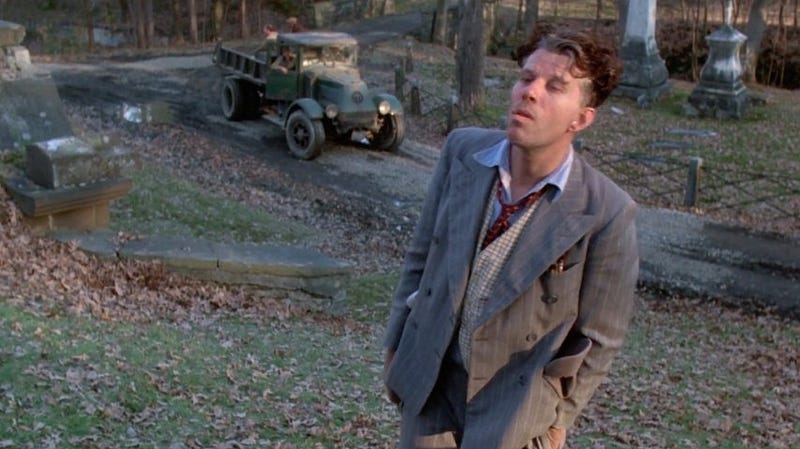
The US Department of Labor released a report discussing alarming spikes in the nation’s hobo population. The spikes, seeming random, occurred at varying times and locations through 2018, the last year for which the Department has data.
“We were baffled,” said a Department spokesperson who asked to remain anonymous just because. “We’re American economists, so all we have is free market theory. Maybe the market just needed more hobos. I don’t know. But actually, digging deeper, we discovered that the phenomenon was producing too many hobos. There was no demand for the supply being produced. So, we had nothing. We were out of ideas.”
Then, William the Improbably Good Looking Janitor came on the scene. “Two nights ago, he’s cleaning the conference room and looks at the pins on the map. Suddenly he’s shouting, ‘Glitter and Doom! Glitter and Doom!’”
The locations and times did have something in common, it seems. They were all stops of Tom Waits’ famed Glitter and Doom 2008 concert tour, which William attended. The hobo surge was all Tom Waits’ fault.
The spokesperson explained, “Wherever Waits played, concertgoers would suddenly aspire to ‘hit the road’ or ‘ride the rails.’ Clothes would be stolen from lines. Apple pies left on window sills to cool would go missing. Folks had all of their possessions tied in a bindle. Everyone had seven o’clock shadow — even the women — and stumpy, wet, unlit cigars. They would complain loudly about being ‘rousted’ by the ‘bulls down at the yard.’”
The Department spokesperson lowered their voice, “Honestly, even though it's a cartoonishly simplistic and possibly offensive depiction of homelessness which absolves us of societal responsibility, I can see the appeal.”
Guitarist Marc Ribot, who fell under Waits’ spell while recording the 1985 album, Rain Dogs, recalled, “On the tour, me and the band would be sitting in this luxurious tour bus, all of our needs being met, and we’d be like, ‘Fuck this, Tom! Let’s get out of this bourgeois monstrosity and just hop a freight train to the next gig!’ I was kind of shocked when Tom told me, ‘You know, I’m not actually homeless. You know that? And none of the songs are actually about hobos?’ I’m still not sure what he was getting at.”
Comedian Tom Scharpling, who once expressed complete indifference to Tom Waits and who is therefore the perfect person to interview for a piece such as this, told us, “I once said that the reason Waits has such a limited audience is because every song he sings — every single one — is about being a hobo and no one really wants to be a hobo. I guess I was wrong about that. Who’d have thought? How do you build an entire career singing about hobos? Nothing but hobos. It’s crazy.”
We talked to one young woman who had succumbed to the hobo allure after Glitter and Doom reached her hometown, Mobile, Alabama. We met her under a railroad crossing and she told us, “It was a train that took me away, but a train can’t bring me home.” We pointed out that her mother’s house was a half-mile east of where we were standing. She responded, “I’m not sure what you are getting at.”
Another young man, referred to Waits’ performance in the 1987 film Ironweed, “When Rudy dies in that film, in poverty, filth, and squalor, and his friends just dump him at the emergency room. That is so,” a glint of a tear appears in his eyes, “… noble.” We point out to this young man that “Rudy” was a character that Waits was playing in a fictional tragedy. “I know that,” he exclaimed, “I’m not sure what you’re getting at.”
The Department of Labor researchers are currently reaching out to their equivalents in Barcelona, Prague, and Milan, sites of the European branch of the Glitter and Doom tour, to test their theory. They received some independent confirmation when they saw another rise in hobo rates in February 2011, the month that saw the release of Waits’ album, Bad as Me; and then again in September 2018, when Waits and Ribot released a song, Bella Ciao, a famous Italian protest song about a beautiful hobo named Ciao.
“That’s certainly telling, and not dispositive!” argued the spokesperson, “It’s clear that Waits makes this lifestyle just too danged attractive. His ensorcelling charisma is a force which must be checked. Mr. Waits should consider the white people of a certain age who fall under his mendicant spell. Does he think of them? Does he wonder, ‘How can I use this power for good?’ At the very least, I wish Mr. Waits would only perform in areas that have a demonstrated hobo shortage.”
We reached out to Tom Waits at his fixed address in Pasadena. He declined comment.
William the Improbably Good Looking Janitor has since left the Department with “nothing but a can of beans.”