
Why You Should Build Up a Data-Driven Corporate Culture
Read here how you can lead your Company to Success through a Data-Driven Culture and using Digitalization

The central goal of digitization is the generation of new digital product ideas, data based business models and the increase of internal process efficiency. To achieve these goals, the analysis, use and commercialization of the company’s own as well as external data sources plays an essential role. Companies are forced to rethink their often analog business models, check them for digital potential and transform them accordingly [1].
Roles and Tools you need
The new roles of the Chief Digital Officer which serve as a driver and to steer a digitization strategy and participants in a digital lab who are characterized by disruptive and agile working and thinking.
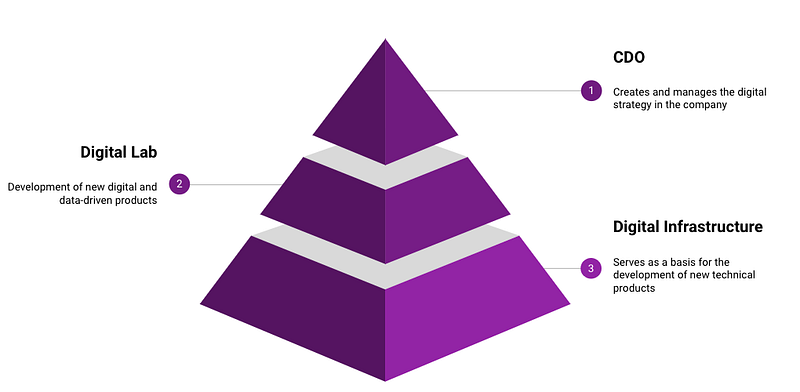
It is also important here that a digital platform is created so that the tool for digitization is available in the first place [2]. This platform should be flexible, scalable and cloud-based. This allows paradigms such as agile development to be implemented and topics and products from the areas of data, processes and apps to be made available more quickly. How to build up such platforms can be read here.
Another soft skill based tool is to use an agile methodology. I really recommend using an agile process for a faster deployment of the developed system in order to minimize risks and undesirable developments in the development process. You can find some inspirations here — for example how storytelling will support data analytics projects.
Goals you want to achieve
What does a digital lab have to do for the company to be considered successful? First of all, it is important to summarize the key strategic objectives and functions associated with the establishment and operation of a digital lab. These are as follow [2][3]:
- Development and design of new digital products, services including prototypes
- Design and testing of new business models
- Use cases for optimizing and digitizing internal processes
- Using modern IT and IoT solutions
- Building a sustainable ecosystem of startups
- Identification of investment opportunities to accelerate market entry into new digital growth markets
Use an innovative Process
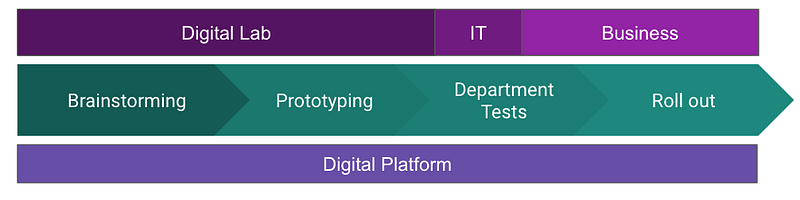
In the first phase, this includes idea generation and the exploration of possible potentially interesting technologies and information. These are then tested within the teams with the corresponding expertise from the specialist departments for a possible use case. If the ideas hold up in this theoretical instance, then prototyping follows quickly and directly. This takes place in the Digital Labs in very heterogeneous teams, which are always specialized more precisely by the use case. After a successful PoC, the roll-out and scaling takes place in the company.
Summary
In the creatively designed spaces, collaboration is made possible, often for a limited period of time, in order to promote communication and exchange outside established corporate structures. By setting up a digital lab and a data driven culture, companies and corporations pursue the goal of equipping themselves for a digital future and culture with new digital business models, innovative product ideas and digital technologies.
“The value of an idea lies in the using of it.“ — Thomas Edison (1847–1931), Inventor
Sources and Further Readings
[1] Michael Rachinger, Romana Rauter, Christiana Ropposch, Wolfgang Vorraber, Eva Schirgi, Digitalization and its influence on business model innovation (2018), Journal of Manufacturing Technology Management
[2] Björn Böttcher, Dr. Carlo Velten, Data is the Product (2017)
[3] Deloitte, Digital Innovation Lab Die digitale Agenda für den Mittelstand (2018)
[4] CIO, Die 6 besten Digital Labs grosser Unternehmen (2019)