
Success Isn't Everything
We need to talk about Kate Spade.
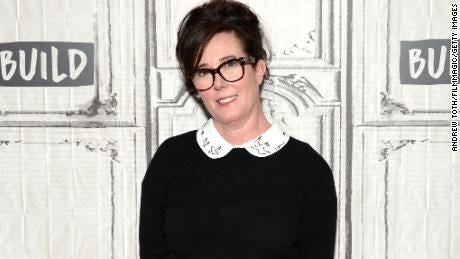
Today, while working on social media posts for a women's franchise network, I came across the sad news that Kate Spade is dead--and apparently by her own hand.
Not again, I thought bleakly.
Spade leaves behind her spouse and a daughter, and I understand how many people will find it in poor taste to even talk about her passing so soon while her family grieves and the investigation is still underway.
But the truth is that she’s not the first celebrity to commit suicide and she’ll also be far from the last. News of Avicii’s own death just came in April, rocking the music industry. This time the world of fashion and design is similarly shocked.
Of course, the news will also impact many of us--the normal people. The un-famous. I can still recall the horror felt in my youth when actors Jonathan Brandis and David Strickland killed themselves. It’s the kind of news that sticks with you.
It’s also a glaring reminder.
Success is simply not enough. Not to get through this life in good mental health, that is.
And we need to talk about that.
Since I have struggled with suicidal ideation for several years--and depression for many more--I understand the stigma first-hand. We tell people to reach out to their friends, family, and a health professional if they are having suicidal thoughts, but behind closed doors whisper words like "crazy" or "manipulative."
There is an honest struggle for people plagued by suicidal thoughts--we fear we will not be believed. We fear the judgment. We fear the assumption that we are not crying out for help, but selfishly yearning for mere attention.
Allow me to fill you in on an [apparently] very well-kept secret:
There is nothing lovely nor fulfilling about the attention you get by being suicidal. Admitting that you wish to end your own life--actually saying those words out loud and telling someone else that things have gotten so bad? It internally reeks of humiliation upon an already festering wound of depression and despair.
Yes, I understand that there are abusers who use threats of suicide to control and manipulate their victims. But please understand that is a completely different segment of people. Those battling genuine thoughts of ending their lives are only able to "go there" because in their minds, they believe they are a nuisance or burden to those they love.
I can personally assure you that we don't think about ending our lives because we believe we're so amazing and deserve more attention than we've been getting. We have these dark thoughts because we believe we cannot rise above the emptiness or pain.
The lack of hope is no small or laughing matter.
Our society has such a bizarre relationship with mental health. We regard the outward, mere appearance of success as the be-all and end-all of life, despite the fact that any one of us can achieve such standing yet still lead a truly miserable and mentally ill life.
We then attach a stigma to poor mental health, as if a person has somehow created the problem all by themselves. As if it's an attitude problem, a dietary problem, or any kind of personal problem the rest of us shouldn't have to even touch with a ten foot pole.
It's so strange because we elevate strangers--these people we don't even know for the successes they've achieved in money, their career, or simple social media influence. We look up to them as if they're somehow greater than the sum of us. But when we find out their mental health is a problem, few of us have any qualms about passing judgment.
"If I had that kind of money, I sure wouldn't have anything to complain about."
"What a selfish person to leave their loved ones alone like that!"
"If they were grateful for what they had they'd still be alive today."
The stigma can be so severe and detrimental that it’s one reason why I openly share my personal struggles with mental health. And it’s why my heart is so hopeful every time I see someone famous like Wil Wheaton open up about his own battle with depression and anxiety.
Because we have to talk about these things. Even when it’s uncomfortable. Especially then. We need to create genuine awareness.
What so many people forget is that mental illness alters your perception. In the throes of suicidal thoughts, a person can have a completely different belief system today as opposed to yesterday. That's just part of the beast.
But guess what? It's not even just people like me who have a problem with accurate perception.
It's also our society and the fact that we define success the way that we do. As something material. As something as frequently meaningless as fame.
We look at famous people and say ridiculous things like, "They couldn't have committed that crime because I grew up watching them on TV. It can't be true."
"They never did anything after that hit movie."
"They're all washed up."
We assign and remove value in such ludicrous ways. When people say such things, I can't help but think of people like Rick Moranis. People who could walk away from fame and the appearance of success to do something that seriously matters. Like being there for your kids after your wife's death.
So what's the answer? How do we get to a better place where we can catch more folks falling through the cracks of depression and suicidal thoughts?
I don't think there's one single answer--I think there are many, because our mental and emotional health is riddled with complexity. Nature and nurture are both at play. Consider how some people like myself can battle mental illness and suicidal ideation, yet still believe programs like 13 Reasons Why have an important and even necessary place in the discussion of mental health. On the other hand, some people will disagree and find the content too much and too triggering for their own mental health issues.
Neither camps are wrong. We simply see things differently and that's okay.
What matters is that we’re talking about it. About the ugly in life and not just our highly filtered snapshots. That adults understand such programs might not be right for their kids, but they could be among the most important shows they themselves will ever watch as mothers, fathers, and teachers.
We need to talk about Kate Spade and Avicii. We need to remember Robin Williams. No, we don't need to talk about how they did it. But we do need to talk about why. And how our currently shallow view of success is no roadmap to good mental health.
I don't believe that mental health issues like depression, loneliness, suicidal thoughts, or even anxiety are mere personal problems. I see them as society problems because the way we collectively talk about them--and even the way we don't--contributes to each of our individual journeys.
The more we talk about hard realities honestly and in a positive way, the easier it becomes to cut through the crap. We need to create a society which fosters good mental health wherever possible. We should be addressing and teaching positive mental hygiene to our children just like we teach good health or nutrition, math or science, and any other subject in school. Mental health needs be a mandatory part of every school curriculum for all ages.
Yes, it's that important.
We cannot continue to speak about "success" without redefining it to include positive mental hygiene and the pursuit of our own optimal mental health.
If you read something here that resonates with you, I’d love to hear your thoughts about mental health as a journey and how we can talk about depression and suicide in a helpful way. And if you’re looking to read more, consider these: