
Study for Obedience: Who Is It For?
A book review for the Counter Arts Book Club 2024
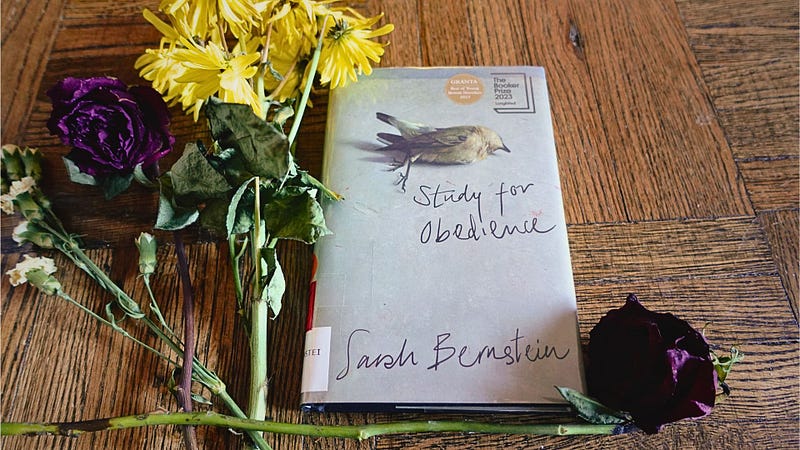
Some books are plot-driven, others are character-driven, “Study for Obedience” by Sarah Bernstein is language-driven. This is the most important thing you should know before you decide to pick up this book. I was not aware of this and my unpreparedness made for a vexing ride.
“Study For Obedience” is the story of a young woman who moves to a remote village in the countryside of an unnamed northern nation to work as a housekeeper for her eldest brother, after the dissolution of his marriage. This is the premise of the book and pretty much the entire plot.
The book’s summary also tells us that soon after her arrival, things take a turn for the weird. Odd incidents happen: “collective bovine hysteria; the demise of a ewe and her nearly born lamb; a local dog’s phantom pregnancy; a potato blight”. Our protagonist has issues getting to the bottom of this because she doesn’t speak the local language and can’t interact with any of the townsfolk, who justifiably or not, treat her with suspicion and give her the cold shoulder at every encounter.
The book ends largely here. We don’t really find out what causes the oddities in the village, we don’t quite know what happens to her brother (although we get a sense of it), and we don’t get a conclusion for her either.
As things start to get interesting towards the end of the book, when we get a glimpse of what the protagonist might truly be, the truth behind the mask of obedience and submission, where the jailed could have in reality been the jailer all along… We are sharply pulled away by the author as the ink runs out and the pages with it.
This is a deliberate choice of course, because, to go back to my original point, the plot and the characters are completely subservient to the language in this dialectical exercise.
Not surprisingly, as soon as I closed the book, one simple question circled my brain: “What did I just read?”. With no one else in my immediate vicinity having gone through the experience, I posed the question to Google.
Other readers, thankfully, managed to shed some light. It was postulated that the country in question might be Romania (this was based on the unnamed breed of a dog that was recognized by some as a Carpathian). Apparently, there are allusions to the Jewish persecution that flew completely past me undetected, and references to the patriarchy and community segregation that whilst more obviously shown, were not here nor there.
So, in the end, what was the point of it all, you might ask? The language. With carefully crafted sentences, half a page in length, underpinned by a rich and elevated lexicon, the language is the undoubted star here.
However, this production choice brought me to ask a quite philosophical question of my own: as writers, who do we write for? Do we write for ourselves or do we write for others? Because this book, in the way that it has been created, is for the author (and possibly for a class of literary criticism in some university hall), but it is not for the people, and certainly not for me.
English is my second language, and despite this, I consider myself quite fluent (you know, having achieved two university degrees in England and worked for the better part of a decade in English as well). I give you here a laundry list of words that I did not understand (and honestly, did not bother looking up on the spot): mien, holdall, libel law, exegesis, pogroms, begot, kishke, vagaries, enfeeblement. (Even as I write here now, I can’t avoid laughing at this list. Do you want to spice up a family dinner? Ask your folks to use them in a sentence) — It looks to me like an abused thesaurus.
The choice of language also utterly confused me about the setting of this story. It sounded to me more appropriate for a narration set in the 1800s, but alas, the reference to Twitter and YouTube brought me back to the present days (wait a second, social media exists, and yet, she couldn’t use a simple type-based translator to communicate with the townfolk)?
The point I am trying to make here is that for most people this book will be utterly inaccessible, at least it was for me, and it is a real shame. The choice of using overly-refined language coupled with an almost complete lack of plot or characterization will deter even the most avid readers like me who usually don’t shy away from slow-burn books.
But maybe this is simply my problem, and not really the author’s concern. Maybe, it is fine to consciously or unconsciously write a book only for ourselves and possibly a small elite of like-worded individuals (having been short-listed for the Booker Prize 2023, I’d believe they exist), and to shut out the majority of the people, if that is not the intended audience. If I had to summarize it in a few words, “Study for Obedience” was for me the Tenet of books.
Thank you for reading! This book review is part of the Counter Arts Book Club 2024. I would like to give a big shout-out to Sadie Seroxcat for putting together this great list. I look forward to reading the other books!
I also would like to mention the review by Jess the Avocado, who has listened to the audiobook and also had a very ear-opening experience!


