
‘Study for Obedience’ — Sarah Bernstein
A Counter Arts Book Club Review
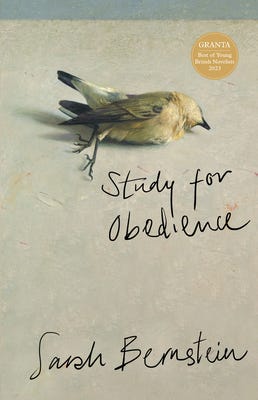
Author Sarah Bernstein, originally from Canada but now a resident of Scotland, has received a flurry of attention over this her second novel, ‘Study for Obedience’. She was the Winner of the 2023 Scotia Bank Giller Prize, shortlisted for the Booker Prize, and placed upon the list Granta publish every ten years of the 20 best young (under 40) writers.
So what to make of the novel that elicited this high praise:
“The modernist experiment continues to burn incandescently in Sarah Bernstein’s slim novel, Study for Obedience. Bernstein asks the indelible question: what does a culture of subjugation, erasure, and dismissal of women produce? In this book, equal parts poisoned and sympathetic, Bernstein’s unnamed protagonist goes about exacting, in shockingly twisted ways, the price of all that the world has withheld from her. The prose refracts Javier Marias sometimes, at other times Samuel Beckett. It’s an unexpected and fanged book, and its own studied withholdings create a powerful mesmeric effect.” — 2023 Finalists — Scotiabank Giller Prize
In ‘Study for Obedience’, an unnamed female narrator moves from the life she has made for herself in a city, to a different country further north, which is described as the land of her forefathers, to live with and care for her eldest brother. This brother, also unnamed, has recently been divorced and now finds himself alone and without someone to keep house for him while he continues what seems to be a very successful, entrepreneurial career.
We find out some basic background to the early family life of the pair, when she, the youngest child, was essentially ‘trained’ into being caretaker for all of her older siblings, though more so this eldest brother. There is a hint, a sliver of a suggestion, of sibling abuse — and there is still a strange, unhealthy, potentially (though never directly stated) incestuous quality to their relationship. She bathes him, she dresses him, and one of his house rules is that doors must always remain wide open — meaning they would be able to see into each others bedrooms at all times too. Whatever is going on between the two, it hinges on more than one aspect of power imbalance, he has control over her and their relationship is creepy at the very least.
Talking of power imbalance and control, the brother seems to have picked up the language of his new, but not further defined, home. In comparison, the narrator doesn’t for the duration of this story seem to have picked up a word of the local language (or so she tells us). This means that any communication with the villagers has to be arranged through her brother. When she wants to join in with a community endeavour, he has to telephone the organiser from whatever ‘away’ location he has retreated to for his work (leaving her in the house alone).
This conveys two things concisely, her dependence on her brother/his supposed control over her, and her position as the ‘Outsider’ in that community. Not only is she a recent ‘incomer’, but she doesn’t speak a word of her language, she remains isolated and removed from them — and they want her at a distance too, because of, we are told, long-standing antisemitism (that persecution was the reason her people were originally hounded from this homeland).
And yet, we are told so little really, snippets of information among description of a mundane life, always from the same internal viewpoint. So the question really should be asked, how do we know we can trust this perspective? In the post #MeToo era, even more than ever, I want to believe this woman, but we certainly need to consider that she is most probably an unreliable narrator, at least to some degree.
It could definitely be argued that she plays into the fear people have of her, given some of the things she does — like making reed dollies (like corn dollies I assumed) and leaving them on some doorsteps around the village. When you already have suspicion surrounding a woman who is considered bad luck and blamed for things happening to animals (a dog’s phantom pregnancy and a sow rolling over onto her tiny piglets), finding she has left a reed/corn dolly on your doorstep, coming and going unnoticed and without knocking or attempting to communicate that this primitive offering is intended as a gift… surely we can’t be surprised to find their discovery engendered a fearful reaction?
And yet… again… we obviously also need to consider the other undercurrent of the story we’re being told here: if we have a woman who has been raised to be the practical slave and scapegoat of a large family, to the extent that we see her completely discard her life and move to a different (by all reports, historically hostile) country whose language she doesn’t speak, in order to retake her position as body servant and housekeeper… well, perhaps we can forgive the fact that, finding herself alone and unwelcome, she begins to enjoy playing upon the fear she feels emanating from the townspeople.
Perhaps, in using that, turning the role she has had thrust upon her since childhood, she begins to find some power in acting the ‘Outsider’, embracing being the ‘Scapegoat’. Enjoying what little aspect of power she can wield, leaning into being the ‘Witch’ — or… is that what she was all along?
By the end of the book it certainly seems as though there are some even more strange circumstances surrounding her. She has been part of a strange church ceremony, where she tells us she spoke to the congregation — which made bells ring loudly, what would be the point of that, if she couldn’t speak the language? And as for the items arranged on the altar, why? And how?
Further along, the brother is home permanently it seems, and he’s ill, in more genuine need of his sister’s constant care — and again, there is something creepy, suspicious about what’s going on, but the reader is left feeling that now it is the female narrator who is now in control. We also wonder how much of a hand she has had in this reversal of fortunes. Is she able, perhaps with ingredients collected during her many walks through the beautiful natural surroundings, to cause illness and even death? Were the local animals test cases before setting to work on her brother?
Could we blame her?
Does this suspicion help or hinder the progress of feminism?
I’m not even sure of that! To feel that perhaps she has become the strong one, in control, exacting revenge in a cleverly improbable fashion…. it’s tempting to feel positively about this, but we shouldn’t be encouraging female empowerment through criminal behaviour and causing harm to others!
I won’t stray any further into how exactly the plot (such as it is) develops toward the end. Perhaps suffice to say, should you decide to read this novel, you will most probably finish it with more questions than answers — even after chewing it over for a while afterwards. I know what I think happened, but am I sure — not in the least.
Nevertheless, Sarah Bernstein is certainly an accomplished writer, her use of language can really be quite beautiful in places — and this may only be a short novel, but it really can’t be easy to write so much whilst saying so little. The language is also, as others have said, rather old-fashioned, therefore adding to the readers sense of confusion and giving a sharp jolt when we are brought rapidly back the present day with mentions of cars, laptops and the like. But that also adds to an overall feeling that we are reading about herblore and witchery in days gone by. Time has passed but transgressions against persecuted minorities are not forgotten, not done with. And this is the real central ‘plot’ here, the language and what Sarah Bernstein can do with it. So I do commend her for that.
Would I read ‘Study for Obedience’ again? Not very likely, no. Would I pick up something else by this author? Probably not actually. But never say never, a book is a book after all!
Thank you for reading. Are you following our Book Club?
The Book Club list and some links to review essays (I’ve some left to finish!) from last year, that’s here.
For further reading on this novel, try here:
Reading guide: Study for Obedience by Sarah Bernstein | The Booker Prizes
Until next time, stay safe, stay warm and stay well (or if you’re ‘Down Under’, stay well hydrated in that heat — Jess the Avocado).
Please do keep reading each others work, especially within our little (but growing!) community at Counter Arts, Rainbow Salad and Seroxcat’s Salon — and I’ll look forward to reading all your work too.
With love — Sadie


