
Studies Show Racism Causes Black People’s Bodies and Brains To Age Faster
Technology is helping us better understand the hidden consequences of racism

We all know that racism creates immense social and economic harm. It can stop people from getting good jobs, finding quality housing, building wealth, and enjoying fundamental human rights. It can even result in murder.
New research is showing that racism also has another hidden, but insidious consequence: it can accelerate the body’s aging process and cause a lot of mental and physical health problems.
Racism and Chronic Stress
Stress activates our fight or flight response. It makes our bodies pump adrenaline and cortisol into our bloodstreams, which increases our heart rates, improves our breathing capacity, and increases our blood sugar levels. Our blood pressure rises, more oxygen goes to our muscles, and we have more energy to deal with the challenge at hand.
Normally, this well-orchestrated process only lasts a few minutes, but when the stress lasts too long and it happens too often, it becomes chronic stress, which heavily damages the human body. Chronic stress results in consistently high blood pressure, which makes people more likely to have a heart attack or stroke.
It makes our cortisol levels consistently high. This damages blood vessels and can lead to high blood sugar levels, which can cause diabetes.
Black Americans are more likely to experience chronic stress more often than other races. They have higher rates of heart disease, high blood pressure, obesity, and diabetes than White people. They’re 30% more likely to die from heart disease and twice as likely to die from diabetes than White Americans.
Chronic stress can also damage the body’s telomeres, which are sequences of DNA found on the tips of chromosomes that protect them from degeneration. Normally, they slowly get shorter as we age. Chronic stress causes telomeres to shorten at a fast rate, which accelerates aging.
Researchers have determined that racism is one cause of this chronic stress
Arline Geronimus is one of those researchers. She’s extensively studied the effects of chronic stress on Black folks in the US and how racism contributes to it.
She actually created a term for this chronic stress. She calls it weathering — a condition that “literally wears down your heart, your arteries, your neuroendocrine systems … all your body systems so that in effect, you become chronologically old at a young age.”
Weathering of the Brain
Weathering doesn’t just decimate peoples’ bodies. It also damages their brains.
A brain imaging study in the Journal of the American Medical Association revealed that Black study participants showed signs of accelerated brain aging during middle age. This made them more likely to get Alzheimer’s Disease or dementia early in life, compared to White or Latinx people.
The study researchers agreed that racism increases weathering and that repeated exposure to stress, adverse environments, and oppression can adversely affect brain health.
Forms of Racism
All of us face stress in life, but racism causes people to experience extremely high levels of stress for long periods of time. Some obvious types of racism that trigger stress are things like being denied jobs or adequate housing and being mistreated in the justice system.
But a lot of the stress from racism that Black Americans face comes from microaggressions, which are more subtle actions that negatively target a marginalized group of people. An example is the Black man whose body is flooded with adrenaline because — once again — he’s stopped by police while driving when he’s done nothing wrong.
It’s a Black teenager who notices White people sometimes cross the street when he approaches them. Or the Black man who’s feeling anxiety because once again, he’s being followed around a store while shopping.
Many Black people have felt the assault of microaggressions and more blatant racism for decades. The racism they experience is like a storm that ebbs and flows, but never ends. It erodes their identities, their self-worth, and their physical and mental health.
Managing the Problem
The stress never ends for many Black folks because they can’t escape its pernicious grasp. They don’t have the resources to move to another location, go on vacation, take some time off of work to relax, hire a good mental health expert, or do other things to alleviate the stress.
Conversely, people from more privileged backgrounds can move, take vacations, get massages, see the best therapists and wellness coaches, and get a lot of support from their peers and family members.
Another problem is that people who face racism often get dismissed when they address it or talk about it. As absurd as it may sound, a lot of people in this country still deny that racism exists in certain organizations, systems, or institutions. When valid reports of racism are dismissed, the victims are gaslighted, pushing many of them further into chronic stress.
How do we manage this dilemma?
People who engage in discriminatory behavior need to first become aware of their unconscious biases toward people of color. When they see that their comments or actions hurt others severely over time, they can begin working on eliminating these behaviors.
We must continue addressing discrimination and racism at different levels — from companies to institutions to systems. Racist beliefs, policies, and behaviors must be consistently challenged and changed.
A great way to help those who have been victimized by racism is to actively show them compassion. Connect with people who have experienced extreme stress and racism. Hear their stories.
Help them heal.
I learned about healing first hand when I returned to prison.
When I was released from prison, I initially vowed to never return there again. I later changed my mind after facing discrimination and realizing I needed to help underprivileged people who were enduring the same challenges I faced. I returned to prison to tell my story and help incarcerated individuals.
This turned out to be the most rewarding work I’ve ever done in my life.
In 2018, I was volunteering at Pelican Bay state prison, one of the worst prisons in the US. I was there with a lot of rich, privileged people who had never been incarcerated.
Most of the incarcerated men there were Black.
All of us volunteers and the incarcerated men listened to each others’ stories. We found that we all shared many of the same fears and insecurities.
Many of us hugged the incarcerated men as we felt their pain and reached new levels of empathy and compassion. We watched in awe as we saw my friend Roy hug an incarcerated Black man for about 4 straight minutes, while the man cried the entire time.
Me and other volunteers joined other incarcerated men of color in a group “sway.” All of us put our arms around each other and slowly swayed to the rhythm of gentle music. Although we exchanged very few words during this exercise, the love and compassion were palpable.
Wounds that resulted from decades of racism, pain, and trauma, were being healed that day.
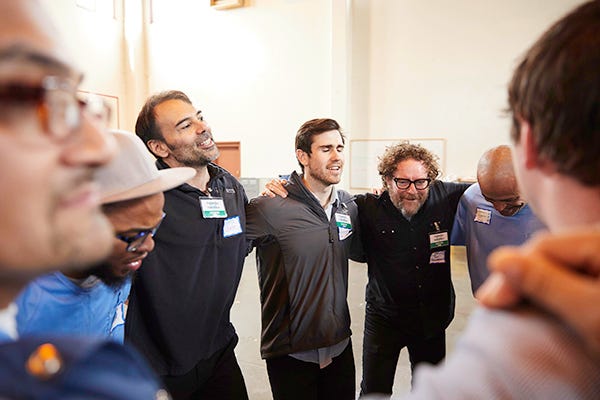
Whenever I look at the picture above, I’m reminded that this is what transformative healing looks like.
And I’m reminded that love and compassion are stronger than racism and hate.


