
HISTORY + POLITICS
Students Should Learn About Voter Suppression: The 1920 Ocoee Race Massacre
“Memory laws” can’t hide White Floridians’ racism.
Conservatives have fallen head over heels in love with “memory laws.” Rather than teach students American history honestly, portraying the good, bad, and ugly, they prefer a whitewashed version. And you know what, they weren’t the first to come up with this political strategy. During the 1930s and early 1940s, Germany’s Nazi regime used “memory laws” to “enshrine state-approved interpretation of crucial historical events nad promote certain narratives about the past” in a gruesome bid to “justify acts of genocide.” Controlling the curriculum became the precursor to their violent detainment and murder of Jewish people. So, we shouldn’t take modern-day Republicans lightly when they insist on racially purging the curriculum.
Indoctrination should have no place in a public classroom. Students should learn using the same primary and secondary historical artifacts available to historians. However, what happens when a society blatantly omits historical events because it could make White students uncomfortable? We end up with generations of students who believe in a mythological origin story. In America, students should learn about voter suppression efforts because without that context, they have no hope of understanding why Congress’s failure to pass federal voting rights legislation is a crisis.
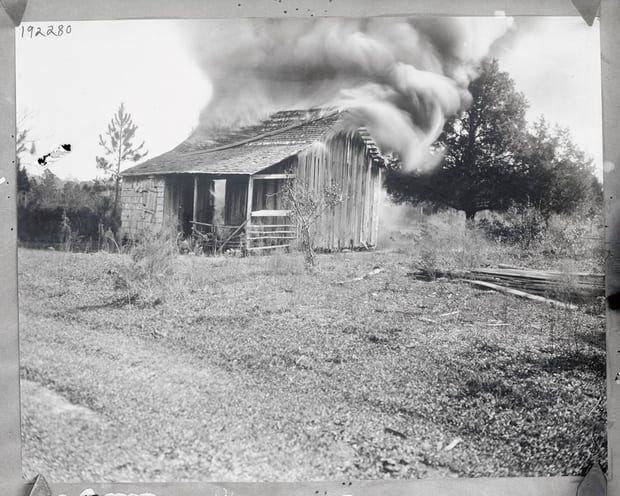
On November 2, 1920, The Ocoee Massacre became one of the most blatant examples of violent voter suppression. And it happened in Florida, a state which joined the Confederacy in 1861 to maintain the chattel slavery system, which made them exceedingly wealthy. On January 5, 1861, John C. McGehee, “president of Florida’s secession convention,” complained that staying in the United States would “destroy every vestige of right growing out of property in slaves.” In other words, McGehee and the majority of White Floridians were willing to go to war, to shed blood, life, and limb to maintain their right to own Black people. Shouldn’t students know that during 1860, 44% of the states’ residents were enslaved Black people, who had no right to vote or live freely? White Floridians knew that ending slavery would upend their economy, which heavily depended on tobacco and cotton harvested with free labor, but would also empower Black people to vote and have equal rights to White people.
After the Civil War ended, White Floridians did not readily accept Black Americans’ citizenship. “Florida also imposed some of the harshest penalties on record during the Jim Crow Era.” White people forced Black people to ride in separate cars on railroad cars, even when they paid for first-class tickets. Black students could not attend schools with White students, and the state would punish any attempt to teach interracial classes with fines and imprisonment. State legislature classified “negroes” as people with at least one-eighth “negro blood.”
1920 was a unique year for American democracy because women had the right to vote for the first time since the country’s founding. Black women played a significant role in the suffrage movement; however, many could not reap the benefits. Prominent figures like Susan B. Anthony and Elizabeth Cady Stanton segregated marches, forbidding Black women from boycotting alongside them, contributing to the stigma associated with Black voters. As a result, the 1920 election became the first time Black people were alone fighting for equitable access, and the tension was palatable in Florida.
The horrors began when July Perry, a prominent Black businessman and landowner in Ocoee, Florida, registered to vote. Since the 15th amendment “granted African American men the right to vote,” Perry was within his rights to register. However, from 1889 to 1938, Florida maintained a poll tax to deter Black people and other low-income residents from exercising their right to vote. With no reparations provided to Black Americans after slavery, the wealth gap ensured a loophole that White politicians exploited to suppress the Black vote. To bypass this racist tactic, Perry, working with the NAACP and John Chenny, “a White attorney and former judge running for the U.S. Senate,” encouraged Black residents to register to vote, paying the poll tax for those who could not afford to pay.
The local Ku Klux Klan, enraged at Black Americans planning to exercise their right to vote, started an intimidation campaign. Just as White supremacists in Charlottesville rioters chanted “Jews will not replace us,” in 2017, these White residents in 1920 Ocoee did not want Black voters to exercise their right because, to them, this would be a form of replacement. In addition to Ocoee, the Klan “marched in full regalia through the streets of Jacksonville, Daytona, and Orlando.” Sam Salisbury, a police chief in Orlando, Florida, was amongst the anti-Black rioters.
On November 2, 1920, Perry went to his local polling place to vote, but White poll workers denied him access. Officials told Black residents they could not find their names listed as registered voters and sent them to see R.C. Bigelow, the notary public. However, the all-white group of poll workers sent Perry and other Black residents on a wild goose chase since Bigelow had “gone fishing.” But, despite numerous voter suppression efforts, a prominent Black farmer named Mose Norman refused to relent. Instead, he decided to “seek the counsel of Judge Cheney,” who advised him to write down all the names of Black voters “not permitted to vote” and the names of the poll workers who “denied their Constitutional right.” Norman planned on filing a lawsuit and returned to the polling place with a few Black registered voters, declaring, “We will vote, by God!” Over 100 White residents hunted Norman that evening, resulting in the “largest election-related massacre in the 20th century.”
Klan members, including Orlando’s police chief Sam Salisbury, arrived at July Perry’s home looking for Norman. But he wasn’t there. Perry defended his home, killing two White men who tried to enter the back door. At this point, it was apparent the White men came to lynch Norman, Perry, or any other Black person they could get their hands on. The White mob, already outnumbering Black residents, “called for reinforcements from Orlando and surrounding Orange county. Eventually, they caught and killed Perry and hung his dead body from a telephone post by the highway from Ocoee to Orlando to intimidate other potential Black voters.” White people burned Black people’s homes to the ground, killed, and ran off most Black residents. Census records indicated 255 Black residents and 560 white residents “lived in Ocoee,” before the violent attack. Months after the Massacre, in which White people killed approximately 50 Black residents, only 2 Black residents remained.
In 2020, some Florida residents honored the memory of July Perry, who White people brutally lynched on November 3rd for daring to exercise his right to vote. A plaque describes the events, but based on Florida’s current governor, Ron DeSantis’ stance on “critical race theory,” it is unlikely Florida students will learn about the 1920 Ocoee Massacre. While recent national attention on the 1921 Tulsa Race Massacre brought attention to the ways White people weaponized their Whiteness in Oklahoma, a comprehensive historical racial reckoning should include events like the 1866 New Orleans Massacree, the 1868 Opelousas Massacre, The Wilmington Race Riot of 1898, the 1910 Slocum Texas Massacre, and the 1920 Ocoee Massacre resulting from voter suppression. As Ida B. Wells once said, “eternal vigilance is the price of liberty.” And it’s only through acknowledging America’s racist past, that we can understand our democracy’s fragility and fight to secure equitable access to liberty. To understand why America’s “memory laws” are so dangerous, we must discuss narratives White people have attempted to purge from our national memory.
🌹Learn more about the author here. 🖊Sign up to read all my stories and thousands more.


